Choose shetland wool for colorwork, lightweight warmth and a sweater that improves with age, or lambswool for a smooth, soft surface and next-to-skin comfort in a simple garment. Shetland wool's woolen-spun halo blends colors and hides light pilling, while lambswool's fine first-shearing fiber feels smooth immediately but pills sooner.
Lambswool comes from a sheep's first shearing and is finer and more uniform than adult fleece.
Shetland's woolen-spun structure traps dead air, so a thin sweater feels warm for its weight.
Fine lambswool fiber pills more at underarms and cuffs, so de-pill with a sweater comb.
Wash both fibers by hand in cool water with a pH-neutral wool wash, then dry flat.
Store sweaters folded, never on a hanger, and air them between wears.
Shetland wool and lambswool are not two competing breeds. They are two different ideas about what a sweater should be. Shetland wool comes from Shetland sheep and is prized for its light, airy hand and its ability to hold intricate colorwork. Lambswool is simply wool taken from a sheep's first shearing, usually a fine-wool breed, and it is prized for softness and a smooth, even surface.
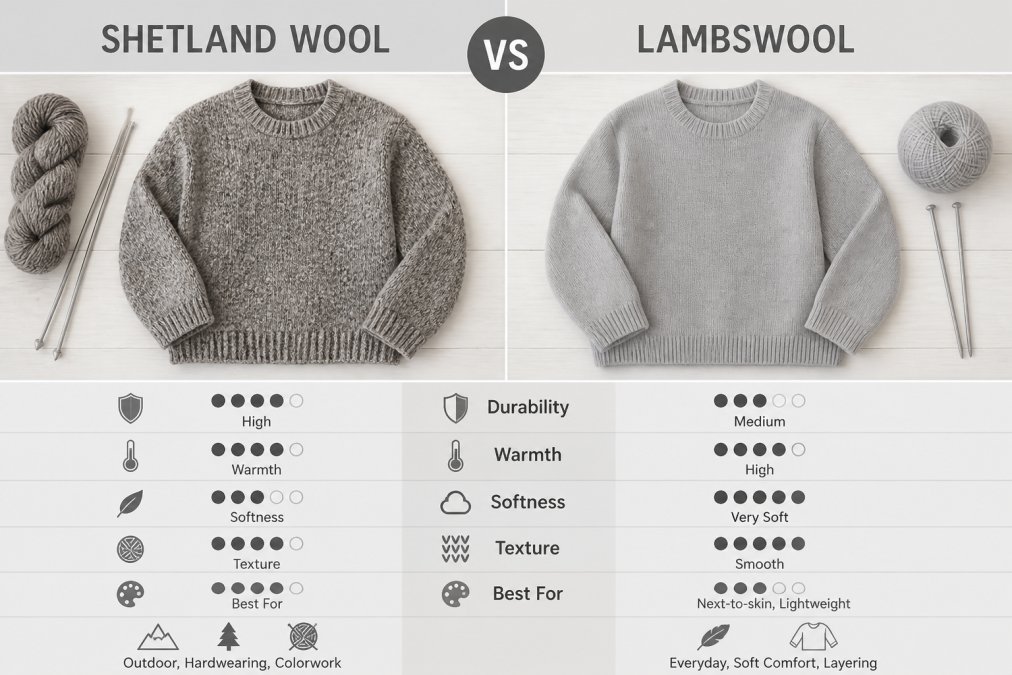
Comparison chart comparing the textures and physical properties of Shetland wool and smooth lambswool sweaters
Fiber Diameter and Staple Length in Plain Terms
Fiber diameter is the width of a single wool strand, measured in microns. Staple length is how long that strand grows before it is shorn. These two numbers decide almost everything else: softness, warmth, how the yarn spins, and how the sweater wears.
Shetland fleece is famously fine and variable, with a soft undercoat and a longer, stronger outer coat. Lambswool, cut at the first shearing, tends to be finer and more uniform than the adult fleece the same animal will grow later. Fine fiber feels softer against skin. Longer staple spins into a stronger, smoother yarn. Neither trait is automatically better; they simply suit different jobs.
Softness, Skin Feel, and Warmth Compared
Softness is where the two fibers diverge most, and the reason comes down to fiber diameter and how the yarn is spun. Lambswool, cut at a sheep's first shearing, is typically finer and more uniform than the adult fleece the same animal will grow later, so a lambswool sweater feels smooth and gentle against the neck and wrists from the first wear. Shetland wool has a wider spread of fiber diameters, including a soft undercoat and a longer, stronger outer coat, which gives it more texture and a faint crispness at first. That crispness fades with wear and washing as the fiber relaxes and the halo develops.
For sensitive skin, the practical difference is real but often overstated. Most people can wear a fine-gauge Shetland sweater directly against skin once it has been washed a few times, but anyone who reacts to coarser fibers should treat lambswool as the safer next-to-skin choice and reserve Shetland for layering over a shirt. A common pattern is to wear Shetland as a mid-layer and lambswool as the base layer in cold weather.
Warmth is closer than most knitters expect, and the mechanism is structure rather than fiber alone. Shetland's airy, woolen-spun structure traps dead air between fibers, so a thin Shetland sweater can feel surprisingly warm for its weight. Lambswool insulates well too, but a dense, smooth worsted fabric can feel heavier for the same warmth because it traps less air per ounce. In practice, a lightweight Shetland sweater often outperforms a heavier lambswool sweater in warmth-to-weight, while lambswool wins on smoothness and immediate skin comfort.
Key TakeawayChoose lambswool for direct-to-skin softness and sensitive skin; choose Shetland for warmth-to-weight and layering. Neither is universally softer or warmer, the spin and gauge decide as much as the breed.
Woolen vs Worsted Spun Yarn: How Construction Changes the Sweater
Spin matters as much as breed. Woolen-spun yarn is carded rather than combed, so fibers lie in every direction and trap air. The result is light, warm, fuzzy, and full of halo. Worsted-spun yarn is combed so fibers lie parallel, producing a smooth, strong, dense yarn with crisp stitch definition. Semi-worsted sits between the two.
Most traditional Shetland sweater yarn is woolen spun, which is exactly why Fair Isle fabric looks soft and blended rather than sharp. Lambswool is often worsted spun for a clean, smooth surface. A common mistake is judging a yarn by breed alone. The same fleece spun woolen versus worsted gives you two completely different sweaters.
Durability, Pilling, and How Each Sweater Wears Over Time
Lambswool's fine first-shearing fiber is soft, and fine fiber pills more readily under friction at the underarms and cuffs. A lambswool sweater usually needs a sweater comb and a little patience. Shetland wool, with its longer outer coat and woolen structure, tends to be more hard-wearing and weather-resistant, and it develops a fuzzy halo that hides light pilling rather than showing it.
Longevity favors Shetland for everyday wear. Lambswool holds up well in gentle rotation but shows wear sooner in high-friction spots. For a fuller durability comparison against another hardy breed, read Shetland vs Icelandic Wool: Durability Compared.
Shetland wool is the best wool for colorwork knitting. Its woolen-spun halo softens the boundary between colors, so Fair Isle patterns read as a blended, traditional fabric rather than a flat graphic. The fiber also grips neighboring stitches, which keeps floats tidy and helps the fabric stay even.
Weight matters here. Fingering and jumper-weight yarns give the fine gauge that stranded patterns need. Brae & Heather's Southern Shetlands Yarn Naturals - Fingering is a 3-ply fingering wool with generous yardage, well suited to detailed colorwork and lightweight garments. For guidance on matching weight to pattern, see Wool Yarn Weights for Colorwork: A Comparison Guide. Lambswool can be used for colorwork, but its smoother surface gives a crisper, less blended result.
Southern Shetlands Yarn Naturals - Fingering
How to Care for Wool Sweaters Made From Either Fiber
Care is where good sweaters are saved or ruined, and the two fibers need slightly different handling even though the basics are the same. Wash both by hand in cool water with a wool-safe, pH-neutral wash, never hot. Hot water and agitation cause felting and shrinkage that cannot be reversed. Squeeze gently, never wring, and dry flat on a towel away from direct heat.
The fiber-specific differences matter at the margins. Shetland's woolen-spun halo hides light pilling and the fabric softens with each wash, so a Shetland sweater often looks better after a season of gentle care. Lambswool's fine, smooth surface shows pills sooner at the underarms and cuffs, so it benefits from more frequent de-pilling with a sweater comb rather than a razor. Because lambswool is finer, it is also slightly more prone to felting if washed too warm, so keep the water cool and the soak short.
Turn the sweater inside out before washing
Use cool water and a pH-neutral wool wash
Soak for 10 minutes without agitating
Rinse in water of the same temperature
Roll in a towel to remove excess water
Dry flat, reshaping to measurements
Store folded, never on a hanger
Watch OutHanging a damp wool sweater stretches the shoulders and hem permanently, and this is worse for lambswool because its finer fiber has less resilience. Store folded, and use a sweater comb on pills rather than a razor, which can cut fibers and create new pills.
Between washes, air both fibers outdoors in cool, dry weather to refresh them. Store folded with a cedar block or lavender sachet to deter moths, and give sweaters a rest day between wears so the fibers can recover their shape. For a fuller durability comparison against another hardy breed, read Shetland vs Icelandic Wool: Durability Compared.
Choosing Your Shetland or Lambswool Sweater Yarn
Pick Shetland wool for colorwork, lightweight warmth, and a sweater that improves with age. Pick lambswool for a smooth, soft surface and next-to-skin comfort in a simple garment. Match the spin to the fabric you want, and buy enough of one dye lot for the whole project.
Shetland wool has a wider range of fiber diameters than lambswool, so some skeins feel coarser against the skin while others are surprisingly soft. Lambswool comes from a lamb's first shearing, which usually means finer fiber and a smoother surface. For sensitive skin, wear a lambswool sweater directly against the body and reserve Shetland wool for layering over a shirt, or choose a finer Shetland yarn knit at a tighter gauge.
Does lambswool pill more easily than Shetland wool?
Lambswool's finer fibers are shorter and more fragile, so pills tend to form faster on high-friction areas like cuffs and underarms. Shetland wool's longer, coarser fibers lock together and resist pilling longer, especially in woolen-spun yarns. A tighter worsted spin on either fiber reduces pilling. Hand washing and air drying between wears also slows pill formation on both types of wool sweater.
Which wool is better for traditional colorwork sweaters?
Shetland wool is the traditional choice for Fair Isle and stranded colorwork because its woolen-spun texture traps air, blends colors softly, and grips adjacent stitches for even tension. The best wool for colorwork knitting has enough tooth to hold pattern stitches without slipping, and Shetland delivers that. Lambswool can work for colorwork too, but its smoother surface shows tension inconsistencies more readily.
How do Shetland wool and lambswool differ in warmth and insulation?
Both insulate well, but Shetland wool's woolen-spun, airy structure traps more warmth per ounce, making it ideal for lightweight layered sweaters. Lambswool knit at a tighter worsted gauge produces a denser fabric with less loft but more wind resistance. For a sweater worn indoors over a shirt, Shetland wool is often enough; for a heavier outer layer in cold weather, a denser lambswool knit holds heat longer.
The hardest part is not choosing between Shetland and lambswool; it is committing to one and knitting it well. Brae & Heather stocks premium Shetland wool, expertly designed patterns, and specialist textile tools to help you finish the sweater you start. Get started with Brae & Heather and turn a single skein into a garment you will wear for years.




0 commentaire