
Wool Yarn Weights for Colorwork: A Comparison Guide
Publié le Oct 21, 2026
By Editorial Team
Économisez 25 % sur les patrons et accessoires de tricot, aucun code requis

Last Updated: October 21, 2026
Understanding wool yarn weights colorwork means comparing how fiber thickness affects stitch definition, float management, and fabric character. Weight determines how quickly a project knits, how clearly your color patterns read, and how the finished fabric drapes and wears.
Wool yarn weights range from delicate lace (under 1,000 yards per 50 grams) to chunky jumbo (under 100 yards per 50 grams). Each category brings distinct advantages and limitations to stranded colorwork, shaping everything from motif visibility to float manageability.
Ply count, the number of individual strands twisted together, influences how a yarn behaves in colorwork. A 2-ply has two strands, a 3-ply has three, and single-ply yarns offer a different character entirely.
Ply count affects how colors blend visually and how firmly stitches hold: a tightly twisted 3-ply produces cleaner color definition than a loosely spun single-ply of the same weight.
Brae & Heather's curated selection includes yarns across different ply structures so knitters can match their colorwork vision to the right fiber. Understanding wool fiber structure and how breed affects yarn character helps explain why a Shetland wool single-ply behaves differently from a commercial 2-ply of the same weight.
Standard yarn weight categories follow a numbering system from 0 (lace) to 7 (jumbo). Within each category, gauge, the number of stitches per 4 inches in stockinette stitch, provides the practical measurement that determines which needles to use. For colorwork, the chart below adds the column that matters most: how each weight behaves when you carry two colors.
| Weight Category | Common Terms | Typical Gauge (sts/4 in) | Recommended Needle Size | Typical Yardage per 50g | Colorwork Behavior |
|---|---|---|---|---|---|
| Lace (0) | Lace, cobweb | 33-40+ sts | US 000-1 (1.5-2.25mm) | 400-800+ yd | Extremely fine motifs; floats are short but hard to read at a distance; slow knitting |
| Fingering (1) | Sock, baby | 27-32 sts | US 1-3 (2.25-3.25mm) | 350-500 yd | Crisp, detailed motifs; short floats; best for intricate Fair Isle and geometric bands |
| Sport (2) | Baby, fine DK | 23-26 sts | US 3-5 (3.25-3.75mm) | 300-400 yd | Balanced detail and speed; floats stay manageable; good for lightweight garments |
| DK (3) | Light worsted | 21-24 sts | US 5-7 (3.75-4.5mm) | 250-300 yd | Clear motif definition with moderate float lengths; the most common colorwork garment weight |
| Worsted (4) | Afghan, aran | 16-20 sts | US 7-9 (4.5-5.5mm) | 180-220 yd | Bold, graphic motifs; longer floats need deliberate tension control; warm, structured fabric |
| Bulky (5) | Chunky, craft | 12-15 sts | US 9-11 (5.5-8mm) | 100-140 yd | Large-scale motifs only; floats are long and visible; best for accessories and outerwear |
| Super Bulky (6) | Roving | 7-11 sts | US 11-17 (8-12mm) | 60-100 yd | Simple color blocks; intricate motifs distort; float management is difficult |
| Jumbo (7) | Roving | 6 sts or fewer | US 17+ (12mm+) | Under 60 yd | Not recommended for stranded colorwork; motifs cannot resolve at this scale |
Gauge matters more for colorwork than for many other techniques because it directly affects motif scale and color-change visibility. A tighter gauge produces denser fabric with smaller, crisper motifs; a looser gauge creates more open fabric where floats lengthen and motifs read larger.
Stitches per inch translates pattern instructions into actual fabric. A pattern written for 28 stitches per 4 inches (7 per inch) requires a different needle size depending on your yarn weight.
Fingering-weight yarns typically produce 7-8 stitches per inch on US 2-3 needles, sport 5.75-6.5 on US 4-5, DK around 5.25-6 on US 5-6, and worsted 4-5 on US 7-8.
For colorwork, this means your color floats scale proportionally with your gauge. Tighter gauges mean shorter floats and more defined motifs. Looser gauges mean longer floats and bolder color blocks. Many colorwork knitters deliberately choose tighter gauges than a yarn's standard recommendation to keep floats manageable and motifs sharp.
When working with wool yarn weights colorwork, use the chart as a filter, not a rulebook.
Then check float length: a float longer than about 1 inch (roughly 5-7 stitches at worsted gauge) is more likely to snag and needs weaving or a tighter gauge.
Finally, confirm yardage. Two yarns in the same weight category can differ by 100 yards per 50 grams depending on ply and fiber preparation. Always compare yards per 50 grams on the label rather than trusting the weight number alone.
Yarn weight standards and gauge specifications from the Craft and Hobby Association provide the official guidelines most knitters reference when choosing weights.
DK and worsted are the two most popular yarn weights for colorwork garments, and choosing between them shapes your entire project.
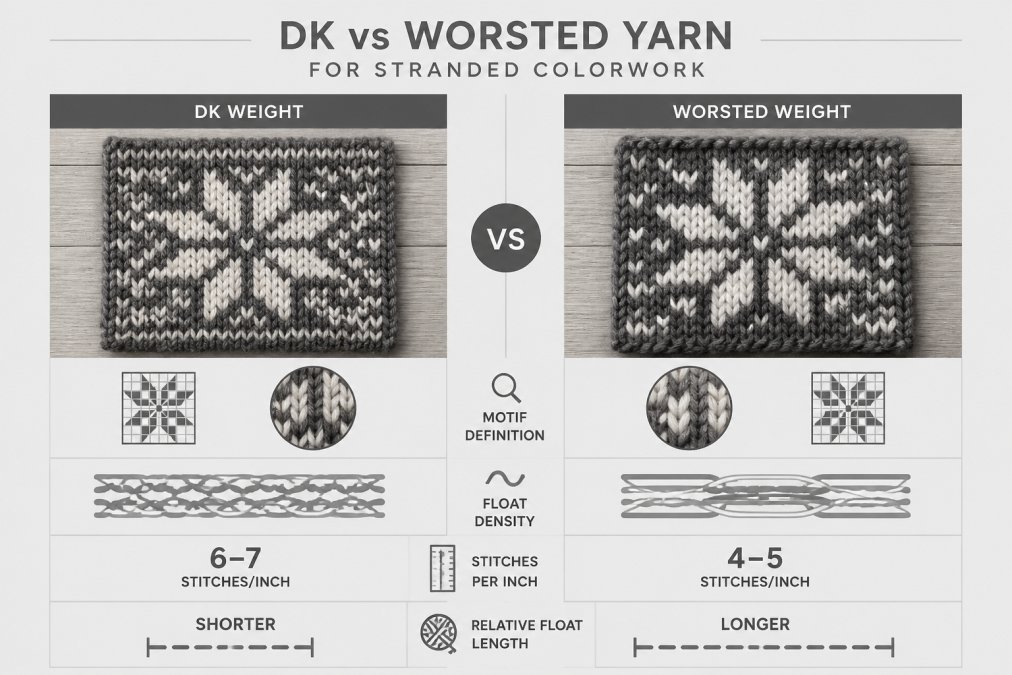
DK-weight yarn sits between sport and worsted, knitting to roughly 20-24 stitches per 4 inches on US 5-6 needles.
Worsted-weight yarn creates bolder, more graphic colorwork. Larger stitches make motifs appear more sculptural, and longer floats require more attention but create a thicker, warmer fabric.
Yarn weight standards and gauge specifications from the Craft and Hobby Association provide the official guidelines most knitters reference when choosing weights.
Motif definition, how clearly your color pattern reads, depends on yarn weight and knitting tension. Tighter tension with finer yarn produces the sharpest motifs; looser tension or heavier yarn creates softer, more blended color transitions.
Floats are the strands carried across the back of your work between color changes. They must stay loose enough not to pucker the fabric but tight enough not to snag.
Brae & Heather's Southern Shetlands Yarn Naturals - Fingering at $16.99 produces 28 stitches and 32 rows over 4 inches in Fair Isle, creating extremely defined motifs with manageable floats. The Regal 2-Ply DK at $8.16 per skein offers 20 stitches per 4 inches, balancing detail with workability.
Southern Shetlands Yarn Naturals - Fingering →


Your knitting tension interacts with yarn weight to determine final fabric characteristics. Two knitters using the same yarn at the same recommended gauge may produce subtly different fabric if their tension differs.
Colorwork demands consistent tension because uneven stitches show up in color transitions: too loose disrupts the line between colors, too tight distorts the motif.
Weight affects how forgiving your tension can be. Fingering and sport show inconsistencies more readily because stitches are smaller and closer together, while worsted is more forgiving because larger stitches smooth out minor variations, making it appealing to intermediate knitters.
Substituting one yarn weight for another in colorwork requires more care than in plain stockinette because gauge changes affect motif scale, float length, and color dominance at once. This method gives you a repeatable way to compare weights before casting on.
Yardage is the most reliable cross-weight comparison because it normalizes for skein size. Divide total yards by skein weight in grams, then multiply by 50. A 215-yard skein weighing 100 grams works out to about 108 yards per 50 grams, placing it in worsted territory; a 430-yard skein at 4 ounces (about 113 grams) works out to roughly 190 yards per 50 grams, closer to sport. Two yarns labeled the same weight can differ by 50-100 yards per 50 grams, so always run this calculation rather than trusting the category name.
Knit a colorwork swatch in each yarn and measure stitches per 4 inches after blocking. Divide the new gauge by the pattern gauge to get your stitch ratio. If the pattern calls for 28 stitches per 4 inches and your substitute works up at 18, the ratio is 18 ÷ 28, or about 0.64. Multiply the pattern's stitch counts by that ratio to keep the same finished dimensions. A 300-stitch cast-on becomes about 192 stitches.
Row gauge rarely scales at the same rate as stitch gauge, especially when you change weight. Measure rows per 4 inches in both swatches, calculate a separate row ratio, and apply it to length-based instructions like yoke depth or sleeve length.
Yardage doesn't scale linearly with stitch count because heavier yarns cover more area per yard. Estimate the total area of the finished piece, then divide by the area your swatch covers per yard. Substituting a heavier weight typically reduces total yardage by roughly 25-35% for the same dimensions, but confirm this with your own swatch.
Changing weight changes float length: a motif that produced 5-stitch floats at fingering gauge may produce 3-stitch floats at worsted, or may need re-charting to avoid floats longer than about 1 inch. Also recheck color dominance, since a heavier yarn can make the dominant color read more strongly. Swatch the actual color pairing, not just the weight.
Best practices for yarn substitution in knitting patterns offers detailed formulas and community-tested examples that can guide your calculations.
Selecting the right wool yarn weight for colorwork starts with clarifying what matters most for your project.
Ask yourself: Do you want crisp, detailed motifs or bold, graphic color blocks? Finer weights support intricate detail; heavier weights create impact through simplicity. How much time do you have? Finer yarns take longer but produce more refined results; heavier yarns move faster but demand more float management. What will the piece endure? A daily-wear sweater needs durable, dense fabric; a decorative shawl can be lighter and more delicate.
Different garments suit different weights. Socks and gloves traditionally use fingering for durable, flexible fabric that fits closely.
Climate shapes the choice too. Lightweight sport and DK yarns suit layering or cool weather, while worsted creates warmer, more substantial pieces for cold climates.
Brae & Heather's Sport Single Ply at $7.55 per 4 oz skein delivers 430 yards, making it ideal for lightweight layering pieces. The Heritage 2-Ply Worsted at $7.55 per skein (215 yards) offers substantial warmth for structured garments. The Softspun Cream Undyed at $10.00 provides worsted-weight versatility for projects where yarn color remains natural or receives custom dyeing.

Choosing the right wool yarn weight for colorwork transforms how your color patterns read and how enjoyable the knitting becomes. Fingering and sport create detailed, intricate fabric where every motif shines.
At Brae & Heather, the carefully selected yarn collection spans these weights in 100% natural wool, each chosen for how it performs in colorwork.
Mixing yarn weights in a single colorwork project is not recommended because it disrupts gauge consistency and creates uneven fabric density. Each color strand contributes to float tension and fabric structure. If you must substitute, recalculate your gauge swatch with the new weight combination and adjust needle size accordingly. Keeping all colors at the same weight ensures even motif definition and prevents puckering or loose areas.
DK weight offers tighter stitch definition and cleaner motifs because stitches sit closer together, making color contrast sharper. Worsted weight creates a more relaxed fabric with bolder, more textured appearance. For intricate Fair Isle patterns with fine details, DK excels. For larger motifs or garments prioritizing drape and warmth, worsted works well. Your choice depends on the pattern's complexity and your desired fabric hand.
Heavier yarn weights produce fewer stitches per inch, creating larger gauge numbers. A fingering-weight yarn might measure 28 stitches per 4 inches in Fair Isle, while worsted weight typically measures 17 stitches per 4 inches. This directly affects finished garment size and yardage requirements. Always knit a gauge swatch in your chosen yarn weight and stitch pattern before starting a project, since colorwork gauge differs from stockinette stitch gauge on the same yarn.
Fingering and sport weights produce the sharpest motif definition because tighter gauge compresses stitches, making color boundaries crisp and preventing float visibility. DK weight balances clarity with faster knitting. Worsted weight creates bolder, more textured motifs with visible float structure, which works well for large-scale patterns but obscures fine detail. For complex stranded colorwork with intricate repeats, fingering or sport weight delivers the clearest results.

0 commentaire