What Actually Drives the Price of a Knitting Pattern
The price of expensive knitting patterns reflects the labor behind them: design time, tech editing, grading across sizes, sample knitting, photography, and layout. Most of that work happens before a single copy sells, which is why expensive knitting patterns often cost more than a casual buyer expects.
Inside a single pattern file: a designer sketches a concept, swatches it in multiple yarns to check gauge, writes stitch counts row by row, then pays a technical editor to verify every number. Size grading multiplies that work, a pattern in six sizes is six coordinated sets of instructions that must each fit a real body.
The Craft Yarn Council size standards exist precisely because grading is difficult. When a pattern covers a genuine size range, the designer has absorbed that cost rather than passing the guesswork to the knitter.
The tension most buyers miss: the price on a pattern page is not a markup on yarn. It is a share of hours.
Rionag Beanie Knitting Pattern by Brae & Heather
Key TakeawayA pattern's price is a recovery of design, editing, grading, and photography costs spread across however many copies sell. Low volume means each copy carries more of that weight.
The Knitting Pattern Testing Process and Why It Costs Money
Pattern testing is where volunteer knitters work the design before release and report errors, unclear steps, and fit problems. It is unpaid or lightly compensated labor, but it still costs the designer time, coordination, and sometimes free yarn.
A typical testing round runs like this:
The designer recruits testers across the available sizes and skill levels
Testers knit the sample and log every point of confusion
Feedback returns as corrections, rewording, and sometimes a redesign
The pattern goes back to the tech editor for a second pass
Only then does it reach the shop page
That cycle can push a release back by weeks. When a pattern arrives with clean charts, accurate schematics, and yarn requirements that match reality, testing is usually why. Newer designers sometimes skip testing to ship faster; the pattern looks fine in the shop and falls apart on the needles, and the reviews say so.
Benefits of Professionally Tech-Edited Patterns
Tech editing is the clearest signal of quality in an expensive knitting pattern. A technical editor checks the math, gauge, stitch counts, and internal consistency of every instruction before a buyer sees it.
Winter Snowflake Beanie Knitting Pattern by Brae & Heather
The benefits land directly on the knitter:
Stitch counts reconcile across every row and size
Gauge instructions match the sample and the suggested yarn
Schematics show real finished measurements, not approximations
Charts and written directions agree with each other
Yarn requirements are calculated, not estimated
The Tech Editing Standard: What a Real Edit Includes
A genuine technical edit covers more than spellcheck. The editor verifies the math works, the grading is proportional, and a knitter following the instructions literally will produce the intended garment. That standard separates a professional pattern from a hobby release, and it is the first thing to look for when a price gives you pause.
Pro TipAsk whether a pattern has been professionally tech edited before you buy. Designers who invest in editing usually say so on the product page, because it is a selling point they paid for.
Indie Designer Patterns vs. Mass-Market Books: Where the Money Goes
Indie patterns and mass-market books fund different things, and the difference shows up in the per-pattern math.
An indie designer's price covers one person's labor, with no publisher absorbing the risk. That single price must recover design hours, tech editing, grading, sample knitting, photography, and layout before the designer sees anything resembling profit. A book spreads its costs across a print run and a publisher's editorial staff, which is why a single book can feel cheaper per pattern: the publisher pays an advance, absorbs editing and printing, and takes on the risk of unsold copies, while the designer trades a smaller per-pattern share for guaranteed payment and distribution.
The trade-off is support. An indie designer answers questions about their own pattern and can update a PDF when an error surfaces. A book is fixed once printed, a wrong chart on page 47 lives in an online errata page, not in the copy on your shelf.
Mass-market titles standardize sizes and techniques to reach the widest audience. Indie releases can afford specificity: a particular gauge, fiber, or construction that only works one way, often the reason a knitter seeks out an indie pattern in the first place.
Budget-Friendly Alternatives That Still Respect the Designer
A higher price does not have to be the only path. Several legitimate options exist, and none require pirating a pattern or passing a PDF around a knitting group.
Free patterns from established designers. Many indies release a free pattern as an introduction to their style and their grading standards. The Rionag Beanie Knitting Pattern is a working example: a free version sits alongside the paid one, which lets a newer knitter test the waters before committing.
Pattern bundles and collections. A coordinated collection spreads the cost across several finished objects. One purchase can cover a matched set you will wear together for years, lowering the effective cost per pattern.
Library access. Many public libraries offer digital magazine subscriptions and craft e-books through services like Libby or Hoopla. The designer is compensated through the library's licensing, so you are not taking anything from them.
Seasonal sales and newsletter discounts. Designers commonly run launch discounts or subscriber-only codes. Following a designer you like costs nothing and often saves a meaningful percentage.
Buy one, knit many. A single well-graded pattern in a versatile gauge can be reworked in different yarns and colorways. The pattern price is paid once; the finished objects multiply.
What none of these alternatives include is buying a copy and sharing it with friends. That is the one shortcut that directly undercuts the labor described above.
Supporting Independent Creators Without Overpaying
Supporting indie work does not mean buying every pattern you admire. It means paying for the ones you actually knit, and being honest about which those are.
A practical approach: keep a wishlist, wait a week, and buy only the patterns you are still excited to cast on. Designers would rather have a buyer who finishes the project and posts a photo than one who purchases on impulse and never opens the file. Reviews, project tags, and word-of-mouth are free ways to support a designer whose work you value.
Key TakeawayA book spreads its costs across a print run; an indie pattern recovers its costs one sale at a time. Neither is automatically better. The question is what you are paying for, and with indie work, you are usually paying for a named person's attention.
Modern Knitting Patterns for Beginners: You Do Not Have to Start Cheap
Beginners often assume they should buy the least expensive pattern available. That logic backfires when a poorly written pattern teaches bad habits or ends up abandoned.
Modern knitting patterns for beginners can be affordable and well made at the same time. The question is not whether a pattern is cheap; it is whether it gets you to a finished object you actually use. A hat pattern with clear charts and a small, manageable size range is a reasonable place to start.
The knitting resources from The Knitting Guild Association emphasize starting with projects that build skills in sequence. A beanie teaches gauge, working in the round, and colorwork at a scale you can finish. A scarf teaches stitch patterns and edge management. A simple mitt teaches shaping in the round. Each of these is a small enough project that a mistake is recoverable, which matters more at the beginner stage than at any other.
What Beginners Should Actually Look For
The quality checklist elsewhere in this article applies to beginners too, but a few criteria matter more at this stage.
A small, honest size range. A hat in two or three sizes is easier to grade correctly than a sweater in nine. Fewer sizes means fewer places for the math to go wrong.
Charts and written directions together. Beginners benefit from seeing both. A chart alone can be opaque; written directions alone can hide the structure of the fabric.
A stated gauge with the exact stitch and row counts. If the pattern does not tell you how to check gauge, you cannot know whether your hat will fit.
A named yarn weight and fiber. A pattern written for worsted weight wool behaves differently in a different weight or fiber. Beginners should match the pattern's yarn as closely as budget allows.
A way to ask questions. A designer who answers emails or maintains a support thread is worth more to a beginner than a slightly lower price.
Cost-Per-Wear for Beginners
The cost-per-wear framework applies to beginner projects too, and it often flips the intuition. A hat worn through three winters lands in the pennies-per-wear range; a sweater worn weekly for years does the same (the EPA). A cheap pattern for a garment you never finish has an infinite cost per wear, because the finished object never exists. For a first project, the goal is a finished object you will actually wear, a slightly higher pattern price that gets you there beats a free pattern that stalls on the needles.
Brae & Heather's Winter Snowflake Beanie Knitting Pattern is built for exactly this stage, using three colors in worsted weight wool with fair isle. Its companion, the Rionag Beanie Knitting Pattern, offers a free version alongside the paid one, which lets a newer knitter test the waters before committing.
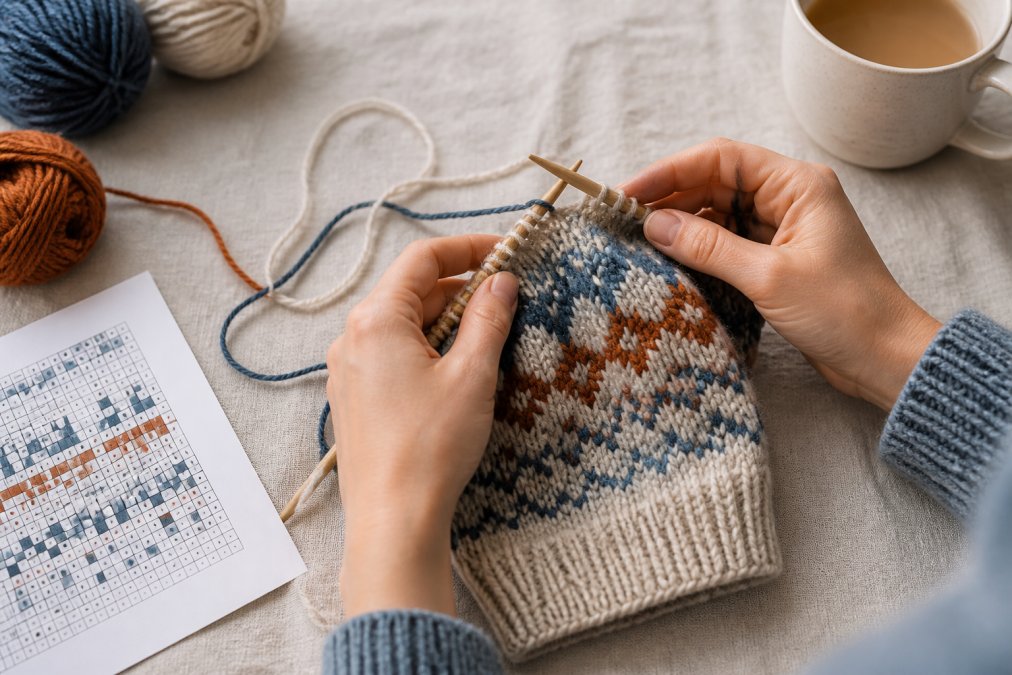
A knitter's hands in soft daylight working a stranded colorwork beanie in three colors, wooden needles, a printed chart resting on a linen surface beside a mug of tea
Pro TipBefore buying any beginner pattern, read the skill level line carefully. A pattern labeled "beginner" that requires short rows, provisional cast-ons, or kitchener stitch in the round is mislabeled. Match the techniques listed to the ones you have already practiced.
An Objective Quality Checklist for Any Expensive Knitting Pattern
Before paying a higher price, score the pattern against objective criteria rather than gut feeling. One that passes most of these earns its price; one that fails several does not, regardless of how the photos look.
Tech edited: The listing names a technical editor or states the pattern was professionally edited
Size range: Multiple finished sizes are listed with actual measurements, not just "small, medium, large"
Schematics: A diagram shows finished dimensions for each size
Gauge: Gauge is stated with the exact stitch and row counts over a defined measurement
Yarn requirements: Yardage is given per size, not as a single figure
Charts and written directions: Both are provided, and they match
Skill level: The stated level is honest about required techniques
Support: The designer offers a way to ask questions or report errata
Updates: The listing mentions whether corrections are issued and how buyers receive them
Cost-Per-Wear: The Math That Settles the Argument
Cost-per-wear turns a pattern price into a per-use figure. Divide the pattern cost by the number of times the finished object is worn or used, then compare that against a comparable ready-made item. A hat worn through three winters lands in the pennies-per-wear range; a sweater worn weekly for years does the same. The pattern price stops being the number that matters, the finished object's lifespan does. A cheap pattern for a garment you never finish has an infinite cost per wear; an expensive pattern for a piece you reach for constantly has one of the lowest.
Watch OutDo not judge a pattern by its price alone. An inexpensive pattern with unclear instructions can cost far more in frogged yarn and abandoned hours than a well-edited one at a higher price.
Brae & Heather's Rionag Mitts Knitting Pattern and Rionag Cowl Knitting Pattern both belong to a coordinated collection, which means one purchase decision can cover a matched set you will wear together for years. That is the cost-per-wear argument in practice.
Conclusion
The price of a knitting pattern is a question of what went into it, and the honest answer is that good patterns cost money to make. Tech editing, grading, testing, and photography are not optional extras; they are the difference between a pattern you finish and one you abandon. Brae & Heather publishes patterns built to that standard, with clear charts, honest size information, and the instructional clarity that keeps a project on the needles. Explore the collection and find a design worth the hours you will put into it.
Frequently Asked Questions
What justifies the price of a professional knitting pattern?
A pattern's price reflects the work behind it: designing the garment, grading it across multiple sizes, tech editing for accuracy, sample knitting, photography, and layout. Independent designers also pay for pattern testing and ongoing support. When you buy an expensive knitting pattern, you are paying for a finished, verified document rather than a rough idea. Compare that to the hours you will spend knitting it, and the cost per hour of crafting is small.
Do expensive knitting patterns offer better instructions?
Not automatically. Price is a signal, not a guarantee. The clearest marker of quality is whether a pattern has been professionally tech edited: consistent gauge, verified stitch counts, clear schematics, and charts that match the written directions. A pattern that lists its sizes, yarn requirements, and skill level up front is usually a safer buy than one that hides those details. Always read the pattern preview before purchasing.
How does pattern testing affect the cost of a knitting design?
The knitting pattern testing process involves recruiting test knitters who work through the design in different sizes and yarns, then report errors, unclear steps, and fit problems. That feedback loop takes weeks and often requires the designer to re-grade or rewrite sections. Testing adds cost, but it catches the mistakes that would otherwise land in your hands. Patterns that skip testing tend to show it in errata and confusing instructions.
Are modern knitting patterns for beginners worth paying more for?
Often yes, if the pattern is written for your skill level. Beginner-friendly patterns from independent designers tend to include more explanation, tutorial videos, and charted alternatives. Look for patterns labeled with a clear skill level, a full schematic, and a support channel. A well-written beginner pattern costs less than a failed project, and it builds the confidence to attempt more complex work later.



0 comentarios