Finding a true Jamiesons of Shetland alternative for knitters is one of the most searched questions in the heritage knitting community. Shetland wool occupies a specific niche: woolen-spun, lofty, with a distinctive hand-feel that no generic "British wool" can replicate. The question we hear most often is not "is there something cheaper?" but "is there something that actually behaves the same way on the needles?" Below, we'll walk through exactly what makes a true substitute, which yarns come closest by weight and construction, and how to make the swap without ruining a project you've invested hours in.
A genuine Shetland alternative is not simply any fine wool. The construction method, the sheep breed, the micron count, and the spinning technique all combine to produce a yarn that behaves in a very particular way during knitting, blocking, and wearing.
What Makes a True Shetland Wool Alternative
A true Shetland wool alternative replicates the structural and tactile characteristics of authentic Shetland wool closely enough to substitute in heritage patterns without compromising gauge, stitch definition, or post-blocking behaviour.
Yarn Construction: Woolen vs. Worsted Spun
The single biggest variable is yarn construction.
Woolen-spun yarns are made by carding fibres in a random arrangement before spinning. The result is a lofty, air-filled yarn with a soft halo, good elasticity, and a slight fuzziness that helps colours blend subtly in stranded colourwork. This is the construction behind the classic Jamieson & Smith 2-ply Jumper Weight.
Jamieson & Smith 2ply Jumper Weight
Worsted-spun yarns align fibres parallel before spinning. The result is a denser, smoother yarn with sharper stitch definition, better durability, and cleaner colour separation.
Neither is universally superior. Woolen-spun suits traditional stranded jumpers where that halo and bloom after blocking are desirable. Worsted-spun suits cables, textured stitch patterns, and colourwork where you want motifs to read cleanly from a distance. A common mistake is substituting a worsted-spun yarn into a pattern designed for woolen-spun and wondering why the finished fabric feels stiff.
Fiber Content, Sheep Breed, and Micron Count
Authentic Shetland fibre comes from Shetland sheep, a breed that produces a fleece with a micron count typically in the range of 23-28 microns, fine enough to wear against the skin for many people, yet resilient enough for colourwork knitting (shetlandamenity.org).
As documented in Shetland Amenity Trust's wool heritage resources, the Shetland breed produces a fibre with a natural crimp that contributes directly to the elasticity knitters rely on for even tension across stranded patterns. Substitute a Merino-blend at 18 microns and you'll get a softer yarn lacking the memory and spring that keeps Fair Isle fabric structured. Substitute a generic British wool blend at 32+ microns and you may find the fabric scratchy.
When evaluating a Shetland wool alternative, look for 100% Shetland or Shetland-type fibre, a micron count between 22 and 29, and a natural crimp rather than chemically treated fibre.
Best Wool for Fair Isle Knitting: Characteristics to Prioritise
The best wool for Fair Isle knitting combines consistent gauge across multiple colours, enough elasticity to manage tension when carrying floats, and a surface texture that allows colours to read distinctly without bleeding into each other.
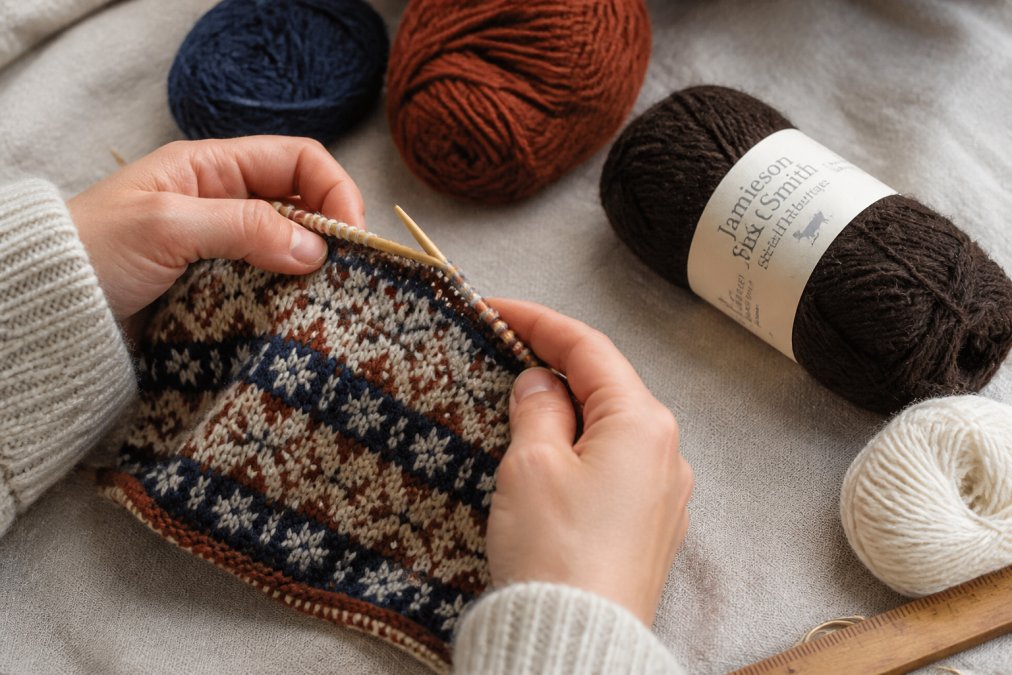
Close-up of hands working a Fair Isle colourwork swatch in muted heritage shades of rust, navy, and natural white, with wooden knitting needles resting on a linen cloth beside a ruler
Stitch Definition and Colorwork Performance
Stitch definition is the clarity with which individual stitches read against their neighbours. Woolen-spun yarns produce a softer definition with a gentle bloom after blocking, historically accurate for traditional Fair Isle garments. Worsted-spun yarns produce sharper definition, which suits geometric patterns where hard edges between colours are part of the design intent.
Twist matters as much as fibre. A tightly twisted yarn will split under the needle during stranded knitting. A lightly twisted, woolen-spun yarn sits more compliantly on the needle and makes managing multiple colours significantly less fatiguing over a long project.
Elasticity, Tension, and Gauge Consistency
Elasticity allows a knitter to maintain even tension across both the working yarn and the floats at the back of stranded work. A yarn with good elasticity will forgive minor tension variations; a yarn without it will produce puckered fabric or pulled floats that distort the pattern (peer-reviewed research).
When you swatch a potential substitute, knit at least 15 cm of stranded colourwork, not just stocking stitch, before measuring gauge. Floats change the fabric's behaviour significantly, and a yarn that matches gauge in plain stocking stitch may run tighter or looser once you're managing two colours.
Shetland Wool Alternative Options by Yarn Weight
Different project types demand different yarn weights, and the available alternatives vary considerably by weight category.
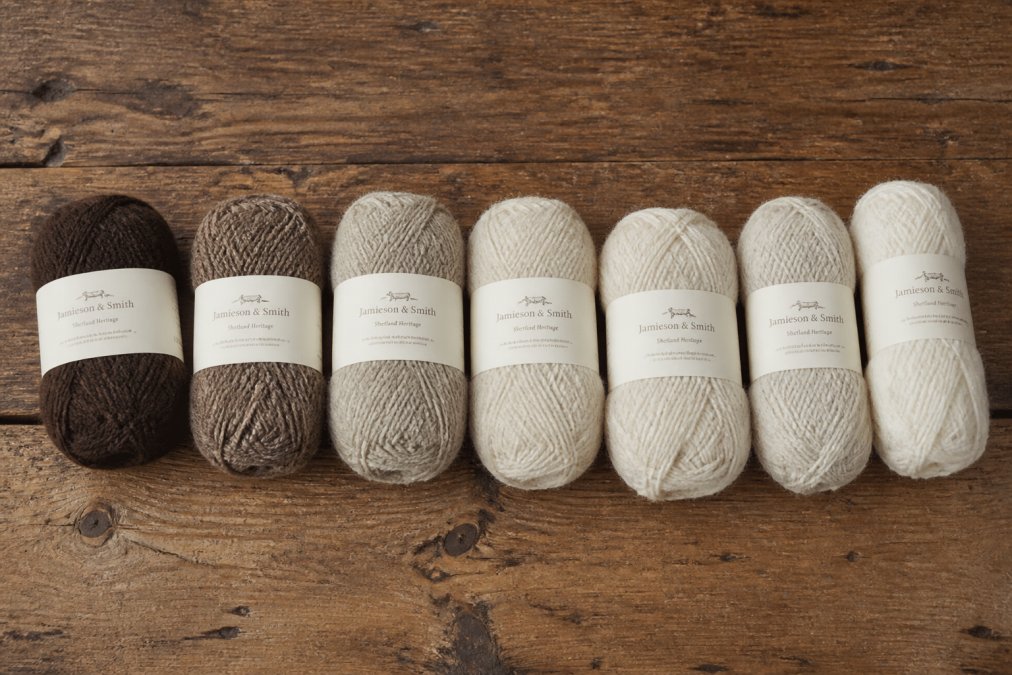
Flat lay of several skeins of natural-coloured Shetland wool yarn in varying weights arranged side by side on a worn wooden surface, with visible differences in ply thickness and fibre texture under soft natural light
Fingering Weight and 2-Ply Jumper Weight
Fingering weight and the traditional 2-ply jumper weight are where the Shetland wool alternative conversation is most nuanced.
The Jamieson & Smith 2ply Jumper Weight is the reference point most knitters work from. At 105m per 25g, it's a 4-ply woolen-spun thickness despite the "2-ply" name. Tension is 28 stitches and 36 rows over 10cm in stocking stitch on 3mm needles, and 28 stitches and 32 rows over 10cm in Fair Isle. Any substitute needs to be swatched in both to confirm it behaves comparably.
For a historically accurate alternative at fingering weight, the Jamieson & Smith Shetland Heritage is compelling. At 110m per 25g and 2.8nm worsted, it's slightly finer than the standard jumper weight and worsted-spun from combed tops, giving smooth finish and exceptional colour clarity. It's the yarn developed in collaboration with Shetland Museum and Archives to replicate the handspun "wursit" found in nineteenth-century Fair Isle artefacts.
The Jamieson & Smith Shetland Aran Worsted is worsted-spun, 100% real Shetland wool, and gauges at 19 stitches and 22 rows over 10cm on 4mm needles. Cables in Shetland wool hold their three-dimensional structure after blocking in a way that softer, lower-micron wools do not.
Jamieson & Smith Shetland Aran Worsted
Budget-Friendly vs. Premium Tiering: What You Actually Get
Most Shetland wool alternatives fall into two broad tiers.
Budget tier (broadly under £8 per 25g): Yarns are typically produced at scale with less control over individual dye lots and sometimes with fibre blends that include non-Shetland wool. They're serviceable for practice swatches and learning projects. The trade-off is colour depth and spinning consistency.
Premium tier (broadly £10 and above per 25g): Small-batch production, tighter dye lot control, and often a direct relationship between the producer and the breed of sheep. The colour palette tends to be richer. For a heritage garment you're investing significant time in, the premium tier is worth the price difference.
The Brae & Heather range sits at the accessible end of the quality spectrum without compromising on fibre authenticity. The Jamieson & Smith 2ply Jumper Weight and Heritage lines represent genuine Shetland wool at a price point that makes large colourwork projects feasible.
Pro TipWhen budgeting for a Fair Isle yoke jumper, calculate your total skein count before purchasing and add 15% for tension swatch wastage. Running out of a specific shade mid-project and finding the replacement is from a different dye lot is one of the most common and preventable frustrations in colourwork knitting.
How to Substitute Yarn for Knitting Patterns Without Guessing
Knowing how to substitute yarn for knitting patterns is a skill that separates knitters who finish projects from knitters who accumulate half-finished ones.
Swatching, Blocking, and Matching Yardage
Swatching is non-negotiable, and blocking the swatch is equally non-negotiable. A dry swatch and a wet-blocked swatch can produce different measurements, and Shetland wool in particular blooms after blocking.
The process for a reliable substitute swatch:
Cast on at least 40 stitches and knit a minimum of 15 cm in the stitch pattern the project uses
Cast off loosely and wet-block the swatch by soaking in cool water for 20 minutes, then pressing flat without stretching
Allow to dry completely before measuring, ideally for 24 hours
Measure gauge in the centre of the swatch, not at the edges
If gauge is off by more than half a stitch per 10 cm, adjust needle size and re-swatch
Yardage matching is the second critical step. Compare metres per gram, not ball weight, when calculating how many skeins to purchase.
Dye Lot and Colour Palette Matching
Dye lot variation is a practical reality with hand-dyed and small-batch yarns. Two skeins from the same colourway but different dye lots can look identical in the skein and noticeably different once knitted up.
Buy all skeins from the same dye lot. If you cannot guarantee dye lot consistency, alternate skeins every two rows, which distributes any subtle variation evenly across the fabric rather than creating a visible line.
For colour palette matching in Fair Isle, swatch your colour combinations before committing to a full pattern, because colours that look harmonious in the skein can clash or disappear into each other when knitted in a small repeating motif.
Watch OutNever assume that two yarns with the same shade name from different producers will match. Shade naming is not standardised across the industry. Always compare physical skeins in natural daylight before purchasing for a project where colour matching matters.
Allergy, Sensitivity, and Washability Guide
Wool sensitivity exists on a spectrum, and Shetland wool sits at a specific point on it. The fibre's micron count puts it in the range that many people who describe themselves as "allergic to wool" can actually tolerate, because scratchiness is primarily a mechanical response to coarser fibres rather than a true allergic reaction to lanolin.
Genuine lanolin sensitivity does exist. Knitters with confirmed lanolin sensitivity should look for superwash-treated Shetland or Shetland-blend yarns, though superwash treatment reduces the natural elasticity and bloom that make Shetland wool distinctive for colourwork.
For washability, authentic Shetland wool without superwash treatment should be hand-washed in cool water with a wool-specific detergent and laid flat to dry.
A practical sensitivity test before committing to a large project: knit a small swatch and wear it against the inner wrist for 30 minutes. If there's no reaction, the fibre is likely tolerable for garment use.
Key TakeawayShetland wool's micron count makes it finer than many people expect. Knitters who have avoided wool for years often find Shetland-breed fibre wearable, particularly after blocking, which softens the surface of woolen-spun yarns considerably.
Yarn Comparison: Characteristics at a Glance
Yarn
Weight
Construction
Yardage
Gauge (10cm Fair Isle)
Best For
J&S 2ply Jumper Weight
Fingering/4-ply
Woolen-spun
105m / 25g
28 sts × 32 rows on 3mm
Traditional Fair Isle, stranded jumpers
J&S Shetland Heritage
Fingering
Worsted-spun
110m / 25g
30 sts × 32 rows on 3mm
Heritage colourwork, crisp motifs
J&S Shetland Heritage Naturals
Fingering
Worsted-spun
110m / 25g
30 sts × 32 rows on 3mm
Natural palette projects, undyed work
J&S Shetland Aran Worsted
Aran
Worsted-spun
61m / 50g
19 sts × 22 rows on 4mm
Cables, heavy colourwork, outerwear
Southern Shetlands Naturals
Fingering/3-ply
Worsted-spun
~114yds / skein
28 sts × 32 rows on 3mm
Shawls, socks, detailed accessories
The Southern Shetlands Yarn Naturals Fingerling occupies the premium tier and suits projects where stitch definition and a smooth, consistent ply are the priority. Its 3-ply construction makes it a better fit for lace knitting and fine accessories than for traditional stranded colourwork.
The challenge most knitters face is not finding a Shetland wool alternative but finding one that genuinely performs the same way in the specific project they have in mind. Construction, fibre breed, micron count, and spinning method all interact in ways that a simple "fingering weight is fingering weight" approach misses entirely. Brae & Heather stocks the Jamieson & Smith range precisely because it represents authentic Shetland wool in multiple weights and constructions, from the classic woolen-spun 2ply Jumper Weight to the historically researched Heritage line and the worsted-spun Aran. Browse the full collection to find the right match for your next project, and swatch before you commit.
Frequently Asked Questions
What ply is Shetland wool, and how does it affect my project?
Traditional Shetland wool for Fair Isle knitting is most commonly 2-ply jumper weight, which despite the name knits to a 4-ply or fingering weight thickness. This woolen spun construction gives it characteristic bloom, elasticity, and a slightly halo-like texture. The ply affects gauge, needle size, and how crisply colourwork motifs read. For most heritage Fair Isle patterns, you need a yarn that knits to 28 stitches over 10 cm using 3 to 3.5 mm needles.
What are the best yarn substitutes for Jamieson's of Shetland Spindrift?
The closest substitutes are other 100% Shetland wool yarns spun to a fingering or 4-ply thickness with similar yardage per 25 g skein. Jamieson & Smith's 2-ply Jumper Weight is the most frequently cited like-for-like substitute, sharing the same sheep breed, woolen spun construction, and gauge. The Shetland Heritage range offers a slightly finer worsted spun alternative with exceptional stitch definition, suited to projects where colour clarity in colourwork is the priority.
How do I check if a yarn substitute will work for my Fair Isle pattern?
Knit a swatch of at least 15 cm square in your substitute yarn before starting any project. Check your stitch and row count against the pattern tension, then wet-block the swatch and measure again once dry. Fair Isle patterns are especially sensitive to row gauge because the colourwork floats affect drape. Also compare the yardage per skein carefully: if your substitute has fewer metres per gram, buy extra skeins to avoid running short mid-project.
Is 2-ply jumper weight yarn interchangeable between brands?
Not always, despite the shared name. The term '2-ply jumper weight' describes a woolen spun yarn that knits to 4-ply thickness, but twist, micron count, and yardage vary by producer. Always swatch before substituting. Jamieson & Smith 2-ply Jumper Weight, for example, gives 105 m per 25 g ball at a tension of 28 stitches per 10 cm. A substitute yarn must match that yardage and gauge closely, or you will need to adjust needle size and total skein count.
Are there British-sourced alternatives to Shetland wool for heritage projects?
Yes. Genuine Shetland wool from Shetland-bred sheep is the most historically accurate fibre for Fair Isle and traditional colourwork. Jamieson & Smith, whose yarns are stocked at Brae & Heather, sources directly from Shetland flocks and produces both woolen and worsted spun options. The Shetland Heritage range is particularly notable: it was developed in collaboration with Shetland Museum and Archives to replicate the original handspun 'wursit' used in nineteenth-century Fair Isle garments.




0 comentarios