
Best Tools for Professional Knitters: 2026 Picks
Publicado el Sep 14, 2026
By Editorial Team
Ahorra un 15% en toda la tienda desde ahora hasta el 31 de diciembre de 2025

Last Updated: September 15, 2026
Professional knitters judge tools by how they behave over hundreds of hours, not by how they look in a product photo. This guide from Brae & Heather covers the needles, blocking equipment, and reference resources that hold up to daily production work with natural wool.
| Tool | Price | Best For | Standout Feature |
|---|---|---|---|
| Addi Turbo Knitting Needles | $16.00 | All-purpose daily knitting | Nickel-plated brass tips |
| Addi FlexiFlips | $30.00 | Socks, cuffs, small circumferences | Dual Rocket and Turbo tips |
| Addi FlipStix | $27.00 | Fine gauge and lace | 6-inch dual-pointed length |
| addiClick Set | $240.00 | Complete interchangeable system | Patented click-in locking |
| Aluminum Double Points | $15.00 | Traditional DPN work | Lightweight aluminum |
| Mitten Boards | $20.00 | Blocking mittens and small accessories | Solid maple construction |
| Jumper Board | $249.00 | Blocking full garments | Shetland-inspired design |
Selection criteria came down to four measurable factors: stitch glide, join quality, durability under repeated use, and how the tool interacts with natural wool.

A common mistake is buying needles by brand reputation alone. What most guides miss is that the same needle can feel completely different depending on fiber content, yarn weight, and knitting gauge. A slick metal tip that's ideal for worsted-spun wool can send a plant-based or smooth cellulose fiber sliding off the needle mid-row.
Every pick here was assessed against professional workloads: long sessions, fine gauge, and heritage projects that need consistent tension. Tools from The Craft Yarn Council's standards for needle sizing informed the sizing consistency checks used throughout.
Ergonomic knitting needles for professionals reduce hand fatigue with lightweight construction and smooth finishes that let stitches move without resistance. The right pair depends less on grip style than on the fiber being worked.
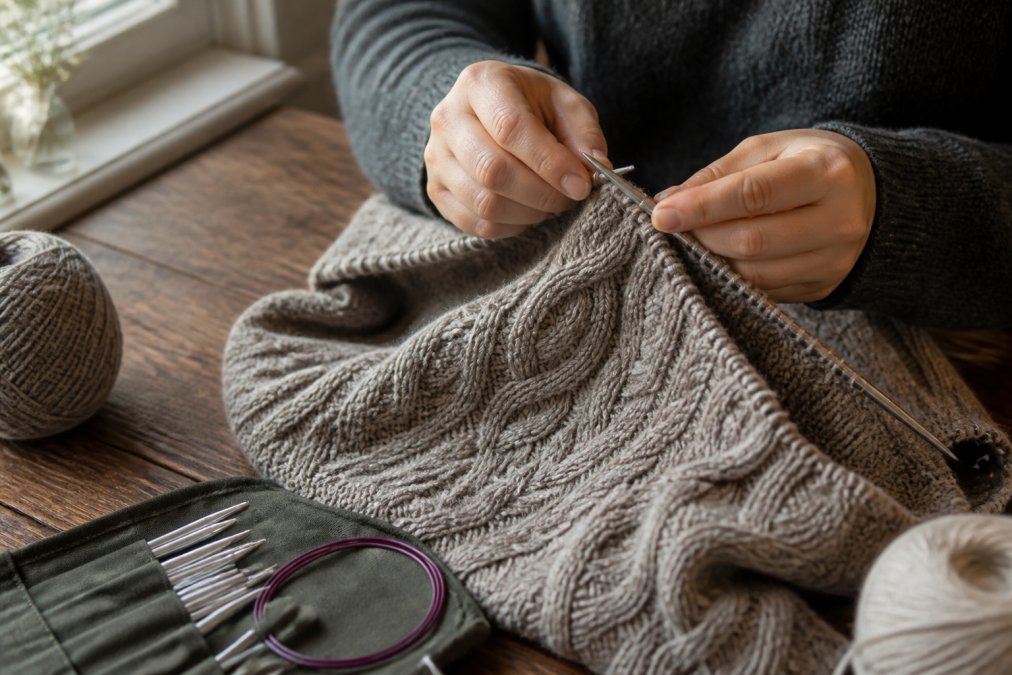
The Addi Turbo is the workhorse of the range. Nickel-plated brass tips glide through wool with almost no friction, and the flexible blue cord lies flat instead of coiling against the work. Seamless joins mean no snagging at the transition point, which matters most on fine yarns where a single catch can distort a stitch. The smooth metal surface offers little grip, so loose tensioners may find stitches slipping on slick plant-based fibers, but for wool, that glide is the point. At $16.00, it's the lowest-risk way to test whether metal suits your style before committing to a full set.
FlexiFlips solve the small-circumference problem. Each set contains three flexible 8-inch circular needles: two hold stitches while the third works them, so a round needs only two needle changes instead of the constant reshuffling double points demand. One end carries a sharper tip, the other a rounder tip, so the same tool handles both lace-weight and standard yarns. FlipStix take a different route: 6-inch dual-pointed needles with the same sharp-and-round pairing, for knitters who prefer the classic DPN feel without juggling four or five needles.

Needle material changes hand-feel, stitch speed, and control over fiber elasticity. The choice is about matching surface friction to the yarn in hand, a slick tip that feels luxurious on tightly spun wool can turn a smooth cellulose fiber into a runaway train.
Every needle sits somewhere on a friction scale, and every fiber has its own natural friction. Pair them so the stitch moves when you want it to and stays put when you don't.
Hand-feel is the part of needle choice spec sheets never capture. Metal feels cool on first contact and warms to hand temperature within minutes; wood feels warm immediately and stays that way. Knitters with nickel sensitivity, redness or itching on the fingertips after long sessions, often do better with wood, bamboo, or coated aluminum. The tool and the yarn both touch skin for hours, and both deserve the same scrutiny.
A $16.00 pair of nickel-plated brass needles that survives three years of daily work costs less per hour than a $6.00 pair that dents, snags, or loses its finish in six months. The math is simple: divide price by the number of hours the tool actually performs. For professionals logging 20 or more knitting hours a week, the premium tool almost always wins on cost-per-use even when it loses on sticker price. The American Craft Council's resources on fiber craft traditions documents how material choice has shaped regional knitting practice for generations, a reminder that tool selection has always been a craft decision, not just a purchasing one.
A complete professional toolkit needs one interchangeable system, one dedicated small-circumference solution, and a spare set of double points. The interchangeable system pays for itself fastest.
A garment project can demand five or six needle sizes before it's finished: a smaller size for ribbing, a larger size for the body, another for sleeves, and yet another for the neckline.
For anyone knitting regularly, yes. A set like the addiClick at $240 replaces dozens of individual needle purchases and lets you switch tip sizes mid-project without losing stitches. The patented click-in mechanism stays secure until you choose to change it, and every part in the system is fully interchangeable across eight tip choices from US 4 to US 19 and eight cord lengths. If you knit several projects a year, the set pays for itself in flexibility and fewer dropped stitches.
It comes down to how the material interacts with your yarn and hands. Nickel-plated brass tips glide quickly through wool, which suits fast colorwork and fine gauge knitting. Wood offers a touch more grip, which helps beginners. Aluminum double points keep small-circumference projects light in the hand. The right choice depends on your yarn, your tension, and how long you knit in one sitting.
Traditional wooden boards work well because their smooth surface protects delicate wool fibers while gently stretching garments into shape. Mitten boards at $20 keep small accessories consistent between pairs, while a jumper board at $249 shapes full sweaters so stitches settle evenly as they dry. Both are handcrafted in the United States from solid hardwood and built for years of use.
Beyond sharp-tipped needles, you need a reliable reference book and a way to keep tools organized. Vogue Knitting The Ultimate Knitting Book at $39.95 covers brioche, entrelac, double knitting, and mosaic knitting with over 1,600 photos. A bottle organizer at $19.99 keeps your needle tips sorted by size so you are not hunting mid-row. Good light and stitch markers round out the basics.
Many do keep DPNs on hand for small-circumference work like socks, mittens, and cuffs. Addi FlexiFlips at $30 provide a clever, comfortable solution for small-round projects, while Addi FlipStix at $27 offer sharp precision and versatile usability for lace and standard yarns. Aluminum double points at $15 are a lightweight, affordable option for knitters who prefer the classic feel of four or five needles in the round.

0 comentarios