What Defines Traditional Shetland Knitting Techniques
Traditional Shetland knitting is the practice of hand-knitting fine, warm garments from 100% Shetland wool using techniques refined over centuries on the Shetland Islands. It relies on fine-gauge yarn, stranded colorwork, and geometric motifs passed down through generations of island knitters.
Shetland Wool Week Annual 2025
The defining trait is tension. Traditional knitters worked at a fine gauge, often achieving 28 stitches and 36 rows over 4 inches in stockinette. That density is what gives authentic Shetland pieces their warmth without bulk.
Three techniques separate traditional work from casual knitting:
Fine-gauge stranded colorwork: Two colors worked across a single row, with floats carried behind the fabric
Shetland lace: Openwork patterns knit from gossamer-weight yarn, fine enough to pass through a wedding ring
Steeked garment construction: Cut openings for arms and necklines after knitting a tube
The Shetland Museum and Archives textile collection documents how these methods evolved from practical workwear into a recognized craft tradition. Brae & Heather carries patterns and materials built on these same foundations.
What most guides miss is that "traditional" describes a gauge and a method, not just a look. A modern knitter can produce a traditional garment with the right yarn weight and stitch definition.
Authentic Shetland Wool Characteristics Every Knitter Should Know
Authentic Shetland wool comes from sheep bred on the Shetland Islands, and its fiber properties differ measurably from mass-market wool. The fleece is fine, soft, and naturally available in a range of undyed shades from white through moorit brown to near-black.
Fiber Properties, Ply, and Stitch Definition
Fiber properties determine how a yarn behaves in stranded knitting. Shetland wool has a natural crimp and halo that traps air, which is why fine-gauge garments still insulate well.
Ply matters just as much. A 2-ply yarn is spun from two strands, while jumper weight refers to the finished thickness, not the strand count. This trips up a lot of buyers.
Jamieson & Smith 2ply Jumper Weight
Pro TipShade numbers, not shade names, are the reliable identifier for jumper weight yarn. Stickers may carry a spinner's name, but the number is what matches your project.
Stitch definition follows from how the yarn is spun. Worsted-spun Shetland yarn, like the Heritage line, gives crisper stitch definition and a smoother finish than woolen-spun yarn. That crispness is what makes complex Fair Isle motifs read clearly.
For a deeper look at fiber selection, the American Wool Council fiber guides explain how crimp, micron count, and spin method interact.
Fair Isle Colorwork Techniques: Then and Now
Fair Isle colorwork techniques have changed less than most people assume. The core method, holding two colors and working them in sequence across a row, is identical today to what island knitters used generations ago.
What changed is the palette and the pattern library.
Motif Evolution and Pattern Adaptation
Traditional motifs were geometric and tightly constrained: crosses, diamonds, zigzags, and stars built on a small grid. Contemporary designers have stretched those grids, scaling motifs up for modern garments and adapting vintage patterns to current silhouettes.
Pattern adaptation usually means one of three moves:
Rescaling: Enlarging a traditional motif for a thicker yarn and larger gauge
Recombining: Mixing bands from different historical patterns into a new layout
Recoloring: Keeping the motif but swapping the original natural palette for a modern one
The Shetland Wool Week Annual 2025 collects eight patterns that show this range directly, from a cozy jacket to fine lace, and it is a practical reference for anyone studying how traditional motifs get adapted today.
Best Practices for Stranded Knitting in Modern Projects
Best practices for stranded knitting come down to three variables: gauge, float management, and color dominance. Get those right and the rest follows.
English vs Continental Knitting and Dominant Hand
English knitting carries the working yarn in the right hand; Continental knitting carries it in the left. For stranded colorwork, most experienced knitters use one method per hand, holding one color in each, which prevents the yarns from twisting.
Color dominance is the part beginners overlook. The strand held lower and to the left typically sits forward and reads as dominant in the finished fabric. Switching which hand holds which color mid-project produces visible banding.
Technique
Yarn Hand
Best For
Watch Out For
English
Right
Single-color projects, beginners
Slower color changes
Continental
Left
Speed, purling, ribbing
Tension varies at first
One color per hand
Both
Stranded colorwork
Dominance must stay consistent
Two-handed Fair Isle
Both
Complex multi-color bands
Steeper learning curve
Watch OutSwapping which hand holds which color partway through a project creates a visible horizontal shift in the fabric. Decide dominance before casting on and keep it for the entire garment.
Circular needles and knitting wires help here. Working small circumferences on a long circular needle keeps floats even and reduces laddering at the joins.
How Traditional and Modern Shetland Knitting Compare
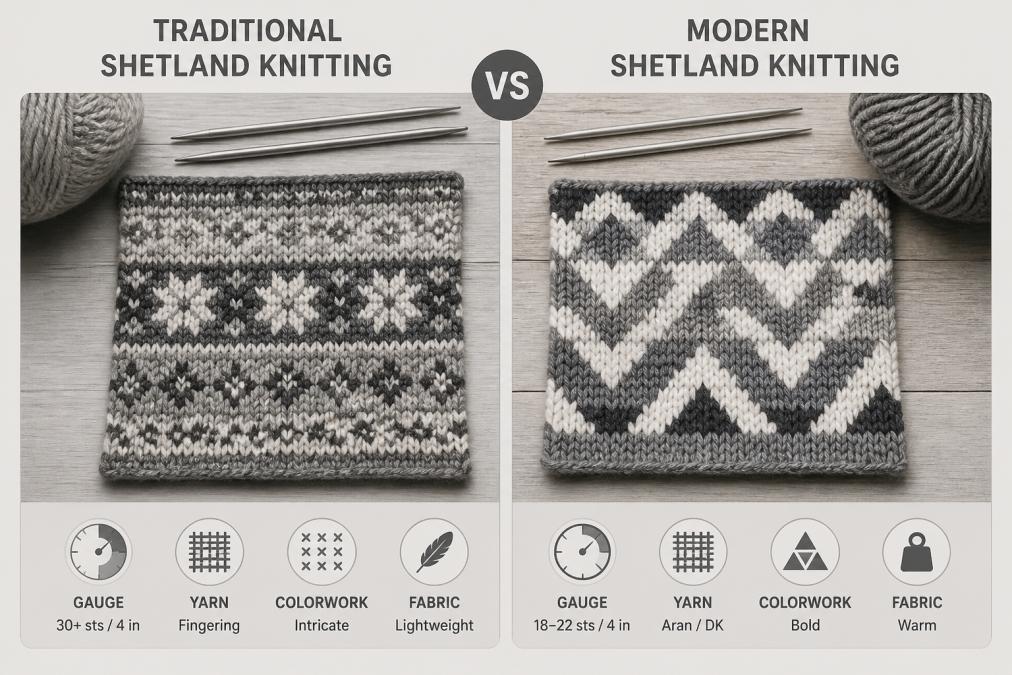
The honest comparison is that traditional and modern Shetland knitting share a method but diverge on gauge, yarn weight, tension, and intent. Traditional work favors fine yarn and dense fabric; modern work often trades some density for speed and drape. The table below breaks the differences down by the variables that actually change your knitting.
A close-up of two knitted swatches side by side on a wooden table, one in fine traditional Shetland wool with intricate Fair Isle colorwork and one in a slightly thicker modern yarn with a contemporary geometric pattern, natural light with knitting needles and a ball of yarn nearby
Factor
Traditional
Modern
Yarn weight
Fine, 2-ply jumper weight
Fingering to DK
Gauge
28 sts per 4 in
22-26 sts per 4 in
Needle size
3-3.5 mm
3.5-4.5 mm
Tension target
Dense, firm hand
Relaxed, drapier hand
Motif scale
Small, dense geometric bands
Larger, simplified motifs
Construction
Steeked tubes, hand-finished
Often seamless, top-down
Color changes per inch
High (many narrow bands)
Lower (fewer, wider bands)
Time to finish
Weeks to months
Days to weeks
Float length
Short, frequent
Longer, more visible
Blocking behavior
Holds shape for decades
Softens and relaxes more
What Actually Changes Between the Two
The single biggest technical difference is stitches per inch. At 28 stitches over 4 inches, a traditional garment packs roughly 40 percent more stitches into the same width than a modern DK-gauge piece at 22 stitches. That density is what makes traditional Shetland fabric wind-resistant and warm without bulk, and it is also why traditional projects take longer.
Tension behaves differently at each gauge. Traditional knitters worked firmly so floats stayed short and the fabric stayed opaque. Modern knitters working thicker yarn often loosen tension to keep the fabric from feeling stiff, which lengthens floats and can let the background color show through the front of the work.
Construction follows gauge. Traditional garments were knit as tubes and steeked, then finished by hand. Modern adaptations frequently use top-down, seamless construction, which removes the cutting step but changes how the shoulders and armholes fit.
The Trade-Offs, Stated Plainly
Warmth and stitch definition: Traditional gauge wins. Dense fabric holds motif edges crisply.
Speed and drape: Modern gauge wins. Fewer stitches and softer yarn mean faster, more fluid garments.
Yarn efficiency: Traditional fine-gauge work uses less yardage per square inch but more stitches, so total yardage for a sweater is often similar.
Repair and longevity: Traditional hand-finished seams and steeks are easier to repair invisibly; seamless modern construction is harder to alter once knit.
Fit forgiveness: Modern relaxed gauge hides small fit errors; traditional dense gauge does not.
Key TakeawayChoose traditional gauge when you want an heirloom piece with crisp colorwork and decades of wear. Choose modern gauge when you want a wearable garment in days, with a softer hand and a more relaxed silhouette.
A Practical Way to Decide
Match the gauge to the garment's job, not to a trend. A colorwork yoke sweater meant for daily wear in a cold climate benefits from traditional density. A lightweight layering piece for mild weather benefits from modern gauge. If you are new to stranded colorwork, start at a modern gauge to learn float management, then move to traditional gauge once your tension is consistent.
A useful test: knit a 4-inch swatch in each gauge, wash and block both, and compare how each holds its shape. Most practitioners find the traditional swatch springs back and the modern swatch relaxes. That single comparison tells you more about which approach suits your project than any pattern description.
Choosing Yarn and Tools for Your Shetland Project
Yarn and tools should match the gauge you intend to knit, not the other way around. Decide the garment first, then pick the weight. This section covers the yarns, tools, and quality checks that separate authentic Shetland work from lookalikes, plus how modern sourcing and processing differ from historical practice.
Yarn Selection by Project Type
For traditional Fair Isle, 2-ply jumper weight is the standard: 100% Shetland wool, fine gauge, and a tension of 28 stitches over 4 inches on 3 mm needles. It comes in the full historical palette, which matters when a pattern calls for fifteen shades. For finer, more defined colorwork, a worsted-spun Shetland heritage yarn gives crisper pattern definition than a woolen-spun jumper weight, because worsted spinning aligns the fibers and produces a smoother surface.
Jamieson & Smith Shetland Heritage Naturals
For modern-gauge projects, a fingering or DK-weight 100% Shetland wool keeps the fiber character while knitting up faster. Avoid substituting acrylic or acrylic-blend yarns: they do not bloom or felt the way wool does.
Project Type
Recommended Weight
Needle Size
Gauge (4 in)
Traditional Fair Isle sweater
2-ply jumper weight
3-3.5 mm
28 sts
Fine lace shawl
Gossamer or cobweb
2-2.75 mm
Varies by pattern
Modern colorwork yoke
Fingering
3.5-4 mm
24-26 sts
Everyday modern pullover
DK
4-4.5 mm
22 sts
Tools Worth Having
Circular needles in 3 mm and 3.5 mm for stranded work, plus a 4 mm and 4.5 mm set for modern gauge
Double-pointed needles in matching sizes for cuffs, necks, and small circumferences
Mitten boards for blocking and drying hand-knit mittens so pairs keep consistent shape
A color card to match shade numbers before ordering
Stitch markers in two colors to track color changes and pattern repeats
A blunt-tip tapestry needle for grafting and weaving in ends without splitting stitches
Brae & Heather's mitten boards are handcrafted in the United States from solid maple, with a smooth surface that shapes wool without snagging delicate fibers.
How to Identify Authentic Shetland Knitwear
When buying modern or vintage pieces, look for these markers of quality and construction:
Fiber content label: Authentic pieces list 100% Shetland wool, not a blend with synthetic fiber.
Gauge: Traditional pieces show fine, dense stitches; hold the fabric to light and check that it is opaque.
Floats: Turn the garment inside out. Short, even floats indicate skilled stranded work; long, loose floats snag easily.
Steeks: Traditional garments often show a cut edge at armholes and necklines, finished neatly.
Seams and finishing: Hand-finished edges and grafted joins signal traditional construction.
Color palette: Historical pieces use natural undyed shades plus a limited range of dyed colors; overly bright or uniform colors suggest modern mass production.
Shade numbers: Yarn labels with shade numbers, not just names, are a reliable indicator of a documented Shetland yarn line.
Pro TipWhen shopping vintage, check the underarm and cuff areas first. These wear points reveal whether the wool has pilled, felted, or thinned, which tells you more about fiber quality than the label does.
Modern Sustainability vs. Historical Practice
Historical Shetland knitting was sustainable by necessity: wool came from local flocks, dyes came from plants and lichens, and garments were repaired rather than replaced. Modern Shetland wool production differs in three ways. First, ethical sourcing now emphasizes traceable flocks and animal welfare standards, which historical practice did not formally document. Second, processing has shifted from small-scale hand spinning to mill spinning, which uses more energy but produces more consistent yarn. Third, modern dyers increasingly use low-impact and plant-based dyes, echoing historical palettes while reducing chemical runoff.
For knitters, the practical takeaway is that choosing 100% Shetland wool supports a fiber system that is naturally renewable and biodegradable, and it produces garments that can be repaired and re-worn for decades rather than replaced each season.
Key TakeawayMatch yarn weight to gauge, buy 100% Shetland wool over blends, and inspect floats, steeks, and finishing when evaluating any piece. Those three habits cover most of what separates authentic Shetland knitting from imitations.
Frequently Asked Questions
What is the difference between Fair Isle and Shetland knitting?
Fair Isle is a specific style of stranded colorwork that originated on Fair Isle, one of the Shetland Islands. Shetland knitting is the broader tradition that includes Fair Isle colorwork, lace knitting, and textured garments. All Fair Isle knitting is Shetland knitting, but not all Shetland knitting uses Fair Isle patterns. Traditional Shetland knitting also encompasses fine lace shawls, haps, and everyday garments knit with local wool.
What are the primary characteristics of authentic Shetland wool?
Authentic Shetland wool comes from sheep raised on the Shetland Islands and has distinct fiber properties: fine diameter, natural elasticity, and a halo that gives garments a soft, slightly fuzzy finish. It takes dye deeply, which is why Fair Isle colorwork shows such rich, lasting color. The yarn is typically light, warm, and durable despite its fine gauge. Look for 100% Shetland wool.
How does modern Shetland knitwear differ from historical patterns?
Modern Shetland knitwear often uses thicker yarn weights and larger needles than historical pieces, which were knit at very fine gauges. Contemporary designs may simplify traditional motifs or combine them with modern silhouettes like cropped sweaters or oversized cardigans. The color palettes have expanded beyond the natural undyed shades used in older garments.
Is Fair Isle knitting considered traditional Shetland knitting?
Yes. Fair Isle knitting is one of the most recognized forms of traditional Shetland knitting. It developed on the Shetland Islands and uses stranded colorwork techniques to create geometric and pictorial patterns. While modern knitters often use the term Fair Isle broadly for any stranded colorwork, the original tradition is rooted in Shetland's specific methods, motifs, and wool. Many contemporary patterns adapt these traditional techniques for today's yarns and styles.
Authentic Shetland knitting rewards patience, and the gap between a finished piece that holds its shape for decades and one that sags after a season comes down to yarn choice and gauge discipline. Brae & Heather stocks the yarn, patterns, and tools that make that standard reachable, from 2ply Jumper Weight and Shetland Heritage yarn to the Shetland Wool Week Annual 2025 and handcrafted mitten boards. Get started with Brae & Heather and knit a garment built to outlast the trend that inspired it.




0 comments