To organize your knitting pattern collection, start with a full inventory and a three-pile sort of keep, donate, and recycle, then file printed patterns in binders with page protectors and digital PDFs in named category folders. Build a searchable spreadsheet index with one row per knitting pattern so you can check what you own before buying duplicates.
Sort every pattern into keep, donate or swap, and recycle piles before buying any container.
Name digital files with the formula Designer_PatternName_YarnWeight.pdf and back the folder up to cloud storage.
Record pattern name, designer, yarn weight, yardage, needle sizes, size range, and storage location in a spreadsheet.
Review your project planner weekly and give any project untouched for a month a restart date or move it to the frog pile.
Measure closet shelf depth, under-bed height, and cart slot width before shopping so containers actually fit.
Learning how to organize your knitting pattern collection starts with subtraction, not storage. A knitting pattern is only useful when you can find it, read it, and match it to yarn you own, so start with a full inventory.
At Brae & Heather, we see the same pattern repeat: knitters buy beautiful designs faster than they can knit them. The fix is a clear-eyed sort before you buy a single container.
The Three-Pile Sort
Clear a table and empty every pattern source onto it: binders, drawers, magazine stacks, printed PDFs, phone screenshots. Then sort into three piles.
Keep: patterns you have knit, will knit this season, or love enough to knit twice
Donate or swap: duplicates, patterns outside your size range, designs that no longer suit your style
Recycle: torn pages, illegible printouts, patterns for yarn you will never buy
Be honest about the "someday" pile. The Craft Yarn Council's fiber arts resources offer a useful reminder that a manageable stash and pattern library keep the craft enjoyable.
If supplies are part of the mess, pair this sort with a full supply declutter. Our guide on how to organize knitting supplies covers the companion workflow.
What to Record Before You File Anything
Before a single pattern goes into storage, capture the details that make it findable later.
Pattern name and designer
Yarn weight and yardage required
Needle sizes called for
This record becomes the backbone of your spreadsheet later. Ten minutes of note-taking now prevents a drawer full of mystery printouts.
Knitting Pattern Storage Ideas for Printed Collections
Printed patterns need protection from bends, spills, and sunlight. The best knitting pattern storage ideas keep pages flat, visible, and grouped by project or category. Three formats handle nearly every printed collection.
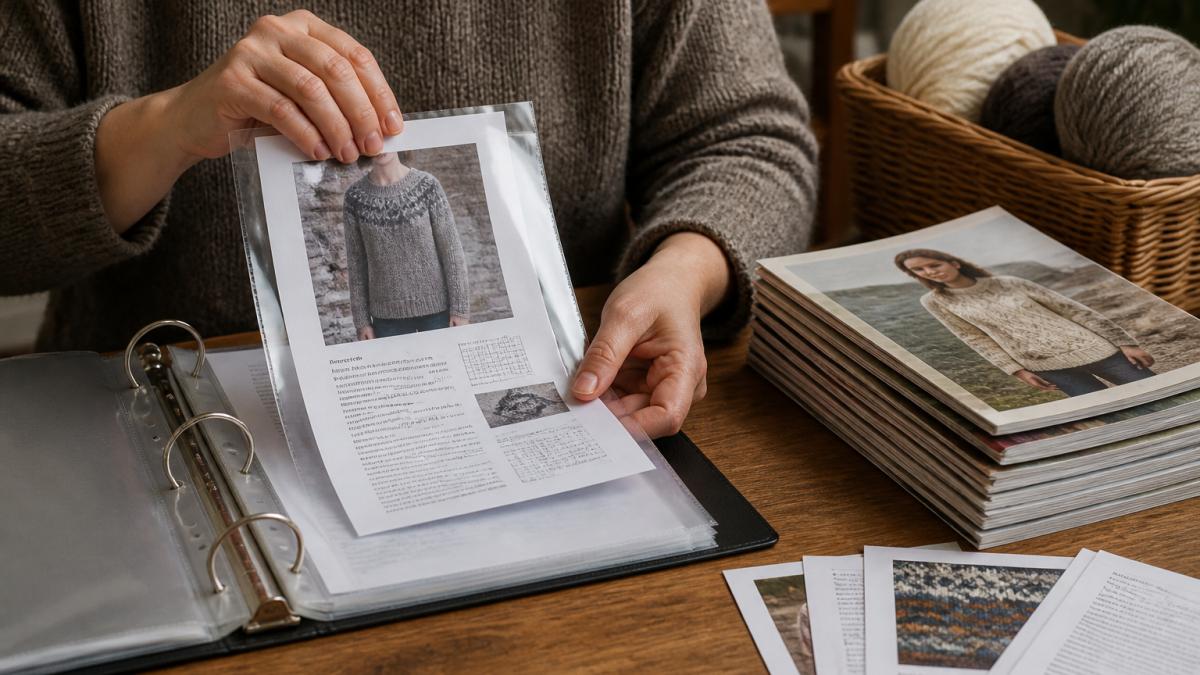
A knitter's hands sliding a printed pattern page into a clear page protector inside a three-ring binder, with a stack of knitting magazines and loose patterns on a wooden table nearby
Binders, Page Protectors, and Hanging Files
A three-ring binder with page protectors is the workhorse of printed pattern storage.
For loose magazine patterns, a file box with hanging files works well.
Watch out: never store printed patterns in a damp basement or a sunny windowsill.
How to Organize Knitting Patterns Digitally
Digital patterns pile up fast, and the challenge is naming, not storage. The key to how to organize knitting patterns digitally is a consistent folder structure, searchable file names, and an index that tells you what you own before you buy it again.
Set up a master folder called Knitting Patterns, then create subfolders by category: Sweaters, Hats, Shawls, Socks, Baby. Move each PDF into the right folder the day you download it.
Naming Files So You Can Find Them Later
Use a repeatable naming formula so search actually works:
Add a size tag if the pattern covers multiple sizes: Smith_CableCardigan_Worsted_XL.pdf
Keep names short and skip special characters
Back up the folder to cloud storage so a crashed laptop does not wipe your library.
Build a Searchable Index, Not Just Folders
Folders organize files; an index finds them. Create a spreadsheet with one row per digital pattern: pattern name, designer, source, yarn weight, yardage for your size, needle sizes, size range, file location, and a status column for queue, in progress, or completed.
This index is the piece most digital systems miss. In a yarn shop or scrolling a sale, search it for "worsted hat" or "fingering shawl" to see whether you already own a match, and it flags duplicates before you pay twice for the same PDF.
Handle Screenshots, Ravelry Links, and Email Receipts
Not every pattern arrives as a clean PDF. Screenshots, browser links, and email receipts all belong in the same system:
Save screenshots into the correct category folder and rename them with the naming formula
Bookmark pattern pages in a single browser folder called Knitting Patterns, not scattered across bookmarks
Forward purchase receipts to one email label so you can prove ownership and re-download a lost file
Set a Monthly Digital Reset
Once a month, open the Downloads folder and camera roll, move new patterns into the master folder, rename them, and add a row to the index. Ten minutes keeps the digital library from becoming a second junk drawer. If a pattern has sat in the index for two years with no yarn assigned, treat it like the paper "someday" pile and let it go.
Pro TipBefore buying a pattern, search your index for the designer name and the garment type. If a close match already exists, knit that one first.
Build a Knitting Pattern Library Spreadsheet
A knitting pattern library spreadsheet turns a scattered collection into a searchable catalog. One row per pattern and a handful of columns answer "do I own a worsted hat pattern?" in seconds.
Sort by category or yarn weight, then filter when you shop for yarn. If you are building a technique shelf alongside it, the best knitting books for technique are worth adding as reference rows.
Use a Knitting Project Planner to Track Works in Progress
A knitting project planner is the bridge between your pattern library and your needles. It tracks what is active, queued, and finished, so half-finished projects stop disappearing into drawers.
Keep a simple planner page per active project:
Pattern name and where the file lives
Yarn and dye lot
Needle size and stitch count
Review the planner weekly. Any project untouched for a month either gets a restart date or moves to the frog pile. This one habit keeps works in progress from becoming permanent residents.
Choosing a Project Bag That Works With Your System
A project bag keeps the active WIP, its pattern, and its yarn together, which is the whole point of a tracking system. The Keep Calm knitting project bag holds yarn, needles, and your pattern in one drawstring bag, so the current project travels as a unit.
Knitting Project Bag - Keep Calm
Match the bag to the project. Small accessories fit in a compact bag; larger garments need room. Label each bag with the pattern name so you can grab the right one without opening three.
Store by Fiber and Care Requirements
Fiber type should shape where and how you store finished pieces and the yarn set aside for them. Wool, including Shetland wool, needs protection from moths and moisture.
Wool and animal fibers: store clean, in breathable cotton bags or sealed bins with cedar, away from damp
Cotton and plant fibers: fold flat, keep dry, and avoid heavy compression
Acrylic-free natural fibers: check monthly for pests, since natural protein fibers attract moths
For deeper guidance, our article on how to store premium yarn to prevent moths walks through the full routine. Wash projects before storing them, since body oils and food traces invite pests.
Small-Space and Budget-Friendly Setup
You do not need a dedicated craft room to organize a pattern collection. A closet shelf, an under-bed bin, or a rolling cart can hold a full library when you sort smart. Define your actual space and budget before you buy a single container, because most small-space clutter comes from containers that do not fit the room.
Measure First, Then Choose Containers
Before shopping, measure the spaces you actually have: closet shelf depth, height under the bed, rolling cart slot width. Write the numbers down and take them with you. A bin two inches too tall will not slide under the bed, and a binder too wide will not stand upright on a narrow shelf.
Set a Realistic Budget
Small-space organization does not require a matching set of bins. Set a modest budget for the whole setup and spend it on the pieces you touch daily: the active project bag, one binder with page protectors, and one lidded bin for yarn. Repurpose what you already own for the rest; a shoebox or unused file tote holds printed patterns as well as a new container.
Low-Cost Moves That Actually Save Space
Use a shoe organizer over a door for rolled magazines and loose pattern pages
Repurpose a file box from an office supply store as a pattern bin
Store binders upright on a bookshelf to save floor space
Make a Shared Room Work
In a shared living room or apartment, the pattern collection has to disappear at the end of a session. A tote or project bag lets you pack the current work in progress away so the room returns to normal. Keep the master binder and yarn bin on a closet shelf, and bring out only the active project bag, labeled with the pattern name.
A Simple Space Plan by Room Type
Space
Best Use
Closet shelf
Binders and labeled bins, upright and reachable
Under-bed bin
Backstock yarn and off-season patterns
Rolling cart
Active project, needles, and notions
Door organizer
Rolled magazines and loose pages
Chair-side basket
Current work in progress only
Budget-friendly does not mean messy; a labeled bin beats an expensive cabinet you cannot reach. Start with the space you have, measure it, and add containers only as the collection grows.
Key TakeawayDefine your space and budget first, then buy containers that fit. In a shared room, the active project bag is the whole system.
Keep Your Collection Safe From Children and Pets
Patterns, needles, and yarn are all tempting to small hands and curious paws. A few simple habits protect both your collection and your household.
Store needles and small tools in closed cases, out of reach
Keep yarn in lidded bins so pets cannot tangle or chew it
Place binders and file boxes on high shelves
Watch out: dropped stitch markers and small notions are choking hazards for toddlers and pets. Sweep the knitting area after each session and keep a small container for loose pieces.
Bring Order to Your Pattern Collection
A pattern collection only earns its keep when you can find the right design at the right moment. The system above, from the three-pile sort to a labeled spreadsheet and fiber-aware storage, turns a drawer of loose pages into a working library.
Brae & Heather can help you build that library with expertly designed knitwear patterns, premium Shetland wool, and a curated selection of books and textile tools.
Frequently Asked Questions
How do you organize a knitting pattern collection?
Start with a full inventory, then sort every pattern into keep, donate, or recycle piles. File printed patterns in binders with page protectors or hanging files, and store digital files in labeled folders on your computer. Add each pattern to a knitting pattern library spreadsheet so you can search by yarn weight, needle size, or project type. The system only works if you update it every time a new pattern arrives.
What is the best way to store knitting patterns?
Printed patterns hold up best in three-ring binders with page protectors, which keep pages dry and let you flip through designs quickly. Hanging files in a file box work well for magazines and larger leaflets. For digital patterns, keep a backup in cloud storage alongside your local files. Whichever method you pick, label everything clearly and keep the most-used patterns within easy reach of your craft space.
How do you keep track of knitting patterns you want to make?
Use a knitting project planner or a simple spreadsheet column marked queue. Record the pattern name, yarn weight, needle size, and where the file lives. Rank the queue by season or occasion so you always know what comes next. Review the queue monthly and remove anything you have lost interest in, which keeps the list realistic and prevents the drawer full of abandoned projects.
How often should you declutter your knitting pattern collection?
A quick monthly check keeps the collection manageable, with a deeper declutter once or twice a year. During the monthly pass, remove duplicate printouts and file any loose patterns. The seasonal pass is the time to ask whether you would still knit each design. If a pattern has sat untouched for two years, pass it along to a knitting friend or a local guild.




0 commentaire