Why Technique-Focused Knitting Books Matter More Than Patterns
Pattern books tell you what to make. Technique books teach you how to think about making. That distinction separates knitters who faithfully reproduce designs from those who can alter, fix, and ultimately create their own.
For knitters ready to move past basic scarves and washcloths, the best knitting books for technique function as a permanent reference library. This guide from Brae & Heather evaluates the most respected titles by what they actually teach.
A common mistake is buying a pattern collection when what you really need is a foundation. The books below cover cast-on methods, bind-off techniques, gauge swatches, tension control, and garment construction.
Key TakeawayThe right technique book pays for itself the first time it saves you from frogging an entire sweater. Look for clear illustrations, thorough indexing, and coverage that matches your current skill level.
Quick Comparison: Top Knitting Books for Technique
Vogue Knitting The Ultimate Knitting Book: The Comprehensive Reference
Considered the gold standard of knitting references, this revised edition delivers 1,600 color images across 352 pages. First published in 1989 and updated in 2018, it covers an expanded library of cast-ons, increases, decreases, and bind-offs, plus in-depth sections on brioche, entrelac, double knitting, and mosaic knitting (penguinrandomhouse.com).
What separates this from other references is the construction chapter, which covers hats, mittens, socks, gloves, and more than 25 shawl shapes. The thorough indexing and footnote cross-referencing make it surprisingly easy to navigate for a book of its size.
This update addresses older editions' limited coverage of newer techniques with fresh material on lace, cabling, finishing, and embellishing. At $39.95, it represents real value for anyone serious about building a technique library.
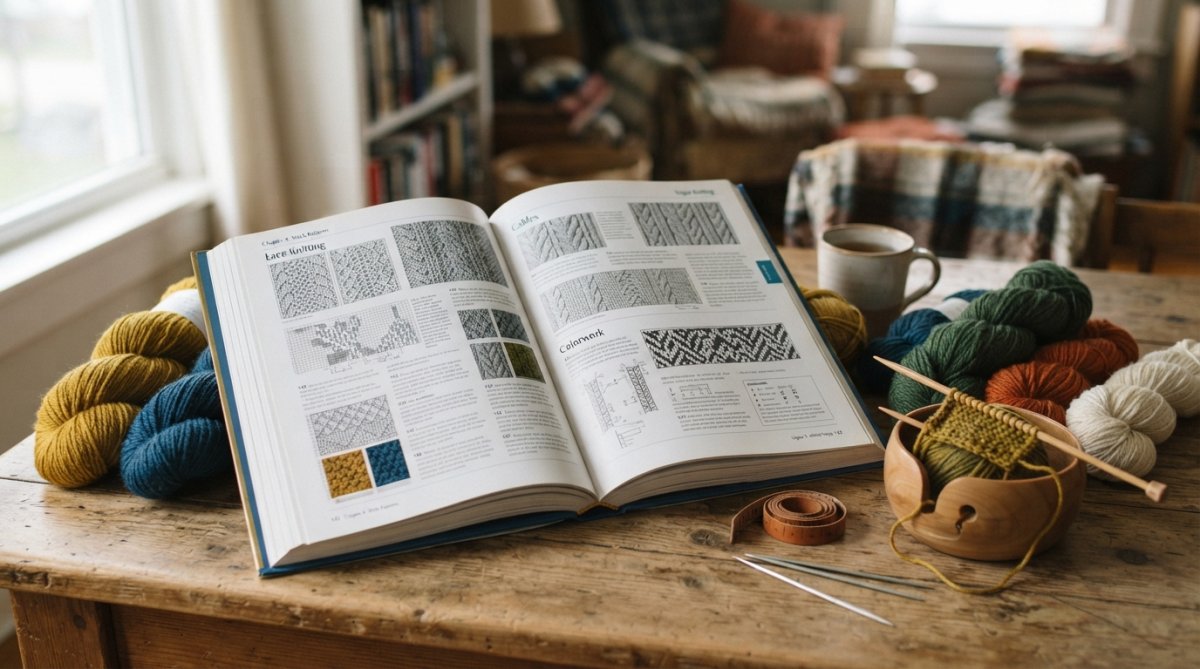
Open copy of Vogue Knitting book on a wooden table, showing detailed stitch illustrations and colorful yarn skeins nearby
Pro TipKeep this book near your knitting chair, not on a shelf. Its real value emerges when you hit a tricky bind-off or an unfamiliar increase mid-project and need an immediate answer.
The Complete Guide to Lace Knitting: A Master Class in Openwork
Lace knitting intimidates many knitters because it combines chart reading with yarn overs and decreases that demand precision. Julia Riede's guide, written by a nuclear physicist who approaches knitting with scientific rigor, covers choosing yarn and needles, gauge and sizing, basic and special stitches including nupps, and reading charts.
The Complete Guide to Lace Knitting: Your lace knitting master class - Paperback
What makes this one of the best knitting books for technique is its design section. Riede explains how to alter existing patterns, create your own stitch patterns, and draft charts from written instructions. The troubleshooting chapter covers fixing mistakes and working with lifelines, which every lace knitter eventually needs.
The book includes example patterns from beginner to advanced, making it useful across multiple skill levels. At 138 pages, it's more focused than a general reference, which works in its favor for lace-specific learning.
Cozy Cables: Mastering Texture Through Guided Patterns
Cables look complex but follow a logical structure that becomes intuitive with practice. Kalurah Hudson's collection of 16 patterns and multiple cable stitches includes small-scale projects like the Smokestack Ankle Socks and Snowberry Hat for portable knitting, plus larger pieces like the Snow Fern Cardigan.
The progression works well: beginners can start with simpler cable patterns while more experienced knitters tackle the asymmetric shawls and fingerless mitts. Hudson's background as a designer featured in Vogue Knitting lends credibility to the instruction quality.
Best ForKnitters who learn best through complete projects rather than isolated technique demonstrations. Each pattern builds cable confidence through repetition and variation.
Your Beginner Guide to Fair Isle Knitting: Starting with Colorwork
Stranded colorwork opens a new dimension of knitting. Traditional Fair Isle knitting involves working with two colors per row while carrying the unused strand across the back of the work (wikipedia.org). The technique requires attention to tension, since strands that are too tight will pucker the fabric.
The Big Book of Latvian Mittens by Ieva Ozolina offers 100 patterns with large color charts, covering stranded colorwork techniques including the distinctive Latvian braid. While the patterns lean traditional, the technique instruction transfers directly to any colorwork project.
Charming Colorwork Socks by Charlotte Stone takes a more whimsical approach with 25 sock patterns that build colorwork skills progressively. Both books work well for knitters who have mastered basic knitting and want to expand into colorwork.
Advanced Knitting Stitch Dictionaries for Expanding Your Repertoire
Stitch dictionaries are the idea engines of the knitting world. But not all dictionaries are created equal, and the right one depends on how your brain processes information. A critical distinction is whether you prefer charts or written instructions. Knowing your preference will save you from a shelf of beautiful but useless books.
The Case for Chart-Led Dictionaries
For visual learners, a chart-led dictionary is non-negotiable. Charts show the architecture of a stitch, how a yarn over leans, how a decrease travels, in a way that text cannot. Look for dictionaries that include a clear legend for symbols and a note on whether the chart is meant to be read flat or in the round.
The Case for Written-Instruction Dictionaries
If you are a textual learner, or if you frequently knit while watching television or commuting, a dictionary with robust written instructions is your ally. The best of these go beyond simple 'K2tog, YO' and explain the purpose of each row, turning a simple pattern into a lesson in construction.
Stitch dictionaries are often expensive, and many knitters only need a handful of patterns from a single volume. Before purchasing, consider the 'Borrow vs. Buy' test:
Borrow from a library: If you are working on a specific project (e.g., a cabled hat) and need a few border or panel ideas, your local library likely has a comprehensive dictionary. Scan the pages you need, and return it. This is a zero-cost way to access 500+ stitch patterns.
Buy for your permanent library: If you are a designer, a teacher, or a knitter who frequently creates original garments, a dictionary is a deductible, long-term investment. The key is to buy one that aligns with your design aesthetic. Do you prefer the clean, modern lines of a Japanese stitch dictionary, or the traditional, dense textures of a Shetland-inspired collection?
A Note on Accessibility and Layout
A frequently overlooked factor is layout clarity. Some books cram four charts onto a single page with tiny, 6-point font symbols, making them nearly impossible to read. When evaluating a dictionary, flip to the most complex chart. Can you easily distinguish a yarn over from a knit-through-back-loop? Is the paper matte or glossy? A well-organized dictionary with a clear index and a spiral binding that lies flat will get far more use than a dense tome that requires a book stand and a bright lamp.
Ultimately, the best advanced stitch dictionary is not the one with the most patterns, it is the one that you can actually read, understand, and apply to your own designs without frustration. Prioritize your learning style and physical usability over sheer page count.
How to Improve Knitting Tension for Professional Results
Uneven tension is rarely a problem with your hands, it is a problem of information. Your hands are reacting to a lack of feedback about what the fabric is doing. The fix is not to 'knit more evenly' but to build a feedback loop that tells you when you are drifting off-course.
The 'Skill-Progression Roadmap' for Tension
Most guides tell you to 'practice,' but they don't tell you what to practice. Here is a specific progression to isolate and correct tension issues:
The Foundation (Vogue Knitting): If you are a newer knitter, your tension inconsistency often comes from an unstable grip. Vogue Knitting's section on knitting mechanics, specifically the photos showing different yarn-holding styles (English, Continental, Portuguese), is your first step. The goal is to find a way that allows your yarn to flow consistently without you having to stop and adjust your grip every few stitches. Practice one style for a week, then switch.
The Isolator (Cozy Cables): Once your grip is stable, the next tension killer is the transition between knit and purl rows. Knit a swatch in stockinette, then a swatch in the seed stitch pattern from Cozy Cables. Measure both. If your seed stitch swatch is significantly tighter, you are pulling the yarn too tightly when moving the yarn to the front for purls. The fix is a conscious effort to relax your index finger on the purl row.
Cozy Cables: Inspired Knitting Patterns to Warm the Body and Soul - Paperback
The Colorwork Challenge (Fair Isle Guides): In stranded colorwork, the issue is 'floats', the strands carried across the back. If they are too tight, the fabric puckers; too loose, and the yarn snags. The specific mechanism to master is stretching the right-hand stitch before you lay the float. A dedicated guide will show you how to spread the stitches on the right needle to their full width before bringing the new color over.
The Gauge Swatch as a Diagnostic Tool
A gauge swatch is not a chore; it is a scientific experiment. To use it effectively for tension control, you must do more than just knit a square:
Knit it in the round: If your garment is knit in the round, your swatch must be knit in the round. Knitting flat introduces purl-row tension variations that will not exist in your actual project, giving you false data.
Block it aggressively: Wash and block your swatch the same way you will treat the finished garment. This reveals the fabric's true drape and recovery. A wool swatch that looks stiff before blocking may bloom beautifully after, while a swatch that looks perfect before blocking may grow 2 inches after a soak (pubs.acs.org).
Measure it in three places: Do not measure just the center. Measure the cast-on edge, the middle, and the bind-off edge. If the middle is wider, your tension is loosening as you knit. If the edges are wider, you are knitting loosely on the first few rows after a break. This tells you where in the row your tension changes, not just that it changes.
The 'Library vs. Purchase' Angle for Tension Books
You do not need to own a book to fix your tension. The principles of tension control are universal, and specific exercises are often found in older, out-of-print books available at your local library. Before spending $40 on a new book, check out a classic and practice the mechanics. If the approach clicks, purchase it for your permanent library; if not, you have lost nothing but a library due date.
Pro TipFor knitters working with premium fibers like Shetland wool, tension takes on additional importance. The natural elasticity of wool responds differently to tight and loose knitting. A swatch knit tightly will feel stiff and have poor drape, while a loosely knit swatch will feel airy and may stretch out of shape. Understanding this relationship is the key to producing fabric with the right hand-feel for your project.
By treating tension as a skill to be isolated and practiced, rather than a vague 'problem' to be solved, you can use the books in this guide as a structured curriculum toward professional-looking results.
Frequently Asked Questions
What is the best knitting book for a beginner who wants to learn proper technique?
For true beginners, start with a foundational primer like Vogue Knitting The Ultimate Knitting Book. It covers cast-on methods, bind-off techniques, and basic stitch patterns with over 1,600 step-by-step photos. This approach builds muscle memory correctly from the first project, preventing bad habits. Pair it with a simple pattern book to practice your new skills immediately.
How can I improve my knitting technique through self-study?
Focus on one skill at a time using a dedicated technique book. For example, use a lace knitting guide to master yarn overs and decreases, or a colorwork book to practice stranded techniques. Knit a small swatch to practice the technique, then measure your gauge swatch to check your tension. Regular, focused practice on specific skills improves technique faster than knitting full projects.
What are the best knitting books for advanced colorwork techniques?
For advanced colorwork, look for books that go beyond basic Fair Isle. The Big Book of Latvian Mittens offers 100 charts for stranded colorwork, teaching you how to manage multiple colors and create intricate patterns. Charming Colorwork Socks is another strong choice, providing 25 patterns that explore complex motifs in a manageable format.
Which knitting books provide the best tutorials for cable construction?
Cozy Cables by Kalurah Hudson is an excellent choice for learning cable construction. The book provides clear instruction on how cables work, moving beyond just following charts to understanding how to read your knitting. With 16 patterns ranging from socks to sweaters, you will learn how to combine different cable stitches to create dynamic textures.
How do I choose the right knitting book for my skill level?
First, assess your current skills honestly. If you are new to knitting, choose a comprehensive reference that covers basics. If you are intermediate and want to learn a specific skill like Fair Isle, pick a book focused on that technique. Advanced knitters benefit from stitch dictionaries or pattern books that challenge their construction knowledge. Matching the book's difficulty to your skill level prevents frustration.




0 commentaire