
How Should You Organize Your Knitting Supplies?
Publié le Oct 24, 2026
By Editorial Team
Économisez 25 % sur les patrons et accessoires de tricot, aucun code requis

Last Updated: October 24, 2026
Quick Summary
Organize knitting supplies by first taking a complete inventory and decluttering, then storing yarn by fiber type in cool, dry areas, keeping needles in accessible cases or organizers by size, and storing patterns in binders or digital formats. This system makes project planning faster and keeps your supplies protected and easy to find.
To organize knitting supplies effectively, take stock of what actually exists. Many knitters accumulate yarn, needles, and patterns over years without a clear sense of volume or condition.
Start by pulling everything out. Empty drawers, closets, and bags. Lay items on a large surface where they're all visible at once. This step forces an honest assessment of what's been collected and what deserves shelf space going forward.
Sort into three categories: keep, donate, and discard. Be direct about this decision. Yarn that's been sitting untouched for two years probably won't get used. Needles that don't match any current projects create visual clutter without purpose.
During this culling phase, check yarn condition. Moth damage, pilling, or fading means the fiber has deteriorated. Discard it rather than storing damaged goods. Similarly, needles with bent tips or cracked shafts belong in the trash, not the needle case.
Once the keep pile is final, count and categorize it. Write down yarn quantities by type, needle sizes on hand, and pattern count. This inventory becomes the foundation for every storage decision that follows.
Different fibers have different storage needs. Grouping yarn by fiber type and care requirements makes both organization and future project planning faster.
All-natural fibers like wool, cotton, and linen each respond differently to temperature, humidity, and light. Wool requires protection from moths and moisture. Cotton prefers dry conditions but tolerates wider temperature swings.
Store yarn in cool, dry areas away from direct sunlight. Baskets and closed containers work well for this purpose.
Organize yarn by fiber content first, then by color or weight within each group. This system makes pattern matching intuitive.
Label containers clearly with fiber type and care notes. A simple tag reading "Merino Wool - Keep Dry" reminds anyone accessing storage about handling requirements.
Consider humidity levels in storage areas. Basements and attics fluctuate seasonally, which can stress fibers. Interior closets or shelves maintain more stable conditions.
For long-term storage of premium fibers like Shetland wool, vacuum-sealed bags work well. These compress yarn significantly while protecting against moths and dust. Label bags clearly before sealing so contents remain identifiable without opening.
Needles need quick access. Unlike yarn, which can stay contained between projects, needles get used constantly.
Needle roll organizers work well for circular needles. These fabric rolls have individual pockets for each needle size, keeping them flat and visible.
Needle cases with compartments suit straight needles and double-pointed needle sets. Cases with labeled sections by size make grabbing the right tool automatic.
Magnetic strips mounted inside cabinet doors hold metal needles vertically. This system saves drawer space and makes every needle instantly visible.
Drawer dividers create sections within a single drawer for different needle sizes. This keeps needles organized without requiring multiple storage containers.
Hanging organizers with pockets work for needles stored in closets or on walls.
The best system depends on collection size and available space. Small collections fit easily in a single needle case.
Group needles by size, not by material. A section for size 6 needles contains both bamboo and metal options, making project planning faster.
Keep frequently used needle sizes most accessible. If circular needles see daily use, store them in the most convenient location. Less common sizes can go in secondary storage.
Different storage methods suit different needle collections and spaces.
| Storage Method | Best For | Key Advantage |
|---|---|---|
| Needle roll organizers | Circular needles | Keeps cables from tangling |
| Needle cases with compartments | Straight and double-pointed needles | Labeled sections prevent hunting |
| Magnetic strips | Metal needle collections | Saves drawer space, instant visibility |
| Drawer dividers | Small to medium collections | Uses existing furniture |
| Hanging organizers | Closet or wall storage | Takes advantage of vertical space |
Patterns need organization that supports both discovery and execution. A chaotic pattern collection makes it hard to start new projects or find patterns that match current inspiration.
Three-ring binders with page protectors work for pattern storage. Organize by project type: sweaters in one binder, accessories in another, or by skill level. Learn how to read complex knitting patterns to better understand and manage the patterns you collect.
File boxes with hanging folders create category-based systems. Label folders by garment type, fiber content, or designer. This structure makes browsing for inspiration straightforward.
Digital organization complements physical storage. Photograph patterns and store images in a folder system on a phone or computer. Add searchable notes about yarn requirements, skill level, and project status.
Pattern binders by designer group work by creator. This approach works well for knitters who follow specific designers consistently.
Spreadsheet tracking creates a searchable inventory. Columns for pattern name, designer, yarn requirements, skill level, and project status turn pattern collection into a database.
For patterns still in magazines or books, use sticky tabs to mark favorites. Photograph marked pages and add them to digital storage. This preserves the original while creating a portable reference.
Store patterns in the same room as yarn and needles when possible. Walking between storage areas slows project planning. Centralized access encourages actually using the patterns instead of letting them sit forgotten.
Active projects need different storage than finished yarn or archived patterns. Works in progress require protection from damage and easy access for regular work sessions.
Project bags keep all components of one project together. The Knitting Project Bag - Little Voices holds yarn, needles, and notions with drawstring closure, making it easy to grab and go between sessions.

Labeled storage containers for each active project work when projects stay at home. Label each container with the project name, pattern, and current row or round.
Knitting Project Bag - Little Voices →
Separate shelf space for active projects keeps them visible and accessible. Seeing ongoing work encourages regular knitting sessions. Hidden storage leads to forgotten projects that never get completed.
Hanging organizers with pockets can hold multiple small projects. Each pocket becomes a project home, with pattern and needles stored together.
Clear storage bins let knitters see project status without opening containers. Transparent sides show yarn color, needle size, and progress at a glance.
Store works in progress away from pets and children. Active projects with exposed yarn and needles create safety hazards. A closed cabinet or high shelf keeps projects protected and prevents accidents.
For projects on hold temporarily, store them in clearly labeled containers separate from active work. Discover how to finish unfinished knitting projects to help move stalled work toward completion.
Portable storage lets knitters work anywhere. A well-stocked project bag contains everything needed for productive sessions away from home.
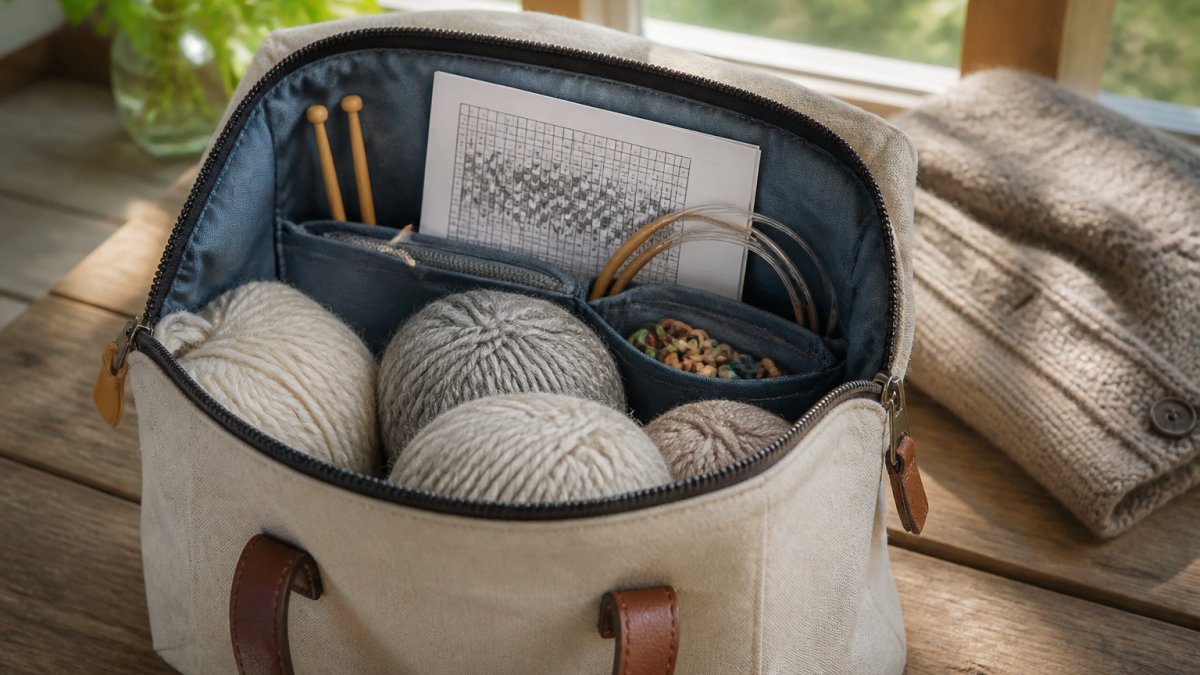
Yarn in the project bag should be the exact amount needed for the current project, not extras.
Needles for the current project plus one backup set of the same size prevent project delays if a needle breaks. Circular needles take less space than straight needles in bags.
Stitch markers in a small container stay organized and don't get lost in bag corners.
Pattern pages in a plastic sleeve stay clean and protected from spills. Highlight the current row or round to avoid losing place between sessions.
Notions like tapestry needles, scissors, and row counters fit in small pouches. A zippered pouch keeps these tools from scattering throughout the bag.
Notebook and pencil let knitters track progress, note modifications, or record yarn dye lot numbers for future reference.
The Knitting Project Bag - Keep Calm holds all these essentials with drawstring closure and twin cotton handles for comfortable carrying.
Choose bags with compartments rather than single open spaces. Divided sections keep yarn separate from notions and prevent needles from shifting during transport.
Limited space doesn't prevent effective organization. Budget-conscious knitters can organize supplies without expensive storage systems.
Repurposed containers work as well as purpose-built organizers. Glass jars hold yarn wrapped around cards. Shoe boxes become needle cases with dividers.
Vertical storage maximizes limited floor space. Wall-mounted shelves hold baskets of yarn without consuming room width. Pegboards with hooks organize needles and tools on walls.
Under-bed storage uses otherwise wasted space. Flat containers slide under beds, keeping supplies accessible but out of sight.
Closet organization transforms unused closet space into a dedicated knitting zone. Shelves, rods, and hanging organizers create storage for yarn, needles, and patterns.
Drawer dividers organize supplies within existing furniture. Dividing drawers by supply type creates sections for needles, stitch markers, and notions without purchasing new storage.
Tension rods inside cabinets create hanging space for project bags or yarn storage. This simple addition doubles usable space in existing furniture.
Rolling carts move supplies between rooms as needed. A three-tier cart holds yarn on one level, needles on another, and patterns on the third.
Budget organization relies on honest assessment of available space and creative use of what already exists.
Organization only works with consistent maintenance. A system set up once but never maintained quickly becomes chaotic.
Weekly reset takes fifteen minutes. Return needles to their designated spots. File away finished patterns. Return project bags to storage.
Monthly inventory check catches emerging problems. Are moth-prone fibers still protected? Do any containers need relabeling? Is the current system still serving its purpose? Small adjustments prevent larger issues.
Seasonal deep clean happens quarterly. Empty storage areas completely. Check for pest damage or moisture issues. Reorganize if the system has drifted from its original design.
Document the system so anyone accessing supplies understands it.
Adjust as collections grow. Organizational systems need updating as yarn stash expands or needle collections change. Quarterly reviews catch when current storage no longer fits current supplies.
When you organize knitting supplies well, the goal isn't perfection. The goal is a system that supports knitting rather than creating friction.
Start simple. Use the organizational approach that matches available space and budget. As the system proves itself, add refinements.
Organizing knitting supplies transforms creative practice. When yarn, needles, and patterns have clear homes, starting new projects becomes frictionless.
A well-stocked knitting project bag holds your active yarn, needles, stitch markers, and pattern. Include a small notions pouch for scissors and tapestry needles. The Knitting Project Bag from Brae & Heather ($44.85) provides 15 × 17 inches of space with drawstring closure and cotton handles, sized to hold everything you need between sessions without overpacking.
Use vertical storage: wall-mounted hooks for project bags, floating shelves for stacked baskets, and drawer dividers for needles. Combine storage by function rather than spreading items across multiple locations. A single project bag keeps your active work portable and contained. Choose clear containers so you can see contents without opening every box. Rotate finished projects out of your main space to keep active supplies accessible.
Store works in progress in a dedicated project bag or container with the pattern, needles, and any reference notes attached. Keep the yarn wound or loosely coiled to prevent tangling. Use stitch markers or a safety pin to note your current row. Store flat or rolled gently to avoid stretching. The Douglas Modern Tartan Stitch Marker Set ($12.40) includes both ring and clasp markers to secure your place, and the compact storage tin keeps markers organized with your project.
Group needles by size and material, then store in a roll, case, or drawer with dividers. Needle rolls keep pairs together and protect tips. For circular needles, coil loosely and secure with a small elastic or store in a shallow drawer. Label dividers by needle size to find what you need quickly. Store needles flat or upright, avoid bending them or laying heavy items on top, which can warp them over time.


0 commentaire