
Is Natural Wool the Best Choice for Colorwork Knitting?
Publié le Oct 29, 2026
By Editorial Team
Économisez 25 % sur les patrons et accessoires de tricot, aucun code requis

Last Updated: October 29, 2026
Quick Summary
Natural wool is a strong choice for colorwork knitting because its crimp, spring, and surface texture hold two colors in place and keep floats tidy and motifs crisp. Wool's elasticity forgives imperfect float tension in a way cotton and silk do not, and its bloom adds separation between colors.
Natural wool is a fiber option for stranded colorwork. Its grip, spring, and surface texture hold two colors in place while motifs take shape.
Here is the core argument. Colorwork involves both tension and color.
The Campaign for Wool on wool's natural properties notes that wool's crimp and elasticity give it a natural memory that smooth fibers lack. That memory is what keeps floats tidy and motifs crisp.
Below, we'll discuss wool and colorwork, how to pick a skein, and common knitting challenges.
Stitch definition is how clearly each stitch reads in the finished fabric. Wool has a surface texture that catches light and shadow.
Elasticity is wool's ability to stretch and spring back.
If floats are your weak point, a focused guide helps: Fair Isle Knitting: Tips for Carrying Yarn Floats walks through carrying techniques step by step.
Elasticity does more than hold floats. It shapes the stitches themselves, and it determines how the fabric behaves when it moves. Wool's crimp means each stitch forms with a slight curve, and those curves nest together, which gives colorwork fabric its even, springy hand.
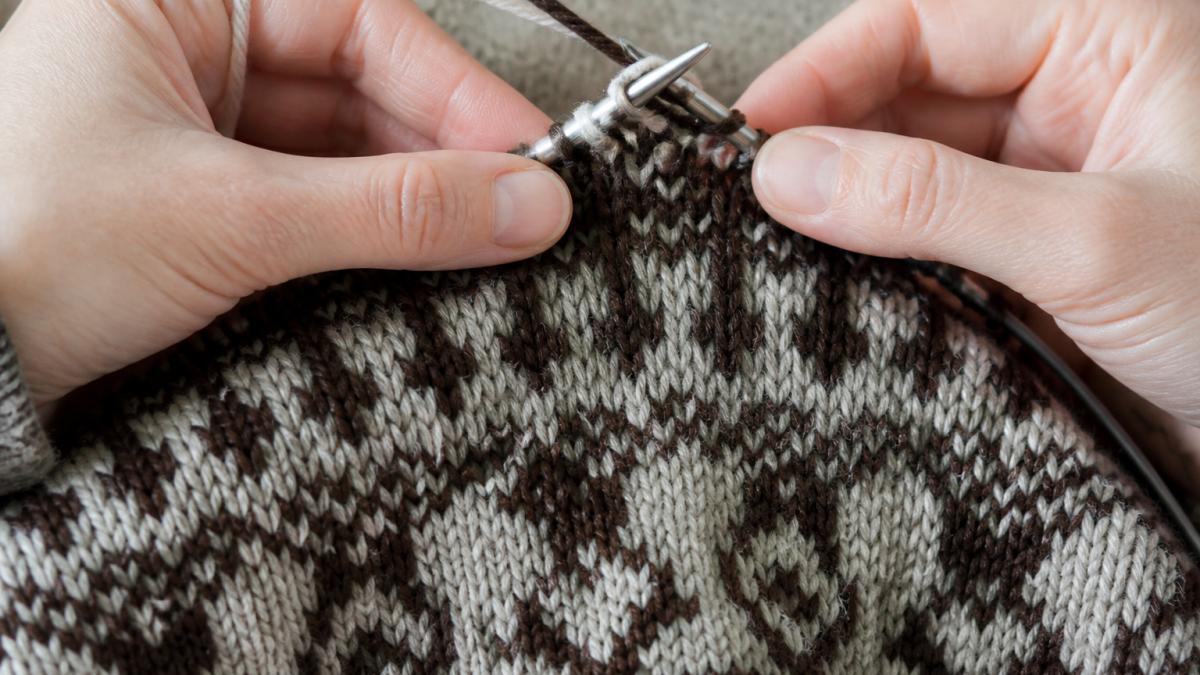
A float is a horizontal strand of the unused color carried across the back of the work. When you knit the next stitch in that color, the float has to span the gap between where it was dropped and where it is picked up again.
Wool gives you a wider margin for error here than smooth fibers. That margin is why traditional stranded colorwork developed in wool cultures: the fiber forgives imperfect tension in a way cotton and silk do not.
Watch out: knitting colorwork too tightly to compensate for slippery yarn creates fabric that cannot relax. Wool lets you knit at a natural tension, which is the whole point.
Some knitters fear bloom as a sign of pilling. In practice, a moderate bloom is a sign of a healthy natural fiber doing what it should. Non-superwash wool blooms more; superwash blooms less.
Yarn weight and gauge are considerations when choosing yarn for Fair Isle knitting.
Start with these criteria:
If you are shopping for a specific pattern, How to Substitute Yarn for Fair Isle Patterns covers how to swap yarns without wrecking your gauge.
Southern Shetlands Yarn Naturals - Fingering →
The Craft Yarn Council's yarn weight standards defines the weight categories that Fair Isle patterns are built around, which makes substitution far easier.
For a direct comparison of how weights and constructions behave, see Wool Yarn Weights Colorwork Comparison.
Stranded colorwork involves managing floats and tension.
Try these:
If your floats are already uneven, Fix Inconsistent Knitting Tension: A Step-by-Step Guide addresses the root causes rather than the symptoms.
Choosing yarn colors for colorwork involves considering contrast. Value is how light or dark a color reads.
One way to assess value is to test colors before you buy:
Palette balance is about restraint. Three to five colors usually read better than eight. Let one color dominate, one support, and the rest accent.
Wool's slight surface texture and bloom add a second layer of separation between colors. Smooth fibers reflect light more evenly, which can flatten value differences. Wool's bloom fills the gaps between stitches and gives each color a slightly different surface, so motifs stay legible even when two colors are close in value.
Here is the trade-off in plain terms:
| Feature | Non-Superwash Wool | Superwash Wool |
|---|---|---|
| Float grip | Strong | Moderate |
| Bloom | Noticeable | Minimal |
| Washability | Hand wash | Machine wash |
| Color bleeding risk | Higher on first wash | Lower |
| Best for | Traditional colorwork | Everyday wearables |
Brae & Heather's Southern Shetlands Yarn Naturals - Fingering is a 3-ply fingering-weight wool produced in the USA for detailed knitting and colorwork. It has approximately 114 yards per skein. At $16.99, it is a product option for colorwork projects.

The listing gives a Fair Isle gauge of 28 stitches and 32 rows over 4 inches. It suggests 3 to 3.5 mm needles.
Natural wool is one option for colorwork. If you want to use natural wool, Brae & Heather offers wool yarns, including Southern Shetlands Yarn Naturals - Fingering for detailed knitting and colorwork.
The listing for Southern Shetlands Yarn Naturals - Fingering describes it as a 3-ply fingering-weight wool for detailed knitting and colorwork. Its listed Fair Isle gauge is 28 stitches and 32 rows over 4 inches.
Consider the pattern's gauge and yarn weight when choosing yarn. Brae & Heather offers Southern Shetlands Yarn Naturals - Fingering, a 3-ply fingering-weight wool for detailed knitting and colorwork.
The product listings include wool yarns in different weights and constructions, including Southern Shetlands Yarn Naturals - Fingering, Sport Single Ply, and Regal 2-Ply DK.
Colorwork rewards the knitter who chooses fiber with intention. If your floats are uneven or your motifs look soft, the yarn is often the culprit, not your hands. Brae & Heather offers Shetland wool selected for grip, bloom, and even stitch definition, plus patterns written for real gauge. Browse the Southern Shetlands line and start your next colorwork project with a fiber that works with you.


0 commentaire