Inconsistent knitting tension is one of the most common challenges knitters face, and it rarely stems from a single cause.
Most knitters discover their tension issues trace back to three areas: yarn holding and wrapping, needle position, and stitch formation. Each directly affects how much pressure the working yarn experiences as it moves through your hands and onto the needles.
Inconsistent tension responds well to targeted practice. Once a knitter identifies the cause, adjustments typically show results within a few projects.
Yarn Holding and Wrapping Issues
How the yarn moves through your fingers dramatically impacts stitch size and consistency. Many knitters wrap yarn too tight around one finger or too loose around another, causing some stitches to pull tight while others sit loose.
Common wrapping mistakes include:
Wrapping yarn too tightly around the index finger
Skipping the pinky finger entirely in the wrap
Changing the wrap pattern mid-row without realizing it
Holding the yarn inconsistently between the fingers
The working yarn should flow smoothly through your fingers without catching or binding. If the yarn resists movement, tension becomes too tight. If it flows too freely, stitches become loose and uneven.
Needle Position and Hand Tension
Where the needles sit in relation to your hands affects how much control the working yarn has.
Keeping needles close together and working near the needle tips gives better stitch consistency. This positioning lets the working yarn move more directly into each stitch, reducing the chance of variable tension.
Hand tension also plays a role. Knitters with tight, tense hands often create stitches that are too tight. The tension in the hands transmits directly to the yarn and needles. Relaxed hands produce more even stitches.
Stitch Formation and Pulling
How the yarn gets pulled into each new stitch affects its final size. Some knitters pull too hard; others pull inconsistently, sometimes gently and sometimes firmly. This variation shows up as obvious differences in stitch size across rows.
The yarn should be pulled with consistent, moderate pressure. Each stitch should sit evenly on the needle without appearing stretched or bunched. The key is finding a pulling rhythm that stays the same from stitch to stitch and row to row.
How to Keep Consistent Tension in Knitting
Consistent tension develops through deliberate practice and attention to the mechanics of yarn handling. The following steps create a foundation for even stitches across entire projects.
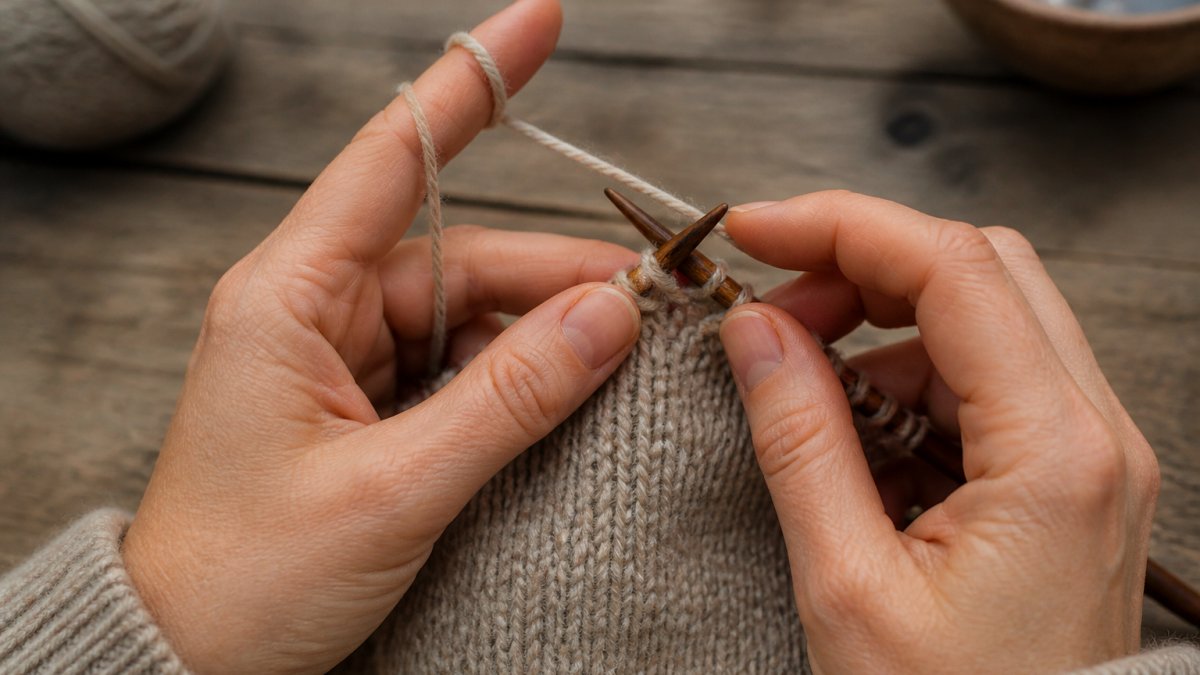
Close-up of hands holding knitting needles with working yarn wrapped around fingers, showing proper yarn tension control and needle positioning during knit stitch formation
Step 1: Establish Your Baseline Yarn Hold
Choose a yarn holding method and practice it until it becomes automatic. The most common are English (yarn in the right hand) and Continental (yarn in the left hand). Neither is inherently better, what matters is consistency.
Keep the yarn wrap the same for every stitch, passing through or around the same fingers in the same order every time.
Practice this wrap without needles first until the motion becomes natural. This builds the muscle memory essential for maintaining consistent tension without thinking about it.
Step 2: Position Your Needles Close Together
Bring the needles close together as the working yarn moves onto each new stitch. This shortens the distance the yarn travels from your fingers to the needle tip, giving more direct control and more consistent stitch formation.
Work near the needle tips rather than the middle of the shaft. Stitches formed near the tips tend to be more uniform than those formed farther back.
Keep the needles positioned at a comfortable angle. They should feel stable in your hands without requiring extra tension or effort to hold in place.
Step 3: Control Yarn Flow at Your Fingers
The working yarn should move smoothly through your fingers without resistance. Check the yarn path regularly, since even small shifts in where the yarn wraps around a finger can affect stitch size.
Some knitters benefit from using a tension ring or adjusting their finger position to control yarn flow.
If using fingers alone, practice maintaining the same pressure throughout each row. The yarn should feel like it has the same resistance every time a new stitch forms.
Step 4: Practice Relaxing Your Hands
Tension in the hands translates directly to tension in the yarn. Knitters with tight shoulders and hands often produce stitches that are too tight and inconsistent.
Some knitters relax with slow, deep breaths while knitting; others put the needles down every 10-15 minutes to stretch. Relaxed hands produce more even stitches.
Pay attention to where tension builds during knitting. If the shoulders creep up toward the ears, that's a sign to pause and relax. If the grip on the needles tightens, loosen it slightly.
Pro TipThe moment a knitter notices tension building in their hands or shoulders, stopping for 30 seconds and shaking out the hands often resets the entire knitting experience. This simple pause prevents hours of tight, uneven stitches.
How to Fix Uneven Knitting Tension
Identifying the type of tension problem helps target the fix. Loose stitches and tight stitches require different adjustments.
Loose stitches appear noticeably larger than surrounding stitches, looking like holes or gaps in the fabric. They sit loosely on the needle and don't hold their shape well.
Loose stitches usually result from:
Not pulling the yarn tight enough when forming stitches
Yarn wrapping too loosely around the fingers
Working too far back on the needle shaft instead of near the tips
Fingers positioned too far from the needles
To fix loose stitches, pull the yarn slightly more firmly when forming each stitch. The increase should be small and gradual. Too much pressure creates the opposite problem. Also check that the yarn is wrapped snugly around the fingers and that needles are positioned close together.
Diagnosing Tight Stitches
Tight stitches appear noticeably smaller than surrounding stitches, look bunched and compact on the needle, and may be difficult to work into on the next row.
To fix tight stitches, relax the pulling pressure slightly. Also examine the yarn wrap to see if it's too tight. Loosening the wrap around one or more fingers often helps. Finally, focus on relaxing the hands and shoulders. Even a small amount of relaxation can noticeably loosen stitches.
Watch OutTrying to fix tension by making large adjustments all at once usually overcorrects the problem. Small, gradual changes are more likely to produce even stitches. Expect to spend 2-3 rows adjusting before the tension settles into a new, more consistent rhythm.
Fixing Tension Mid-Project
Tension inconsistency sometimes appears only partway through a project, often when fatigue sets in or when switching to a new stitch pattern.
Identify which rows show the tension change, then examine what changed in the technique at that point. Did the yarn wrap shift? Did the needles move farther from the fingers? Did hand tension increase?
Once the cause is identified, make small adjustments going forward. Continue knitting with the new, corrected tension. The fabric will show the transition line, but blocking often helps even out these minor variations.
Knit-Versus-Purl Tension Troubleshooting
Many knitters find that knit stitches and purl stitches have different tension. This creates visible inconsistency in stockinette stitch and other patterns that mix knits and purls.
The difference usually stems from how the yarn moves around the needle for each stitch type. Knit stitches require the yarn in back; purl stitches require it in front.
To keep knit and purl stitches even, maintain the same pulling pressure for both.
Practice rows of stockinette stitch (alternating knit rows and purl rows) to train the hands to maintain consistent tension across both stitch types.
How to Knit Evenly in Colorwork
Colorwork patterns like Fair Isle introduce additional tension challenges.
When switching colors in colorwork, maintain the same tension with both the active yarn and the carried yarn.
Many colorwork knitters find it helpful to work with one color in each hand using English or Continental methods. This gives independent control over tension for each color.
Another approach is to tension each color separately as it becomes the active yarn. This means releasing the previous color's tension and establishing a new tension for the current color.
Does Blocking Fix Uneven Tension in Knitting
Blocking can improve the appearance of unevenly tensioned fabric, but it cannot completely fix the underlying problem.
Blocking cannot fix major tension issues. If some stitches are significantly larger or smaller than others, blocking only partially disguises the difference, and the variation will still be visible, especially in lighter-colored yarns.
Blocking works best as a finishing technique for fabric with minor, subtle tension inconsistency. For serious tension problems, fixing the knitting technique itself is the only real solution.
Many knitters use gauge swatches to test their tension before starting a project.
Key TakeawayBlocking improves appearance but doesn't fix poor tension. The real solution is consistent knitting technique. Practice and attention to yarn handling, needle position, and hand relaxation produce the most even, beautiful fabric.
Building Your Tension Practice Routine
Developing consistent tension takes deliberate practice over multiple projects. A structured practice routine accelerates improvement.
Start with simple stockinette stitch in a worsted-weight yarn, which is forgiving and makes tension variations obvious.
After completing a practice piece, examine it carefully. Look for rows where tension changes noticeably.
Keep a knitting journal to track which adjustments helped and which didn't.
For beginners building foundational skills, Knitting for Beginners provides step-by-step guidance on holding yarn and needles correctly from the start.
Knitting for Beginners: The Unbelievable Guide to Knitting with Pictures, Instructions, and Lessons! (Knitting, How to Knit, Knitting Patterns - Paperback
Quality needles also support tension consistency. Addi Turbo Knitting Needles feature smooth, seamless joins and nickel-plated brass tips that reduce friction as stitches move along the needle.
Addi Turbo Knitting Needles
Inconsistent knitting tension frustrates even experienced knitters, but the problem is solvable.
Frequently Asked Questions
Why is my knitting tension inconsistent across rows?
Inconsistent tension usually stems from three sources: uneven yarn wrapping around your fingers, varying hand pressure as you work, and different stitch formation speeds. Your index and pinky fingers control yarn flow, so if you're not maintaining steady pressure on the working yarn, your stitch size will fluctuate. Tight rows often appear when you pull the yarn too hard after completing a stitch, while loose rows happen when you release tension too early. Practice maintaining the same finger position and yarn pressure throughout each row to achieve even stitches.
How do I keep consistent tension in knitting without thinking about it constantly?
Consistency becomes automatic through deliberate practice with gauge swatches. Work 4-inch by 4-inch swatches using the stitch pattern from your actual project, counting stitches and rows to identify your natural tension. If you're knitting tight stitches, position your needles closer together and relax your grip on the working yarn. If your stitches are loose, wrap the yarn an extra time around your index finger or pinky to increase tension slightly. After 15-20 minutes of focused practice with the same yarn and needles, your hands will remember the correct pressure.
Does blocking fix uneven tension in knitting?
Blocking smooths and evens out minor tension irregularities, especially in finished garments. Wet blocking relaxes yarn fibers and allows you to gently stretch and shape the fabric, which can mask slight unevenness in stitch size. However, blocking cannot fix severe tension problems or dramatically different stitch sizes. If your fabric looks sloppy or has obvious tight and loose sections, blocking will improve appearance but won't solve the underlying tension control issue. The real fix is correcting your yarn hold and hand position before you finish the project.
How can I knit evenly in colorwork if my tension changes with each color?
Colorwork requires consistent tension across both knit and purl stitches, plus consistent handling when switching colors. Many knitters tighten unconsciously when picking up a new color strand. Practice holding both colors with the same finger configuration so your yarn tension stays identical whether you're working with the first or second color. Work a Fair Isle or colorwork gauge swatch first, measuring stitch size in both colors to confirm they match. If one color appears tighter, adjust how you wrap that yarn around your fingers or relax your grip slightly when working with it.




0 commentaire