Circular Needles vs Straight Needles for Sweaters: Quick Comparison
Choosing between circular needles straight needles affects how stitches sit on the needle, whether you knit flat or in the round, the physical strain on your wrists, and ultimately whether you finish the project.
Neither option is universally "better", but one will suit your specific project and body better than the other. Below, we'll show you how to choose, including specific cable length guidance and what material matters most for comfort during long knitting sessions.
Needle Type
Best For
Stitch Count Range
Portability
Wrist Strain
Circular Needles
Seamless construction, large projects, knitting in the round
60+ stitches
Excellent
Lower
Straight Needles
Flat knitting, small projects, traditional feel
Under 60 stitches
Limited
Higher
What Are Circular Needles?
Circular needles consist of two short needle tips connected by a flexible cable cord, ranging from 16 to 60 inches depending on project stitch count. The cable does much of the weight-bearing work, making the system lighter than straight needles.
Circular needles excel at knitting in the round, creating seamless garments without seams to sew later. They're also ideal for flat knitting when your stitch count exceeds what a straight needle can comfortably hold, and the cable keeps stitches contained during transport or storage.
Pro TipThe Magic Loop technique lets you work small-circumference projects on a single long circular needle. By creating a loop in the cable, you can knit socks, mittens, and sleeves without juggling multiple needles, a game-changer for knitters who prefer circulars but work on smaller garments.
What Are Straight Needles?
Straight needles are two needles with points on one end and a stopper on the other, typically 10 to 14 inches long. You knit back and forth, creating flat pieces that you later seam together to form the finished garment.
Straight needles work well for smaller projects and flat knitting sections. However, they require active management to prevent stitches from sliding off, take up more space in your lap, and require more arm movement during knitting.
For sweater construction, straight needles mean knitting separate pieces that require seaming, which adds time and introduces potential misalignment at seams.
How to Choose Knitting Needles for Sweaters
Stitch Count: Sweater yokes or body sections with 100+ stitches require circular needles; straight needles cannot comfortably hold that many stitches without tension issues. Sections under 60 stitches work fine on straight needles.
Construction Preference: Seamless construction via knitting in the round produces a polished finish without visible seams and eliminates the seaming step. If your pattern supports knitting in the round, circular needles make this possible.
Ergonomics and Comfort: This factor matters most over long knitting sessions. Weight distribution, wrist angle, and arm position all influence fatigue and strain. This is where the needle material and cable design become critical.
Key TakeawayFor sweater projects with moderate to large stitch counts, circular needles reduce physical strain and enable seamless construction. For small, flat-knitted pieces, straight needles remain practical and familiar.
Circular Needle Cord Length Guide
Selecting the correct cable length prevents tension problems and awkward needle handling. Too short a cable creates uneven gauge and wrist strain; too long wastes needle space.
For knitting in the round:
Hats, small circumference projects: 16-inch cable
Sleeves, cuffs: 16 to 24-inch cable
Sweater bodies, yokes: 24 to 32-inch cable
Large blankets, shawls: 40 to 60-inch cable
For flat knitting with large stitch counts:
Use a cable length slightly shorter than your cast-on width
Example: 100 stitches at a gauge of 5 stitches per inch equals 20 inches of fabric width; a 24-inch cable works well
The addiClick Set from Brae & Heather offers eight interchangeable cord lengths, letting you match the cable to each specific project without buying multiple needle sets.
addiClick Set
Knitting Needle Materials for Beginners
Needle material directly affects how yarn behaves on the needle, how consistently you maintain gauge, and how your hands feel after hours of knitting. For sweater projects, material choice influences both the knitting experience and the finished garment's quality.
How needle material affects tension and grip:
Smoother surfaces (metal) reduce friction, allowing yarn to glide freely, desirable for experienced knitters but challenging for beginners. Slightly textured surfaces (bamboo) create gentle friction that helps yarn "stick" to the needle momentarily, making it easier to maintain even tension.
For sweater yokes and body sections where gauge directly affects fit, a metal needle may require conscious tension control, while a bamboo needle naturally encourages a steadier pace.
Metal needles (nickel-plated brass or aluminum) create the fastest, smoothest knitting experience. Yarn slides effortlessly, accelerating your knitting speed but demanding precise finger tension. They excel with premium natural fibers and maintain their smoothness indefinitely.
The trade-off: loose tension can amplify on metal needles; tight tension won't be "forgiven" the way a grippier needle might.
Bamboo needles offer moderate grip and warmth. The wood's natural texture creates subtle friction that helps yarn settle evenly on the needle, especially valuable for beginners and knitters working with slippery fibers. The slight resistance tends to slow your knitting pace naturally, improving stitch definition and reducing tension errors.
The trade-off: bamboo needles gradually wear smooth with use and are more prone to breakage if dropped, though this is rare with quality needles.
Aluminum needles provide a lightweight middle ground, smoother than bamboo but slightly less slippery than nickel-plated brass, and work well for small-circumference projects.
Matching material to your sweater project:
For a sweater knit in premium natural fiber (wool), metal needles preserve the yarn's luster. For gauge-critical projects, choose based on your tension style: bamboo if you knit loosely, metal if you knit tightly. For your first sweater, bamboo circular needles offer the best learning environment, helping you develop consistent tension without fighting the needle.
Pro TipTest needle materials before committing to a full sweater. Knit a gauge swatch on both metal and bamboo needles using your intended yarn and stitch pattern. Compare the resulting gauge, stitch definition, and how your hands feel after 20 minutes of knitting. The material that produces the most consistent gauge with the least hand fatigue is your answer.
Ergonomics and Wrist Strain: Which Needles Win
Wrist strain and fatigue during long knitting sessions often determine whether a sweater project gets finished. The choice between circular and straight needles has measurable effects on your hands, wrists, and shoulders over the 40+ hours a typical sweater requires.
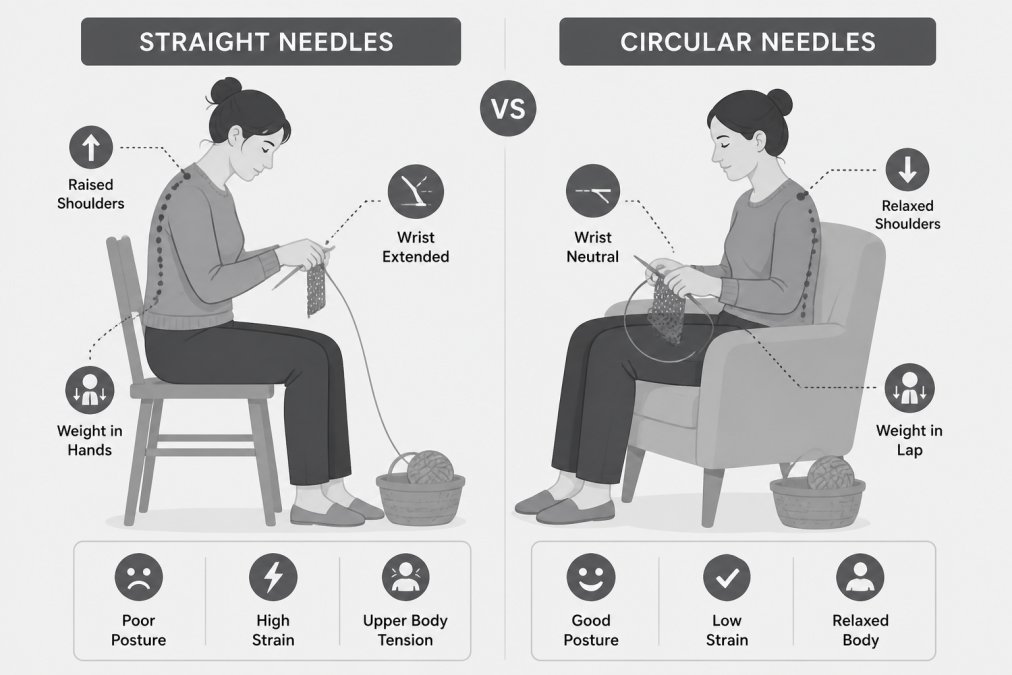
Diagram comparing posture when using circular needles vs straight needles to show reduced wrist strain.
Weight distribution and load on your wrists:
Straight needles require your hands and wrists to support the full weight of the needle and growing project. This weight concentrates in your hands and wrists as you move stitches from one needle to the other with each row, creating sustained tension in the forearm muscles and wrist joints.
Circular needles distribute the project's weight across your lap and thighs. Your hands hold only the active needle tips while the cable and stitches rest passively in your lap, reducing the load on your wrist joints by 80-90 percent compared to straight needles.
Over 40+ hours of knitting, circular needles' weight distribution translates directly to reduced fatigue and lower risk of repetitive strain injury.
Wrist angle and forearm positioning:
Straight needles often force an extended wrist position, especially as stitches accumulate.
Circular needles allow a neutral wrist position. The cable naturally guides the work toward your body, and your wrists remain in a relaxed, straight alignment. Your forearms can rest on the edge of a table or armrest, further reducing active muscle engagement.
Shoulder and neck strain:
With straight needles, as your project grows heavier, you may unconsciously raise your shoulders or lean forward to compensate for the weight in your hands. This postural shift creates secondary strain in your neck, shoulders, and upper back, strain that can persist long after you stop knitting.
Circular needles eliminate this compensation. Because the weight rests in your lap, your posture remains neutral. Your shoulders stay relaxed, and your neck maintains its natural alignment. Many knitters report that switching to circular needles for large projects resolves not just wrist fatigue but also neck and shoulder tension they didn't realize was connected to their needle choice.
Cable length and its effect on posture:
A cable that's too short forces your hands closer together, creating an awkward arm angle and increased shoulder tension. A cable that's too long allows stitches to spread too far, requiring you to reach or lean forward to access the working stitches.
Real-world impact for sweater knitters:
Needle tips and repetitive strain:
Key TakeawayFor sweater projects, circular needles measurably reduce wrist strain, enable neutral posture, and distribute weight away from your joints. The effect is most pronounced in projects over 200 stitches or 20+ hours of knitting. If you experience any wrist discomfort during knitting, circular needles should be your first choice.
Conclusion
Circular needles and straight needles each serve distinct purposes, but when comparing circular needles straight needles for most sweater projects, circular needles offer clear advantages: they handle large stitch counts, enable seamless construction, and reduce wrist strain during extended knitting. The right choice depends on your stitch count, construction preferences, and physical comfort during long sessions.
Frequently Asked Questions
Do you need circular needles for sweaters?
No, but they offer distinct advantages. Circular needles allow seamless construction and handle large stitch counts better than straight needles, reducing wrist strain on bigger projects. Straight needles work fine for seamed sweaters or smaller garments. Your choice depends on your pattern, yarn weight, and comfort preferences during knitting in the round versus flat knitting.
What size circular knitting needle should I use for a sweater?
Match your needle size to your yarn weight and pattern gauge. Most sweater patterns specify the required needle size. For yoke construction, you'll typically start with smaller needles and increase as your stitch count grows. Circular needle cord length matters too: choose 24-32 inches for typical adult sweaters to prevent bunching stitches or straining your wrists.
What needle material works best for wool sweaters?
Nickel-plated brass needles like Addi Turbo ($16.00) glide smoothly through wool without catching, maintaining consistent tension. Bamboo offers more grip if your stitches slip. For beginners, smooth metal needles help you see tension issues clearly and keep stitches secure. Avoid materials that feel sticky or cause hand fatigue during long knitting sessions on larger projects.
Can you knit a flat sweater on circular needles?
Yes. You knit flat sweater pieces back and forth on circular needles the same way you would on straight needles. The advantage is weight distribution across your lap instead of concentrated on your hands and wrists, reducing fatigue. The circular cord accommodates all your stitches without them sliding off, and you can set the project down easily between rows.



0 commentaire