
7 Ways Yarn Twist Changes Your Stitch Definition
Publicado el Oct 30, 2026
By Editorial Team
Ahorra un 15% en toda la tienda desde ahora hasta el 31 de diciembre de 2025

Last Updated: October 30, 2026
Quick Summary
Yarn twist is the number of turns applied to fibers as they are spun into a single strand, measured in turns per inch (TPI). More twist binds fibers tightly for sharp, crisp stitch definition, while less twist keeps yarn soft and lofty, so stitches can blur slightly. Choosing the right yarn twist for your pattern makes a real difference to the finished fabric.
Yarn twist is one of the quiet forces behind every crisp cable, every soft cowl, and every stitch that either sharpens or blurs on the needle. Choosing yarn by how it will actually behave in a finished piece makes a real difference to the result.
Yarn twist is the spiral that holds fibers together. Twist is the number of turns applied to fibers as they are spun into a single strand. More twist binds fibers tightly, while less twist lets them stay loose and soft.
Twist is introduced during spinning, when fibers are drafted, or pulled out and thinned, and then turned around one another. The direction and amount of those turns determine the final yarn's character.
Fibers are typically spun in one of two directions:
Twist is measured in turns per inch (TPI). A yarn with more TPI feels firmer and more compact. A yarn with fewer TPI feels airy and lofty.
Twist does more than hold a yarn together. It determines how the yarn resists pulling, snagging, and splitting.
Too little twist, though, leaves fibers loosely connected. The yarn can pill, fuzz, or pull apart during knitting. Too much twist can make a yarn stiff and harder to work with, especially for beginners.
Strength also depends on fiber length and quality. Twist works best when it matches the fiber it is holding.
Yarn sits on a spectrum, and each level suits different projects.
Regal 2-Ply DK 100% Wool Yarn is a looser-spun, 100% wool yarn with plenty of character. It is well suited to sweaters, colorwork, and weaving.

The article's three twist levels, and what each one does to stitch definition, can be compared at a glance:
| Twist level | Stitch definition | Best for |
|---|---|---|
| High twist | Sharp and crisp | Cables and textured patterns |
| Medium twist | Balanced | Everyday sweaters, hats, and mittens |
| Low twist | Softer, can blur slightly | Drapey shawls and cozy garments |
Direction matters most when plies are combined. Single-ply yarn is one twisted strand, while multi-ply yarn twists several strands together, usually in the opposite direction, to create balance. Balanced yarn resists kinking and twisting back on itself.
Regal 2-Ply DK 100% Wool Yarn →
For most knitters, S-twist and Z-twist yarns knit up almost identically. The effect becomes noticeable when you combine yarns or work with hand-spun fiber. Mixing directions can cause a yarn to spin back or curl. Check the ply structure on the label before you buy if you plan to combine strands.
Cables and textured stitches need yarn that holds its shape. Crisp definition comes from firm, well-balanced twist and a clear fiber structure.
Watch out: Very soft, low-twist yarn can make complex cables look muddy. Swatch first.


Splitty yarn is usually a twist and ply-structure problem, not a personal failing. When a yarn is loosely plied or poorly balanced, the needle or hook can slip between the plies instead of through the stitch. Splitting slows you down, distracts from the pattern, and leaves uneven stitches that show in the finished fabric.
If a yarn splits across multiple tool sizes, tensions, and stitch patterns, it is a structural mismatch for your project. That is not a defect; it is information. A firmer, more balanced ply often gives cleaner stitch definition and a smoother working experience, especially in cables and textured stitches.
A single swatch tells you whether you like a fabric. For weight comparisons across colorwork and texture, see the Wool Yarn Weights for Colorwork guide. A controlled swatch test tells you why. To compare yarns fairly, hold every variable constant except the yarn: same stitch pattern, same needle or hook size, same stitch count, same row count, and the same blocking method. Otherwise you are comparing your tension and tooling, not twist.
Compare the swatches side by side under the same light and look for four things:
A practical pattern many knitters use is to swatch two yarns of the same weight but different twist side by side in the same stitch pattern. The firmer, more balanced yarn usually produces sharper lines; the looser yarn usually produces a softer, blurrier surface. Neither is wrong. The swatch tells you which effect your pattern needs.
Twist is measured in turns per inch (TPI). You can estimate TPI by marking a 1-inch length of yarn, untwisting it until the fibers lie straight, and counting the turns. This is a rough field method, not a lab measurement, and it has real limits: a thick yarn and a thin yarn with the same TPI behave very differently, and a two-ply and a three-ply of the same TPI can feel nothing alike. Use TPI to compare yarns of similar thickness and construction, not as a universal score.
Do not attribute every stitch effect to twist alone. Fiber type, staple length, ply structure, and spinning method all interact with twist. A soft, short-staple fiber with high twist can still blur, while a longer, coarser fiber with moderate twist can stay crisp.
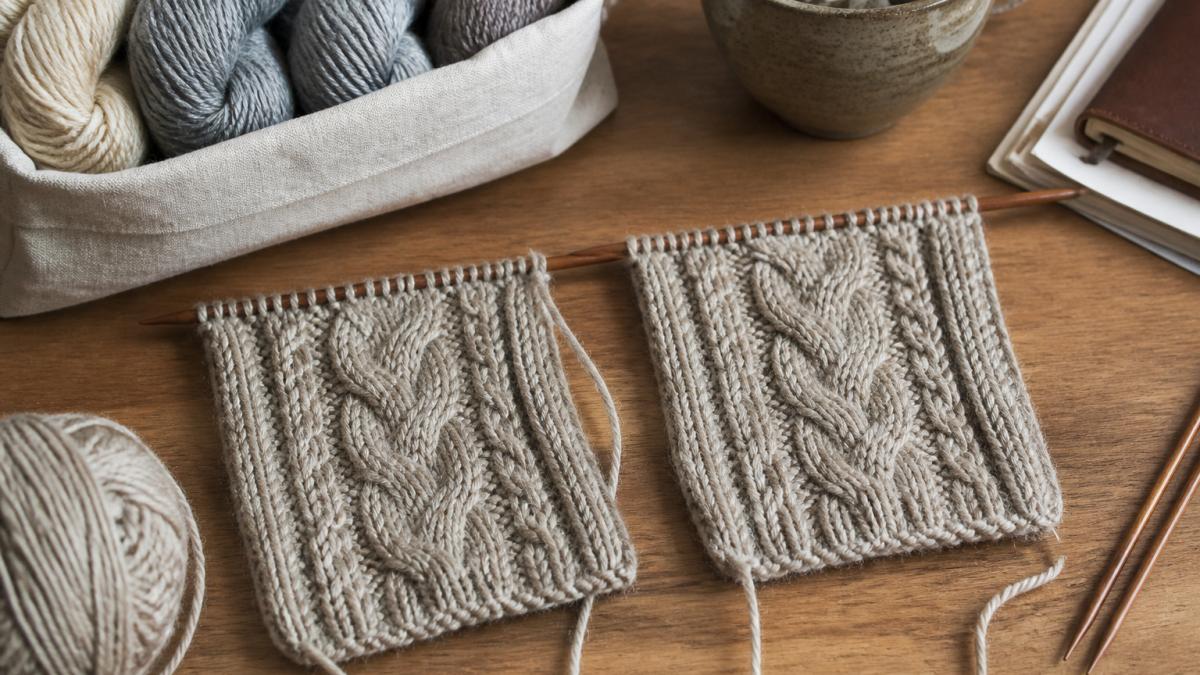
Yarn twist is the number of times fibers are spun around each other along the length of a yarn. Twist binds loose fibers into a single cohesive strand. More twist makes a yarn firmer and tighter, while less twist keeps it softer and fluffier. Twist is usually described as high, medium, or low, and it is set during spinning. Knowing a yarn's twist helps you predict how its stitches will look, how it will wear, and whether it will split as you work.
In many cases, yes. Tightly twisted yarn tends to produce crisp stitch definition because the plies and fibers sit close together and the surface stays smooth, so each stitch reads clearly. Cables and textured stitches especially benefit from firmer yarn. Loosely twisted yarn creates a softer, fuzzier fabric where stitch edges can blur. The right choice depends on your pattern, so swatching both options is the most reliable way to decide.
Yarn splits when the needle tip pushes between the plies instead of sliding past them. Loosely plied or very soft yarns are the most prone to this. Splitting is also more likely with slippery fibers or when the yarn is worked too tightly. To reduce splitting, try a pointed needle with a sharp tip, work with a slightly larger needle, and check that your yarn is plied tightly enough for your project.
Yarns with medium to high twist and a plied or worsted construction generally work best for cables and textured stitches, because they hold crisp edges and show the stitch structure clearly. Heritage 2-Ply Worsted is a dependable choice for classic textured projects, and Atlantic 3-ply Aran offers a warm, sturdy fabric for heavier pieces. Swatch a few options before committing to a full project.


0 comentarios