
Worsted vs. DK Yarn: Key Differences Explained
Publicado el Sep 23, 2026
By Editorial Team
Ahorra un 15% en toda la tienda desde ahora hasta el 31 de diciembre de 2025

Last Updated: September 22, 2026
Worsted and DK yarn represent two distinct weight categories in the standard yarn weight system, each suited to different projects and knitting styles. DK (double knitting) yarn is lighter and thinner, typically requiring smaller needles and producing finer fabric, while worsted weight yarn is thicker and heavier, worked on larger needles to create denser, warmer garments. Understanding the differences between worsted vs DK yarn helps knitters select the right material for sweaters, accessories, and colorwork projects that will drape properly and wear well.
At Brae & Heather, we recognize that choosing between these two weights often determines whether a project succeeds or sits abandoned in a drawer. The difference isn't just about thickness, it affects gauge, needle size, yardage requirements, drape, and how colors blend in colorwork. Below, we'll walk through exactly how these yarns differ and how to choose the right one for your next project.
DK yarn, short for double knitting, sits in the middle of the yarn weight spectrum. It's thinner than worsted but thicker than sport weight, making it versatile for garments that need moderate warmth without excessive bulk. DK yarn typically produces 20-24 stitches per 4 inches when worked on needles sized 3.5-4.5mm, creating fabric with good stitch definition and a balanced drape.
The term "double knitting" originally referred to a knitting technique, not the yarn weight itself, but it has become the standard name for this category. DK yarn works beautifully for colorwork projects because the finer stitches allow intricate patterns to show clearly without the yarn becoming unwieldy. Many knitters find DK ideal for sweaters worn in layered outfits, shawlettes, and accessories where a lighter fabric is desirable.
Brae & Heather's Regal 2-Ply DK 100% Wool Yarn exemplifies this category. Spun loosely to create a heavy DK weight, it produces 20 stitches over 4 inches on 4.5mm needles and comes in 272-yard skeins. The looser spin makes it excellent for both colorwork and weaving.

Worsted weight yarn is the standard workhorse of knitting. It's thicker and heavier than DK, designed to work up quickly into substantial garments. Worsted yarn typically produces 16-20 stitches per 4 inches on needles sized 5-6mm, creating dense fabric that provides real warmth and structure.
Brae & Heather offers two excellent worsted options. The Heritage 2-Ply Worsted 100% Wool Yarn produces 17 stitches per 4 inches on 5mm needles and comes in 215-yard skeins, perfect for sweaters, hats, mittens, and scarves. For those seeking authentic Shetland wool, the Jamieson & Smith Shetland Aran Worsted delivers traditional Shetland character with 19 stitches per 4 inches on 4mm needles, excelling at cables and colorwork.


The most obvious difference between worsted and DK yarn is physical thickness. Worsted yarn is noticeably bulkier, while DK yarn appears almost delicate by comparison. This thickness difference drives everything else: needle size, stitch count, finished fabric weight, and how garments feel when worn.
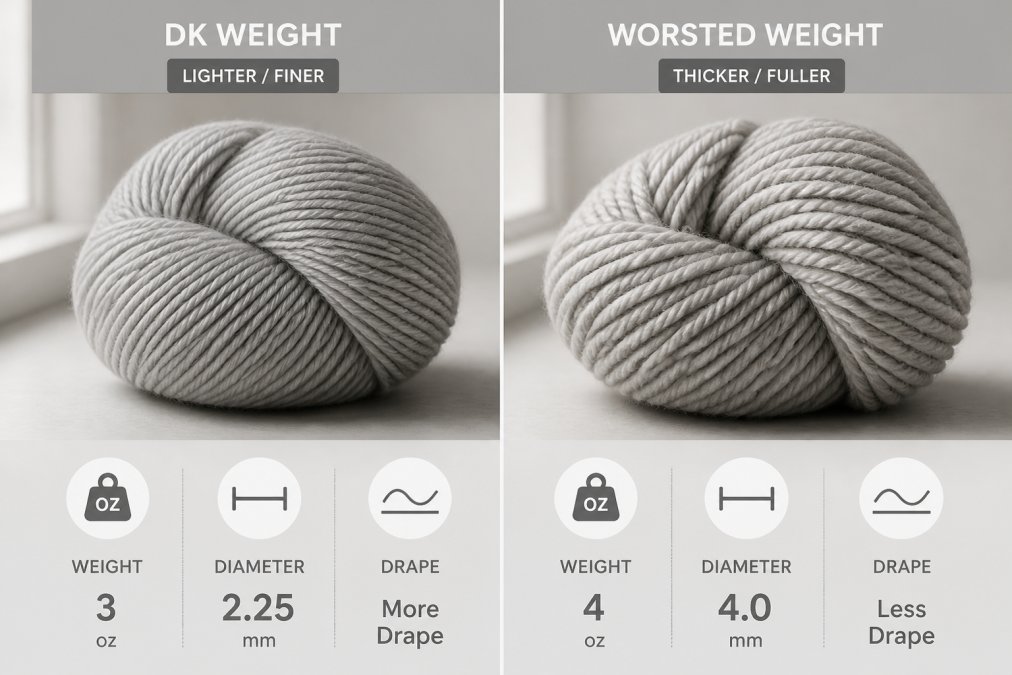
Drape refers to how fabric hangs and moves. DK yarn creates fabric with more fluid drape because the finer stitches and lighter weight allow garments to move gracefully. Worsted weight creates fabric with more structure and body, it drapes more stiffly and holds its shape. For fitted sweaters or garments meant to skim the body, DK's superior drape often produces more flattering results. For oversized silhouettes or garments meant to provide warmth and structure, worsted's stiffer drape works better.
Weight per yardage differs significantly between these categories.
Gauge is the number of stitches and rows per 4 inches of knitted fabric. It's the single most important factor determining whether your finished garment matches the pattern's intended size. Gauge directly correlates to yarn weight, heavier yarn produces fewer stitches per inch, lighter yarn produces more.
DK yarn typically produces 20-24 stitches per 4 inches (5-6 stitches per inch). Worsted weight typically produces 16-20 stitches per 4 inches (4-5 stitches per inch). This difference means a sweater pattern written for worsted will be significantly larger if knit in DK, the finer gauge creates more stitches across the same width, adding inches to the finished garment.
Understanding gauge is critical because it explains why you cannot simply swap yarns without adjusting patterns. If a pattern calls for worsted weight at 18 stitches per 4 inches and you substitute DK yarn at 22 stitches per 4 inches, your finished sweater will be smaller than intended unless you increase stitch counts accordingly. Many abandoned projects fail because knitters ignored gauge and ended up with garments that didn't fit.
To find your yarn's true gauge, knit a swatch at least 6 inches square using the needles you plan to use. Wash and block the swatch exactly as you would the finished garment, this matters because blocking changes gauge. Measure carefully across the middle of the swatch, counting stitches and rows over at least 4 inches. This real-world gauge is more reliable than the ball band because individual tension and needle preferences affect results.
Regal 2-Ply DK 100% Wool Yarn →
Wraps Per Inch (WPI) is an objective measurement system for determining yarn weight when ball band information is missing or unclear. WPI measures how many times a yarn wraps around a ruler or measuring tool in one inch. This measurement provides a quick way to compare yarn thickness across different brands and spinners.
To measure WPI, wrap your yarn snugly (but not tightly) around a ruler or measuring tape, starting at the zero mark. Count how many complete wraps fit within one inch. A DK yarn typically wraps 12-16 times per inch. Worsted weight typically wraps 8-12 times per inch. Sport weight wraps 16-20 times per inch. This simple measurement helps you identify mystery yarn or verify that a yarn matches its claimed weight category.
WPI correlates reasonably well with stitch gauge, though the relationship isn't perfectly linear.
Many knitters find WPI invaluable when shopping for yarn online or when working with vintage or hand-spun yarns without clear weight information. Measuring WPI takes only a few seconds and provides confidence that you're selecting the right weight for your project. For serious substitutions or when working with unfamiliar yarns, WPI measurement combined with actual swatch gauge testing ensures success.
Converting between yarn weights requires understanding the relationship between thickness, yardage, and stitch count. The chart below summarizes how DK and worsted compare across key metrics:
| Yarn Weight | Needle Size (mm) | Stitches per 4" | Wraps Per Inch | Typical Yardage per 100g |
|---|---|---|---|---|
| DK (Light Worsted) | 3.5-4.5 | 20-24 | 12-16 | 250-300 |
| Worsted (Aran) | 5-6 | 16-20 | 8-12 | 180-220 |
Substituting DK for worsted or vice versa requires more than just grabbing different yarn. You must recalculate yardage requirements because the weights differ significantly. If a pattern calls for 1,000 yards of worsted weight, you cannot simply use 1,000 yards of DK, you'll have too much yarn and end up with a larger garment.
To substitute correctly, calculate total weight needed rather than yardage. If a pattern requires 1,000 yards of worsted at approximately 190 yards per 100g, that's roughly 525 grams of yarn. To substitute DK yarn at approximately 275 yards per 100g, you'd need about 190 grams, or roughly 520 yards. This approach accounts for the weight difference and helps you purchase the right amount.
Fiber content affects substitution success too. When substituting between different fiber types, swatch generously and consider how the finished fabric will behave during wear and washing.
The right choice between worsted and DK depends on your project goals, desired drape, and intended wear. For sweaters meant to provide warmth and structure, cardigans, pullovers for layering, winter accessories, worsted weight excels. It works up quickly, creates substantial fabric, and produces garments that hold their shape. Brae & Heather's Heritage 2-Ply Worsted and Jamieson & Smith Shetland Aran Worsted deliver reliable performance for traditional sweater patterns and colorwork.
For projects requiring fluid drape and refined stitch definition, fitted sweaters, shawlettes, lightweight garments, DK yarn is superior.
Not directly without adjustments. DK yarn is thinner than worsted, so substituting it will change your gauge and final garment size. If you want to use DK instead of worsted, you'll need to adjust your needle size or add extra stitches to maintain the intended dimensions. Always swatch first to verify your gauge matches the pattern's requirements.
DK (double knitting) yarn is lighter and thinner than worsted weight. DK typically knits at 20-24 stitches per 4 inches on size 3-4mm needles, while worsted knits at 16-20 stitches per 4 inches on size 5-8mm needles. Worsted produces a denser, warmer fabric; DK creates a lighter drape and finer texture, making it ideal for colorwork and fitted garments.
Check the yarn label or ball band, which lists the weight category according to the Craft Yarn Council's standard yarn weight system. The label also shows recommended needle size, gauge (stitches per 4 inches), and yardage. If the label is missing, you can measure wraps per inch (WPI) by wrapping the yarn around a ruler without stretching, this gives you an objective measurement to identify the weight category.
Yes, significantly. At Brae & Heather, our Heritage 2-Ply Worsted and Regal 2-Ply DK are both 100% wool from small flocks, ensuring consistent quality and performance across weight categories while supporting sustainable sourcing.

0 comentarios