Scottish knitting is a living archive of motif, technique, and wool heritage, yet most guides treat it as museum history rather than craft you can practice today. This traditional scottish knitting patterns guide from Brae & Heather bridges that gap, pairing the stories behind Fair Isle and Sanquhar with concrete instruction you can take to the needles. The patterns that survived centuries did so because they were knit, worn, and passed down, and this guide aims to keep that chain unbroken.
Below, we'll walk through the two great Scottish colorwork traditions, the wool that makes them sing, and a step-by-step tutorial for the eight-pointed star, a motif that anchors both regional styles. You'll also find practical direction on yarn weight, stranded colorwork technique, and modern ways to wear these designs, plus guidance on sourcing authentic materials and caring for finished heirloom pieces.
Defining Scottish Knitting: Fair Isle, Sanquhar, and Beyond
Scottish knitting patterns divide into two principal colorwork traditions: Fair Isle from the Shetland archipelago and Sanquhar from the Dumfriesshire town of the same name. Fair Isle is stranded colorwork, worked in the round with two or more colors per row across repeating geometric bands. Sanquhar, by contrast, uses a distinctive two-color technique where the background and pattern alternate every two stitches, producing dense, intricate grids often set in diamond and cross motifs.
The deeper heritage spans more than colorwork. Shetland also produced fine lace knitting, while the Aran islands of the west contributed heavily cabled garments. Each regional style reflects local sheep breeds, available dyestuffs, and the practical needs of fishing and farming communities.
Fair Isle vs. Shetland Knitting: What Is the Difference?
Fair Isle knitting is a specific stranded colorwork technique, while Shetland knitting describes all knitting originating from the Shetland islands, including lace and textured patterns. The distinction matters for sourcing: genuine Fair Isle refers to garments knit in the stranded style on Fair Isle itself, whereas Shetland knitting encompasses the broader island tradition. Both rely on the same local wool, prized for its crimp, warmth, and durability.
Traditional Shetland Wool Characteristics and Why They Matter
Shetland wool comes from the native sheep of the islands, a breed with a fine undercoat and a longer, coarser outer coat. The undercoat, known as pirl, spins into a soft yarn suitable for garments worn next to the skin, while the outer coat, or tait, adds strength and weather resistance. This dual-coat structure gives Shetland yarn its hallmark combination of softness and resilience, qualities that made it ideal for hard-wearing fishermen's sweaters and delicate lace alike.
Fiber content drives every decision in heritage knitting. A true Shetland yarn, spun from 100 percent Shetland wool, blooms after blocking, fills in stranded colorwork evenly, and wears for decades. Yarns blended with other fibers change the hand, the drape, and the longevity of the finished piece, so knitters seeking authentic results should read labels carefully and prioritize single-breed wool.
Pro TipWhen substituting yarn for a heritage pattern, swatch in the round, not flat. Stranded colorwork produces a different gauge than stockinette knit flat, and the difference can shift a garment by a full size.
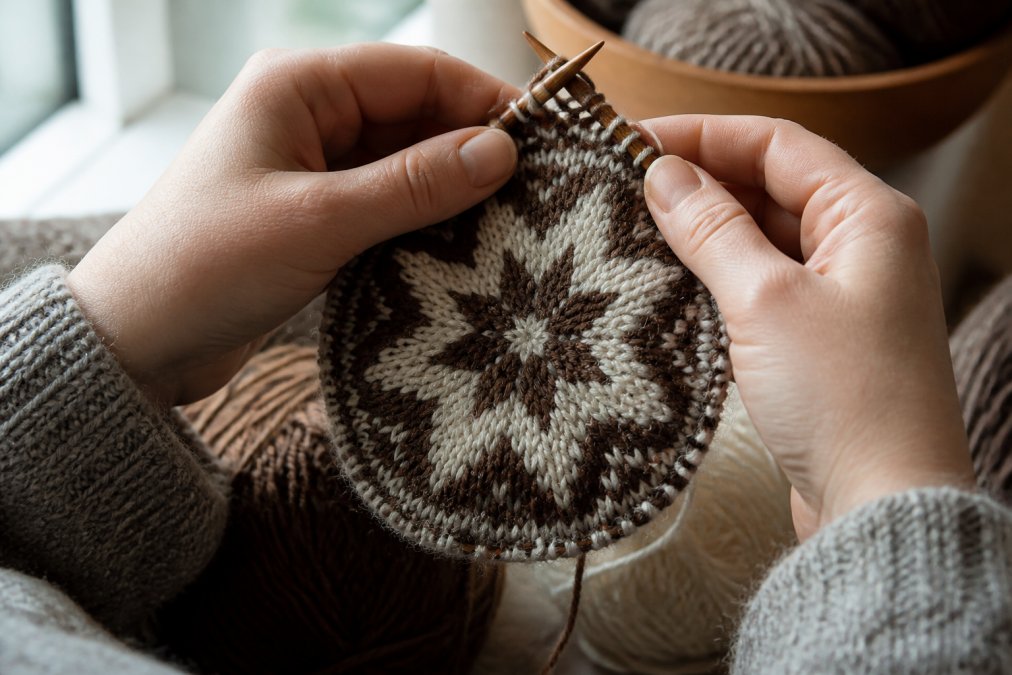
A Step-by-Step Scottish Knitting Pattern Tutorial: The Eight-Pointed Star
The eight-pointed star is a foundational motif in both Fair Isle and Sanquhar traditions, and mastering it unlocks countless traditional charts. This tutorial assumes basic stranded colorwork experience and uses two colors: a main background and a contrasting star.
Cast on a multiple of 8 stitches plus 1 for the join, then close the round carefully.
Knit one full round in the background color to establish the base.
Begin the chart: work the star points across 8-stitch repeats, carrying the unused yarn loosely across the back.
Complete the full star chart, typically 8 to 16 rounds depending on the pattern.
After the final chart round, knit one round in the background color before proceeding to the next section.
The star reads clearly when tension stays consistent. Practice the motif as a hat crown or a small pouch before committing to a full garment.
Close-up of a knitter's hands working a small circular project with an eight-pointed star motif in two colors of natural Shetland wool, soft window light, shallow depth of field
Charting Your First Traditional Motif
Reading a traditional chart requires understanding that each square represents one stitch and each row of squares one round. Fair Isle charts typically show only the pattern rounds, with plain rounds implied between them, while Sanquhar charts often include every round explicitly. Before casting on, trace the chart with a finger to confirm the motif repeats cleanly and that the edge stitches align with your garment's shaping.
What Is the Difference Between Worsted and DK Yarn for Heritage Projects?
Worsted weight yarn and DK yarn differ primarily in thickness, which directly affects gauge, drape, and the scale of your finished motif. DK yarn, sometimes called light worsted, knits to roughly 5.5 stitches per inch on US size 6 needles and suits finer Fair Isle garments, while worsted weight knits to about 4.5 to 5 stitches per inch on US size 7 or 8 needles and produces a denser, quicker-knitting fabric (craftyarncouncil.com).
For heritage colorwork, the choice shapes the result. Traditional Fair Isle garments from Shetland were often knit in a fine 2ply jumper weight, closer to fingering or sport, which allows intricate motifs to read crisply. Worsted weight suits bolder, larger-scale patterns and outerwear, while DK offers a middle ground for accessories and lighter garments. Always swatch in the pattern stitch to confirm the fabric meets the pattern's requirements before committing yarn to a project.
Jamieson & Smith 2ply Jumper Weight
Yarn Weight
Gauge (stitches per inch)
Typical Needle Size
Best For
Fingering / 2ply Jumper
7-8
US 1-3
Traditional Fair Isle, fine garments
DK / Light Worsted
5-5.5
US 6
Accessories, lighter sweaters
Worsted
4.5-5
US 7-8
Outerwear, bold motifs
Best Practices for Stranded Colorwork: Tension, Steeking, and Finishing
Stranded colorwork rewards consistent tension, clean floats, and confident finishing. The most common mistake is pulling the carried yarn too tightly, which puckers the fabric and distorts the motif. Knitters should spread the stitches on the right needle before each color change, allowing the float to lie flat across the back, and should check the reverse side regularly for overly long or tight strands.
Steeking, the technique of cutting a knitted tube open to create armholes or a cardigan front, opens up garment construction possibilities. Steeking requires a sturdy fabric, usually knit in the round with a reinforcing line of stitches, and a crochet hook or sewing machine to secure the edges before cutting. For knitters new to the technique, practice on a swatch first to build confidence with the cutting and finishing process.
Watch OutCutting into a finished knit is irreversible. If a steeked edge is not properly reinforced, the fabric can unravel completely. Practice the reinforcement and cutting sequence on a swatch before attempting a garment.
Modern Adaptations: Wearing Traditional Patterns Today
Traditional motifs adapt naturally to contemporary wardrobes when scaled, recolored, or repositioned. An eight-pointed star chart designed for a full yoke works equally well as a single band across a modern pullover, a repeating border on a hat, or a small accent on mittens. Reducing the color palette to two or three tones gives traditional patterns a more minimalist feel, while unexpected color combinations update the look without losing the heritage character.
Many knitters find that smaller projects offer the perfect entry point for exploring traditional scottish knitting patterns. Hats, cowls, and mittens require less yarn and time than a full sweater, allowing experimentation with new motifs and techniques. For those seeking guidance, Brae & Heather offers a curated collection of expertly designed patterns and premium Shetland wool to support these projects.
Caring for Heirloom Knits and Sourcing Authentic Materials
Heirloom knits deserve careful handling to preserve them for the next generation. Handwash wool garments in lukewarm water with a gentle wool wash, pressing water through the fabric rather than rubbing or wringing. Roll the garment in a towel to remove excess moisture, then reshape and dry flat away from direct heat and sunlight. Store folded in a breathable cotton bag with cedar or lavender to deter moths, and check periodically for signs of damage.
Sourcing authentic materials matters as much as technique. Genuine Shetland wool, spun on the islands from native sheep, carries a provenance that machine-spun blends cannot replicate. The Shetland Museum and Archives preserves historical garments and documents that inform modern reproductions, while Jamieson & Smith's Shetland wool archive offers yarns developed in consultation with those collections. Knitters seeking verified heritage yarns can find Jamieson & Smith Shetland Heritage Naturals at Brae & Heather.
Jamieson & Smith Shetland Heritage Naturals
Conclusion: Your Scottish Knitting Journey Begins
Traditional Scottish knitting rewards patience, precision, and a willingness to learn from the past. Whether you begin with a single eight-pointed star motif or commit to a full Fair Isle yoke, each round connects you to generations of makers who refined these techniques through daily practice. The patterns endure because they work, and they work because knitters kept knitting them.
Brae & Heather supports that tradition with expertly designed patterns, premium Shetland wool, and specialized textile tools. From the Douglas tartan stitch marker sets that keep your place to the heritage yarns that carry your stitches, the right materials make the difference between a project you finish and one you abandon. Begin with a small project, swatch carefully, and let the rhythm of stranded colorwork guide your needles.
Douglas Modern Tartan Stich Marker Set
Frequently Asked Questions
What are some traditional Scottish knitting patterns?
The most recognized traditional Scottish knitting patterns include Fair Isle and Sanquhar. Fair Isle is characterized by its stranded colorwork and repeating geometric bands, often featuring borders of small motifs like stars and crosses. Sanquhar knitting, from southwest Scotland, uses a different technique that creates intricate two-color patterns with a fine, dense fabric, commonly seen in gloves and traditional tam o'shanter hats. Both styles carry a rich history and distinct visual identity.
What is the difference between Fair Isle and Shetland knitting?
Fair Isle is a specific technique of stranded colorwork that originated on the island of Fair Isle, part of the Shetland archipelago. Shetland knitting is a broader term that encompasses various styles from the Shetland Isles, including Fair Isle, but also lace knitting and other traditional garment construction. While all Fair Isle is Shetland knitting, not all Shetland knitting is Fair Isle. The distinction lies in Fair Isle's specific use of multiple colors per row to create patterns.
How do I choose the right wool for traditional Scottish patterns?
For authentic traditional Scottish knitting patterns, choose a true Shetland wool. It is known for its fine, soft crimp and excellent warmth. For Fair Isle, a traditional 2ply Jumper Weight yarn, which is a fingering weight, is ideal for stranded colorwork, as it creates a light yet warm fabric. For Sanquhar patterns, a similar fine yarn is used. Always swatch to check your gauge and tension, as these heritage yarns can vary.
What are the defining characteristics of traditional Scottish knitting patterns?
Traditional Scottish knitting patterns are defined by their geographic origins and specific techniques. Fair Isle is known for its bands of stranded colorwork using multiple colors, typically with a limited palette, and geometric motifs like the eight-pointed star and peerie (small) patterns. Sanquhar patterns are notable for their complex, all-over two-color designs, often in black and white. Both are typically worked in the round with fine Shetland wool, creating dense, durable, and decorative fabric.
What is the oldest known knitting pattern?
Knitting patterns as we know them did not exist before the 19th century. Before that, knitting was passed down through oral tradition and by examining finished garments. The earliest published knitting instructions appeared in the early 1800s, with pattern books becoming more common in the mid-19th century. The oldest known examples of knitted items are from Egypt, dating back to the 11th century, but they were not created from written patterns.
How has the history of Scottish knitting influenced modern pattern design?
The history of Scottish knitting has shaped modern pattern design through its enduring motifs and techniques. Traditional Fair Isle patterns are frequently reimagined in modern garments, from sweaters to accessories. The principles of stranded colorwork are foundational in contemporary colorwork design. The emphasis on yarn provenance and heritage, with a focus on specific sheep breeds like the Shetland, has also influenced a modern return to natural fibers and authentic materials.
What is the best way to manage tension in stranded colorwork?
Managing tension in stranded colorwork is crucial for an even fabric. The key is to keep the floats, the strands of yarn carried across the back, loose enough to match the knit stitches. A common practice is to spread the stitches on the right needle before working the next color. Many knitters find success with a knitting thimble or ring to hold the yarns, which helps maintain consistent tension and speed. Practicing and swatching regularly will help you find a rhythm that produces even stitches.
Where can I find authentic Shetland wool yarn for my projects?
Authentic Shetland wool comes from the Shetland sheep breed, and the best source is often directly from mills in the Shetland Isles. Look for yarns spun by established producers like Jamieson & Smith, who are known for their traditional 2ply Jumper Weight and Heritage Naturals lines. When shopping online, check the yarn's fiber content to ensure it is 100% Shetland wool and read descriptions for details on its provenance and spinning method.




0 comentarios