Knitting patterns for beginners have never looked this good. The craft has moved beyond scratchy acrylic dishcloths into a world of clean lines, considered texture, and genuinely wearable results. This guide answers every new knitter who wants to start with something modern rather than merely manageable.
Below, you'll find 10 contemporary projects worth casting on, a practical guide to yarn and tools, and honest advice on the mistakes that derail most beginners before they finish their first project.
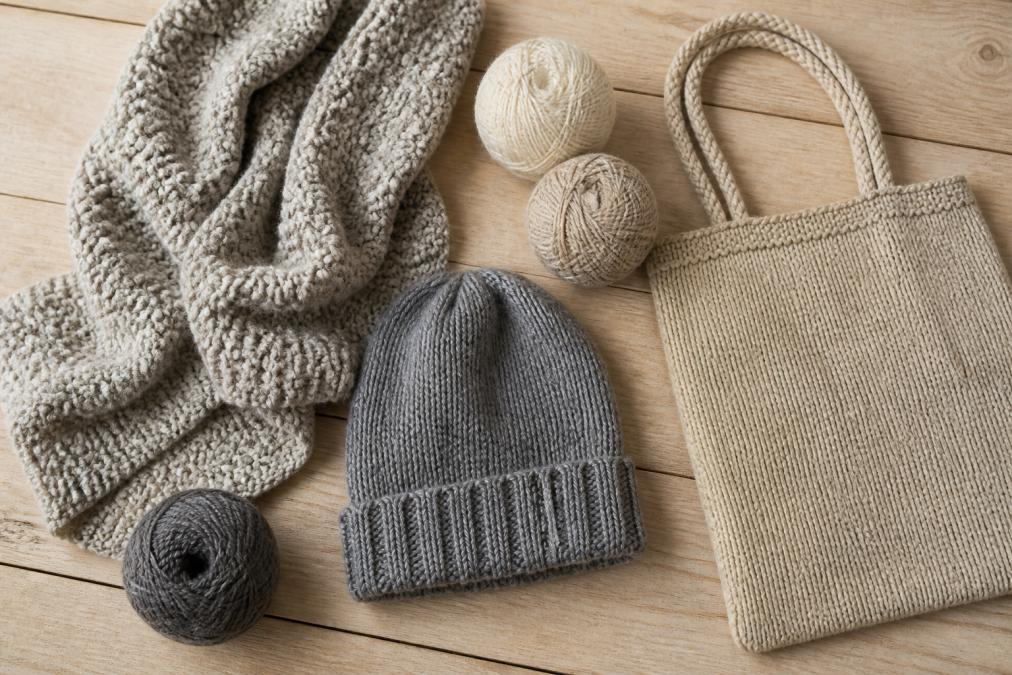
Flat lay of hand-knitted items including a chunky textured scarf, a ribbed grey beanie, and a simple rope-handled tote bag arranged on a light wooden surface with balls of neutral wool in cream, oatmeal, and slate
10 Modern Knitting Patterns for Beginners Worth Casting On
Modern knitting patterns for beginners are defined by forgiving construction and results that look intentional. The ten projects here are ordered by complexity, starting with the genuinely foolproof and building toward pieces that introduce new skills one at a time.
1. Garter Stitch Scarf
The garter stitch scarf is the single best first project in knitting. Every row is a knit stitch, no purl, no shaping, no seaming. The fabric lies flat naturally, so you cannot accidentally knit it inside out. Choose chunky wool in a single colour and you will have a finished scarf within a weekend. Garter stitch is deeply forgiving of uneven tension; the horizontal ridges absorb small inconsistencies in ways that stockinette stitch never would.
2. Chunky Ribbed Beanie
Ribbing alternates knit and purl stitches in regular sequence, most commonly two knit followed by two purl. The result is stretchy, structured fabric ideal for headwear. Work flat and seam it, or use circular needles to avoid a seam. Chunky wool makes the project fast; most knitters finish in three or four evenings.
3. Stockinette Cowl
Stockinette stitch is the classic smooth fabric on most commercial knitwear. Knit one row, purl the next. Worked in the round on circular needles, a cowl is all knit stitches, making this project deceptively simple. The key skill is circular knitting, which opens almost every garment pattern that follows.
Pro TipWhen knitting in the round, place a stitch marker at the beginning of each round so you always know where one round ends and the next begins. This habit prevents a surprising number of errors.
4. Simple Dishcloth or Facecloth
A small square worked in garter stitch or a combination of knit and purl. This is ideal for practising tension consistency because the finished object is small enough to complete quickly and inexpensive enough that imperfection carries no cost.
5. Garter Stitch Tote Bag
The tote bag is a garter stitch scarf with ambition. Cast on more stitches, knit a rectangle, fold it, seam the sides, and add handles. This teaches you how to read a pattern's assembly instructions and how to use a tapestry needle for seaming, skills you will use repeatedly on every project that follows.
6. Knit and Purl Cushion Cover
Combining knit and purl stitches in planned arrangements creates patterns: basketweave, seed stitch, moss stitch. A cushion cover is a flat rectangle with no shaping, but the stitch pattern gives you something that looks genuinely designed. Work two panels and seam them together.
7. Beginner Mittens
Mittens introduce simple shaping: increasing stitches to widen the thumb gusset, then decreasing to close the top. You are adding or removing one or two stitches every few rows, and the change in the fabric is immediately visible and satisfying.
8. Simple Drop-Shoulder Sweater
The drop-shoulder silhouette is the beginner's gateway to garment knitting. There is no armhole shaping and no set-in sleeve construction. You knit four rectangles (front, back, two sleeves), seam them together, and pick up stitches around the neck for a simple collar. Many modern patterns use this construction deliberately for its relaxed, contemporary drape.
Watch OutGauge swatching is non-negotiable on a sweater. Knit a 10cm square in your chosen yarn, measure it against the pattern's gauge specification, and adjust your needle size if it does not match. Skipping this step risks a finished piece that fits nobody.
9. Seed Stitch Headband
Seed stitch alternates knit and purl stitches on every row, offset so that knit stitches sit above purl stitches. The result is dense, textured fabric that holds its shape without curling. A headband is narrow enough to complete in an afternoon and wide enough to show off the stitch pattern properly.
10. Striped Flat-Knit Baby Blanket
Stripes are the simplest form of colour work: change yarn at the beginning of a new row, carry the unused colour up the side, and continue. A flat-knit baby blanket in two or three colours teaches colour management without the complexity of Fair Isle or intarsia.
Project
Key Technique
Difficulty
Best Yarn Weight
Garter Stitch Scarf
Knit stitch only
Absolute beginner
Chunky
Chunky Ribbed Beanie
Knit and purl
Beginner
Chunky
Stockinette Cowl
Circular knitting
Beginner
Aran
Dishcloth / Facecloth
Tension practice
Absolute beginner
DK
Garter Stitch Tote Bag
Seaming
Beginner
Chunky
Knit and Purl Cushion
Stitch patterns
Beginner-intermediate
Aran
Beginner Mittens
Simple shaping
Intermediate
DK or Aran
Drop-Shoulder Sweater
Garment assembly
Intermediate
Aran
Seed Stitch Headband
Stitch pattern
Beginner
DK
Striped Baby Blanket
Colour changes
Beginner
DK or Aran
Best Yarn for Beginner Knitters: Fibres and Weights Explained
Choosing the right yarn affects everything that follows. The wrong fibre makes tension harder to control; the wrong weight makes pattern instructions impossible to follow.
Understanding Yarn Weight
Yarn weight refers to the thickness of the strand and determines how quickly a project knits up and how the finished fabric feels. For beginners, three weights cover almost every project you will want to make.
DK (double knitting) is the workhorse of beginner patterns. It knits to a standard gauge, appears in the widest range of patterns, and produces fabric light enough for garments. Aran weight is slightly thicker, knits faster, and suits scarves, hats, and cushion covers particularly well. Chunky wool is the fastest and most forgiving of tension inconsistencies, ideal for very first projects.
Merino wool sits at the accessible end of the premium fibre spectrum. It is soft against the skin, blocks beautifully, and has natural elasticity that makes it forgiving to knit. A practical approach: start with an accessible Shetland wool for your first three or four projects, then invest in premium fibre for the first piece you genuinely want to keep.
Essential Knitting Tools for Beginners
Essential knitting tools for beginners are fewer than most people expect. You need very little to start.
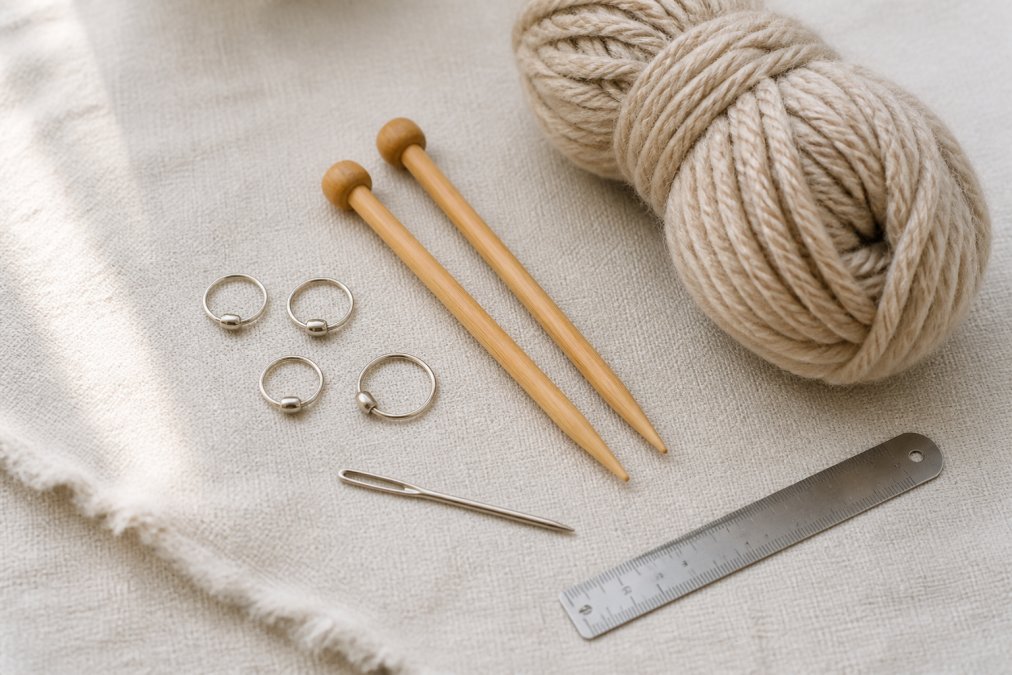
Overhead close-up of beginner knitting tools arranged neatly on a cream linen cloth: a pair of bamboo knitting needles, a tapestry needle, four metal stitch markers, a small metal ruler, and a skein of oatmeal-coloured chunky merino wool, soft natural light from the left
Knitting needles are the obvious starting point. Bamboo needles are the standard recommendation for beginners because the slight grip prevents stitches from sliding off accidentally. Start with a pair in 5mm or 6mm, which suits most chunky and aran weight patterns.
Stitch markers are small rings that slip onto the needle to mark a specific point in your knitting. They cost very little and prevent a large number of errors.
A tapestry needle is a blunt, large-eyed needle used to weave in yarn ends and seam pieces together. Every finished project requires one.
Scissors and a small ruler or tape measure complete the kit. The ruler matters specifically for gauge swatching: you need to measure accurately across 10 centimetres of fabric to confirm your tension matches the pattern.
Circular needles are worth adding once you move beyond flat knitting. They are two needle tips connected by a flexible cable, allowing you to knit in the round without seaming.
How to Read a Knitting Pattern Without Getting Lost
How to read a knitting pattern is the skill that unlocks every project you will ever make. Patterns use a compressed notation system that looks impenetrable at first and becomes second nature within a few projects.
Abbreviations, Repeats, and Gauge Swatches
Knitting patterns use standard abbreviations to keep instructions concise. The most common ones are:
k, knit
p, purl
yo, yarn over (creates a new stitch, used in lace and shaping)
sl, slip stitch (move a stitch from one needle to the other without working it)
k2tog, knit two stitches together (a decrease)
cast on / bind off, adding stitches at the start of a project and securing them at the end
Repeat sections are indicated by asterisks or brackets: *k2, p2; repeat from * to end means you alternate two knit and two purl stitches across the entire row.
The gauge swatch is the section most beginners skip and most experienced knitters never skip. A swatch is a small test square, typically 15cm, knitted in your chosen yarn before you start the actual project. You measure it to confirm that your tension matches the pattern's specification. A difference of even half a stitch per 10cm compounds across a sweater into a garment that fits nobody.
Key TakeawayReading a knitting pattern fluently takes three or four completed projects, not three or four hours. The abbreviations become familiar through repetition, not through study.
Troubleshooting Common Beginner Knitting Mistakes
Most beginner knitting problems trace back to a small number of root causes. Identifying them early prevents the frustration that leads to abandoned projects.
Stitches that are too tight to work. This almost always means you are tensioning the yarn too firmly in your non-dominant hand. Consciously loosen your grip and allow the yarn to flow more freely.
Accidental yarn overs. If your stitch count keeps increasing without any deliberate increases in the pattern, you are likely wrapping the yarn over the needle between stitches without realising it. The yarn must go between the needle tips, not over them.
Dropped stitches. A dropped stitch is a live loop that has fallen off the needle. Catch it immediately with a stitch marker or a safety pin. On a knit fabric, you can pick it back up with a crochet hook by drawing the horizontal strand of yarn through the loop from front to back.
Curling edges. Stockinette stitch curls naturally at the edges because the knit side has more tension than the purl side. Add a border of garter stitch or seed stitch at the edges to prevent curling, or block the finished piece firmly.
Uneven tension throughout a project. Tension changes as you knit longer, typically becoming more consistent. The beginning of a project often looks looser or tighter than the middle. This is normal and blocking evens out many tension inconsistencies in finished pieces.
Where to Find Modern Knitting Patterns for Beginners
The best place to find modern knitting patterns for beginners depends on what you prioritise: cost, design aesthetic, instructional depth, or the quality of the yarn the pattern is designed around.
Free pattern libraries offer a starting point. The Ravelry pattern database hosts an enormous archive of both free and paid patterns, searchable by skill level, yarn weight, and project type.
For patterns with consistent instructional quality and a contemporary design sensibility, curated collections from specialist retailers are worth the investment. Brae & Heather offers an unparalleled collection of expertly designed knitwear patterns, premium fiber, and Shetland wool for discerning knitting enthusiasts. Our curated selection includes everything from sophisticated accessories and textile tools to specialized books and yarn, all crafted to inspire your creative journey.
A practical checklist for evaluating any beginner pattern before you start:
Does the pattern include a full abbreviation key?
Is the gauge specification clearly stated with needle size?
Are the instructions written row by row, or chart-only?
Does the pattern include finished measurements?
Is there a notes section addressing common questions?
Is the pattern graded for multiple sizes (for garments)?
Patterns that pass all six checks are worth your time.
Starting out with the right patterns and materials makes the difference between a craft that sticks and a drawer full of abandoned projects. The ten projects in this guide build genuine skills in a logical sequence. When you are ready to invest in materials that match your growing ambitions, Brae & Heather offers a curated collection of premium Shetland wool, expertly designed patterns, and specialist textile tools selected for knitters who take their craft seriously. Visit the Brae & Heather collection and find the pattern worth casting on next.
Frequently Asked Questions
What are the best simple knitting projects for someone new to the craft?
Scarves and dishcloths are the classic starting points because they use only the garter stitch, knit every row, with no shaping required. Once you are comfortable with tension and binding off, a ribbed beanie or a seed stitch headband makes a satisfying next step. These projects are short enough to finish in a weekend, which builds the confidence to move on to modern knitting patterns for beginners that involve simple shaping or two-colour stripes.
Are there modern knitting patterns that use only basic stitches?
Yes. Many contemporary designs rely entirely on knit and purl combinations, garter stitch, stockinette stitch, and seed stitch, to create texture without complex techniques. Drop-shoulder sweaters, chunky cowls, and tote bags are popular examples. The modern aesthetic comes from clean lines, considered colour choices, and quality yarn rather than intricate stitch patterns, so a beginner can produce something genuinely stylish without needing to master cables or colourwork first.
How do I choose the right yarn for a beginner knitting pattern?
Match the yarn weight to the needle size stated in the pattern, then check the fibre content. Smooth, plied yarn in a chunky or aran weight is forgiving because it slides easily on needles and shows stitches clearly. Merino wool is a step up in quality and feel, with good stitch definition. Avoid fluffy or mohair-blend yarns at first, they make it very difficult to see individual stitches or to undo mistakes without the yarn felting together.
What essential tools do I need to start my first knitting project?
For most beginner patterns you need a pair of straight or circular knitting needles in the size specified by the pattern (commonly 5 mm-8 mm for chunky projects), a tapestry needle for weaving in ends, a small pair of scissors, and stitch markers to track pattern repeats. A tension gauge or ruler helps you check your swatch before starting a garment. Circular needles are worth buying early, they handle both flat knitting and circular knitting, so they grow with your skill level.
Where can I find modern, free knitting patterns in the UK?
Several sources offer free modern knitting patterns for beginners. Tin Can Knits' Simple Collection provides twelve progressive free patterns with full tutorials. Many yarn brands publish free patterns on their websites, organised by skill level and yarn weight. Dedicated knitting platforms offer a mix of free and paid downloads, often filterable by difficulty. For premium, expertly designed patterns with a heritage quality, Brae & Heather curates a collection that balances contemporary style with traditional craftsmanship.



0 comentarios