
Is Expensive Yarn Worth the Cost? A 2026 Guide
Publicado el Sep 10, 2026
By Editorial Team
Ahorra un 15% en toda la tienda desde ahora hasta el 31 de diciembre de 2025

Last Updated: September 11, 2026
Expensive yarn costs more because of what goes into it before it ever reaches a shelf: the fiber itself, how it was sourced, and how much human labor shaped it. Understanding those inputs is the only honest way to judge whether the price tag reflects value or marketing.
At Brae & Heather, this question comes up constantly from knitters holding two skeins that look nearly identical but carry very different prices. The gap almost never comes down to branding alone. It comes down to raw materials and hands.
Fiber content is the single largest cost driver. Wool from a specific breed raised in a specific place, shorn and sorted by hand, costs far more than generic fiber pooled from many sources. Finewool fleeces command higher prices because each animal produces less usable fiber, and the sorting required to isolate the best locks takes time.
Natural fibers also behave differently over years of wear. Wool resists pilling, holds its shape, and regulates temperature in ways synthetic fibers cannot match. That durability is part of what a higher price buys.
Hand-dyeing is slow, small-batch work. Each skein passes through a dyer's hands, often multiple times, and results vary slightly between dye lots, which is precisely what many knitters want. Mass-produced yarn runs through automated dye baths in enormous volumes, and the cost per skein drops accordingly.
Spinning method matters too. Worsted spinning, which combs fibers parallel before spinning, produces a smoother, stronger yarn than woolen spinning. That extra processing step shows up in the price.
The difference between worsted and DK yarn comes down to thickness and how the fiber was prepared, and both affect how far a skein stretches. Worsted weight is thicker, typically knitting at about 20 stitches per 4 inches on larger needles (craftyarncouncil.com). DK, or double knitting, sits slightly finer, usually around 22 stitches per 4 inches (craftyarncouncil.com).
Why does that matter for value? A thicker yarn covers more fabric per stitch, so a worsted sweater may use fewer yards than the same sweater in DK. Comparing price per skein without comparing yardage and gauge is how knitters accidentally overpay.
Worsted-spun yarns, regardless of weight category, also tend to show stitch definition more crisply. Cables pop. Colorwork reads cleanly. That visual payoff is part of what a well-made yarn delivers.
Natural fiber yarn outperforms synthetic alternatives in three areas that matter over a garment's lifetime: durability, drape, and stitch definition. Wool fibers bend and recover rather than flatten, so knitted fabric keeps its loft after repeated wear. That recovery is mechanical, not marketing: the crimp in wool fibers acts like a tiny spring, and the scales on the fiber surface help fibers grip each other so the fabric resists stretching out of shape.
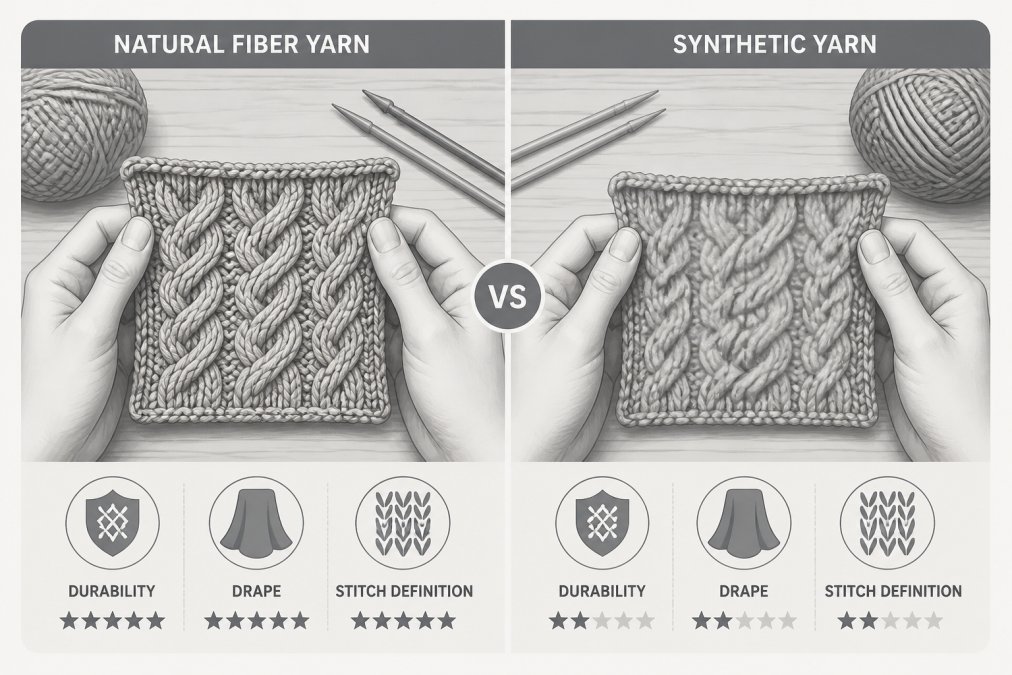
Drape is the quality most knitters notice only after the fact. A sweater knit in a stiff yarn hangs like cardboard. The same pattern in a well-spun natural wool moves with the body. Stitch definition follows the same logic: fibers with good twist and crimp hold the shape of every cable and colorwork motif instead of blurring into mush.
Ply and twist determine how a yarn ages. A 2-ply yarn, like the traditional Shetland jumper weight used for Fair Isle, is lighter and warmer but wears differently than a firmly twisted worsted. Loosely spun yarns pill faster because fibers escape the structure. Tighter twist resists abrasion but can feel firmer against the skin.

Gauge ties it together. Knitting at the recommended gauge with the right ply gives fabric the density it needs to survive years of wear. Swatching first is not optional if longevity matters.
Most yarn reviews stop at how a skein feels in the hand. You can go further with a simple comparison that takes a few weeks and costs nothing but swatches. Knit two 4-inch squares, one in the natural fiber you are considering, one in a synthetic or blend you already own, and treat them identically:
Firmly twisted natural wool often shows less pilling after repeated washes than loosely spun alternatives, and synthetic squares can develop a shine or fuzz that changes the fabric's appearance. This is not a laboratory test, but it is a real one, and it tells you more about longevity than squeezing a skein in a shop ever will.
A garment that survives five years of regular wear costs less per wearing than a cheaper garment that pills and loses shape in one season. That is the real durability argument for expensive natural fiber: not that it feels nicer on day one, but that it still looks intentional on day five hundred. When you evaluate a premium yarn, ask how many wears the finished piece will get, and whether the fiber's structure, ply, twist, crimp, is built to survive them.
Cost per skein tells you almost nothing. Cost per yard tells you what you are actually paying for fiber. A skein with generous yardage can cost less per yard than a cheaper skein that runs short, and the gap widens once you factor in how much yarn a project actually consumes.
Here is the calculation worth running before any purchase:
| Step | What to Do | Why It Matters |
|---|---|---|
| 1 | Divide skein price by yardage | Gives true cost per yard |
| 2 | Multiply by pattern yardage | Shows total project cost |
| 3 | Add 10-15% buffer | Covers gauge differences and swatching |
| 4 | Compare across candidates | Reveals which yarn is genuinely cheaper |
Run the numbers on a hypothetical: a skein priced at $6.99 with 272 yards costs roughly 2.6 cents per yard. A skein at $5.49 with only 180 yards costs about 3.1 cents per yard. The cheaper skein is the more expensive yarn. Multiply that difference across a sweater that needs 1,200 yards and the gap becomes real money, roughly $31 versus $37 before buffer, and the gap compounds once you buy extra skeins to cover short yardage.
Yarn chicken, the nerve-wracking game of knitting to the very last yard, is a symptom of buying too little yarn, and it has a real cost. Running short mid-project means ordering more, and a new dye lot rarely matches the original exactly. That replacement skein often costs more than the savings from buying the minimum, and the finished piece carries a visible color shift.
Cheap skeins encourage this trap because the low price per skein makes knitters buy the minimum. When the project stalls, the replacement skein costs more than the savings, and the finished piece carries a visible color shift. Buying enough yardage upfront, with a buffer, is the cheaper decision over the life of the project.
Expensive yarn changes the risk profile here. When a skein costs more, the temptation to buy exactly the pattern yardage is stronger, but the penalty for running short is also higher, because matching a premium dye lot is harder and the replacement cost stings more. The rational move is the same either way: buy the buffer, and treat the buffer as part of the project cost, not as waste.
Leftover yarn is not automatically waste. A partial skein from a premium natural fiber holds value: it can patch a worn elbow, extend a cuff, or become a colorwork accent in a future project. Leftover acrylic or heavily blended yarn is harder to repurpose and more likely to sit unused. When you compare cost per yard, compare what happens to the leftover yard, too. A yarn that leaves usable remnants is cheaper per wear than one that leaves nothing you want to knit with again.
Yarn chicken, the nerve-wracking game of knitting to the very last yard, is a symptom of buying too little yarn, and it has a real cost. Running short mid-project means ordering more, and a new dye lot rarely matches the original exactly.
Cheap skeins encourage this trap because the low price per skein makes knitters buy the minimum. When the project stalls, the replacement skein costs more than the savings, and the finished piece carries a visible color shift. Buying enough yardage upfront, with a buffer, is the cheaper decision over the life of the project.
Expensive yarn is worth the cost when the project will be worn often, washed repeatedly, and expected to last years. It is not worth the cost for a test swatch, a seasonal decoration, or a project where the yarn's qualities will never show.
The honest answer depends on three questions: How long will this piece be used? How much does stitch definition or drape matter here? Will the fiber's durability actually be tested?
Match the yarn to the job. A few guidelines:
Two factors rarely appear in yarn cost breakdowns, yet both shape whether a purchase was wise: giftability and environmental impact. A hand-knit gift made from durable natural fiber carries weight that a fast-fashion equivalent never will. It lasts, it can be repaired, and it does not end up in a landfill after one season.
Synthetic fibers are petroleum-derived and shed microplastics with every wash, which is a documented concern for waterways (the EPA). Natural wool biodegrades and, when sourced from well-managed flocks, supports grazing practices that maintain pastureland. Neither point makes every synthetic yarn a villain, but the environmental ledger is not neutral.
Choosing yarn is a budgeting decision disguised as a craft decision, and the knitters who get it right are the ones who calculate cost per yard, buy enough buffer, and match fiber to purpose. Brae & Heather carries a curated selection built for exactly that kind of thoughtful making, including expertly designed knitwear patterns and premium Shetland wool sourced for heritage projects. For example, our Shetland Heritage Naturals yarn, replicated from garments held in museum collections, is worsted-spun and ideal for colorwork and cables. Explore the collection at Brae & Heather and start your next project with fiber chosen to last.

Natural fibers with longer staple lengths and tighter twist resist pilling and abrasion far better than short-staple or synthetic alternatives. Wool from breeds like Shetland develops a natural halo over time while maintaining structural integrity. A well-crafted garment in quality wool can last decades with proper care, while cheaper yarns often pill, felt, or lose shape within a few seasons. The upfront cost of expensive yarn spreads across years of wear, often making it cheaper per wearing than budget options.
Worsted and DK refer to yarn weight, not spinning method, though the terms sometimes overlap confusingly. DK (double knitting) typically knits at 22 stitches per 4 inches on US 6 needles, while worsted knits at 20 stitches on US 7 to 8 needles. The difference between worsted and DK yarn matters for gauge, drape, and yardage calculations. A worsted-spun yarn (regardless of weight) has fibers combed parallel before spinning, giving sharper stitch definition and less halo than woolen-spun alternatives.
It can, depending on the project. A sweater knit in quality wool that lasts 15 years costs less per wearing than a fast-fashion equivalent replaced every two years. The benefits of natural fiber yarn include resistance to pilling, better elasticity recovery, and the ability to reblock and repair. However, expensive yarn only saves money if the finished piece gets worn regularly. For novelty projects or items worn once, the economics rarely justify the premium.
Ask three questions: Will this piece be worn or used frequently? Does the design rely on stitch definition, drape, or colorwork where yarn quality shows? Is the project a gift or heirloom intended to last? If you answer yes to two or more, premium yarn earns its cost. For learning new techniques, swatching, or quick accessories, a mid-range yarn works fine. Match the investment to the project's expected lifespan and visibility.
American Wool Council fiber sourcing guidance Textile Exchange materials benchmarking NOAA marine debris microplastics research

0 comentarios