
How to Choose Knitting Needles for Beginners
Publicado el Sep 21, 2026
By Editorial Team
Ahorra un 15% en toda la tienda desde ahora hasta el 31 de diciembre de 2025

Last Updated: September 21, 2026
Learning how to choose knitting needles for beginners starts with selecting a yarn project and locating its label, it contains recommended needle sizes, fiber content, and yardage. Also consider your preferences: Do your hands tire easily? Do you prefer needles that feel warm, or ones that let stitches glide quickly? These factors shape whether you'll enjoy knitting long-term.
This guide walks through how to choose knitting needles for beginners by examining material options, needle types, sizing systems, and comfort considerations that matter most when starting out.
Knitting needle sizes come in two measurement systems: US sizing and millimeter equivalents. US sizes range from 0 (smallest) to 50 (largest), while millimeter measurements run from 2mm to 25mm. For beginners, the most practical sizes fall between US 6-8 (4mm-5mm). These mid-range needles work well with medium-weight yarns, which are forgiving and less likely to show tension inconsistencies.
Needle size directly affects fabric density: larger needles create looser, airier fabric; smaller needles produce tighter, denser knit. The yarn label dictates which size produces the correct density for that specific yarn.
US sizing uses whole numbers and half-sizes (US 6, 6.5, 7, 7.5, 8). A US 6 needle equals 4mm; a US 8 equals 5mm. Most yarn labels show both systems, so beginners can match either way.
Bulky yarns pair with larger needles (US 10-15 / 6mm-10mm); lightweight yarns require smaller needles (US 1-3 / 2.25mm-3.25mm). Worsted-weight yarn, most common for beginners, typically calls for US 7-9 needles (4.5mm-5.5mm). The yarn label removes guesswork.
Gauge is the number of stitches and rows per inch of knitted fabric. It determines whether your finished sweater will fit or become a doll's dress, depending on yarn weight, needle size, and your personal tension.
If a pattern calls for "16 stitches = 4 inches on US 7 needles," your needle choice directly influences whether you'll hit that target. Tight knitters might need to go up a size; loose knitters might need to go down. For fitted garments, test gauge by knitting a small swatch before starting. For simple projects like scarves or dishcloths, gauge matters less.
The material of your needles shapes the entire knitting experience. Bamboo and metal represent the two most popular choices for beginners, each with distinct advantages and trade-offs.
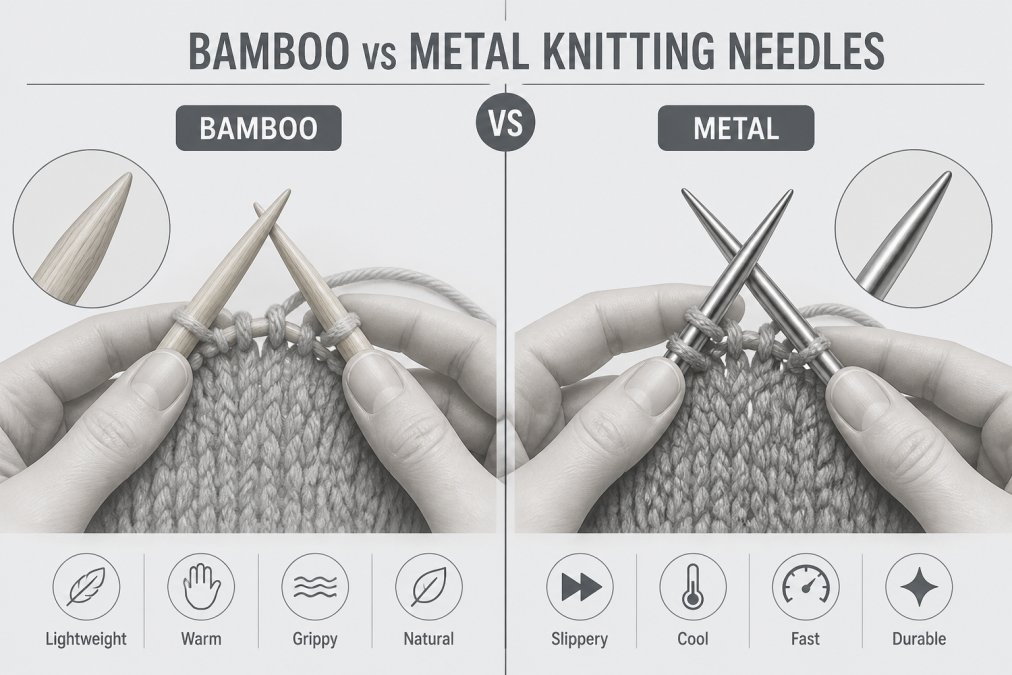
Bamboo needles feel warm in the hand and offer natural friction that grips yarn securely. This friction is especially helpful for beginners whose tension tends to be inconsistent. Stitches move more slowly on bamboo, giving new knitters time to notice mistakes before they compound. The slight grip prevents stitches from sliding off accidentally, a common frustration for beginners using slippery metal needles.
Bamboo needles are lighter and gentler on hands during extended sessions, making them ideal for people prone to hand fatigue or arthritis (Needlework With Hand Arthritis). The trade-off: bamboo needles wear over time and can develop splinters with heavy use.
Metal needles (typically nickel-plated brass or aluminum) create a smooth surface that lets stitches glide effortlessly and makes picking up dropped stitches easier. Metal needles last indefinitely without splintering or degrading.
The downside: metal's smoothness can frustrate beginners, as stitches slide off more easily if tension lapses. Metal also conducts temperature, feeling cold in winter, and can increase fatigue for those with arthritis or hand sensitivity.
For beginners, bamboo typically offers more forgiveness. The grip and warmth support learning. Once tension becomes consistent and speed becomes desirable, transitioning to metal needles makes sense. Many knitters keep both types on hand for different projects and moods.
Three needle styles dominate knitting: straight, circular, and double-pointed. Each serves different project types and knitting methods. Understanding when to use each prevents frustration and ensures projects fit your skill level.
Straight needles are the classic two-needle design for flat pieces like scarves, blankets, and sweater panels. They're the most intuitive for absolute beginners.
Straight needles come in various lengths (typically 10-14 inches). For a beginner's first scarf, 10-inch needles are usually sufficient. They're also the least expensive needle type.
The limitation: straight needles can't work small circumferences or circular projects without seaming, and large projects become unwieldy.
Circular needles consist of two needle tips connected by a flexible cable, allowing seamless in-the-round knitting for hats, socks, and sweaters. The cable distributes weight evenly, reducing hand and wrist fatigue.
Circular needles come in various cable lengths (16, 24, 32 inches, and longer). Shorter cables work for smaller circumferences; longer cables handle larger projects. They're beginner-friendly for projects designed to use them.
The learning curve involves managing the cable and remembering to join the round without twisting stitches. Once that clicks, many knitters prefer circular needles for their ergonomic advantages and project versatility.
Double-pointed needles (DPNs) are sets of four or five needles with points on both ends, used to create seamless small items like sock legs, hat crowns, and mittens. They're traditional but have a steep learning curve.
Managing five needles simultaneously intimidates many beginners, though DPNs are lightweight and portable. For absolute beginners, circular needles can handle most small-circumference projects.
The yarn label is your roadmap to successful knitting. It contains recommended needle sizes, yarn weight, fiber content, yardage, and care instructions. Understanding each element prevents costly mistakes.
Yarn weight uses categories: fingering, sport, DK, worsted, bulky, and super bulky. Worsted weight is most common for beginners. Recommended needle size shows the range the manufacturer tested (e.g., "US 7-9" or "4.5mm-5.5mm"), accounting for personal tension variations.
Fiber content lists what the yarn is made from. Look for all-natural fibers like wool, cotton, silk, or linen. These breathe, age beautifully, and feel luxurious.
Knitting should feel good in your hands. Pain or fatigue signals that something, needle material, size, or technique, isn't working. Addressing comfort early prevents injury and keeps knitting enjoyable long-term.
Selecting needles becomes straightforward once you follow a simple process. This framework removes decision paralysis and ensures your first project succeeds.
Choose a worsted-weight yarn in a solid color (variegated yarns hide tension inconsistencies, but solids teach you to see your stitch work clearly). Read the label completely. Note the recommended needle size, yardage, and fiber content. Write down the needle size recommendation.
Decide what you're making. A scarf or blanket? Use straight needles. A hat or pair of socks? Use circular needles or DPNs. A sweater? Circular needles work best. Match the needle type to your project, not the other way around.
If possible, hold the needles before buying. Do they feel warm or cold? Do stitches slide easily or grip the needle? Do your hands tire quickly? Buy needles in the recommended size from the yarn label, then test them with your yarn. Knit a small swatch (4 inches square) and assess comfort. If your hands hurt, try the next size up or switch materials.
| Decision Point | Straight Needles | Circular Needles | DPNs |
|---|---|---|---|
| Best for beginners? | Yes, intuitive motion | Yes, ergonomic | No, steep learning curve |
| Flat projects (scarves, blankets) | Excellent | Good (if working flat) | Not suitable |
| In-the-round projects (hats, sweaters) | Requires seaming | Excellent | Excellent for small items |
| Hand fatigue risk | Moderate to high | Low | Moderate |
| Cost | Low | Moderate | Moderate |
| Portability | Good | Excellent | Excellent |
New knitters often make predictable errors when selecting needles. Awareness prevents frustration and wasted yarn.
US 6 to US 8 needles (4mm to 5mm) are ideal for beginners. These mid-range sizes work well with worsted-weight yarn, which is forgiving and easy to handle. Start with straight or circular needles in these sizes for your first projects. Check your yarn label for the recommended needle size, this is your primary guide. As you gain confidence, you'll learn to adjust based on your personal stitch tension.
Bamboo needles are generally better for beginners. They provide natural friction that prevents stitches from slipping off, offer warmth in your hands, and are gentler on wrists during long sessions. Metal needles are faster and more durable but require more stitch control. If you experience hand fatigue or find stitches sliding off easily, bamboo's grip and ergonomic warmth make learning more comfortable. Metal becomes preferable once you've developed consistent tension.
No. Start with one pair of needles that matches your first yarn project. Most beginners choose either straight or circular needles in US 6-8 (4mm-5mm) based on their pattern. The Addi Turbo needles or a basic bamboo pair will serve you well for multiple early projects. As you try different yarn weights and project types, you'll gradually build your collection. An interchangeable system like addiClick is an option later when you know your preferences.
Check your yarn label, it always lists the recommended needle size in both US and millimeter measurements. Yarn weights range from lace (requiring tiny needles) to super bulky (requiring large needles). Worsted-weight yarn, ideal for beginners, typically calls for US 7-9 needles. The label also shows gauge (stitches per inch), which tells you how tight or loose your fabric will be. Always prioritize the yarn label's recommendation over general rules.

0 comentarios