
Advanced Colorwork Knitting Technique Guide 2026
Publicado el Sep 18, 2026
By Editorial Team
Ahorra un 15% en toda la tienda desde ahora hasta el 31 de diciembre de 2025

Last Updated: September 18, 2026
Colorwork knitting is the practice of working two or more colors into a single fabric, most often through stranded techniques where unused yarn travels behind the work. This guide from Brae & Heather examines the techniques that separate competent colorwork from genuinely refined colorwork: tension control, color dominance, steeking, and the tools that make complex motifs manageable.
Tension is the single most common failure point in stranded knitting. Uneven floats create puckering, and puckering ruins the geometry of a motif regardless of how well the chart was followed.
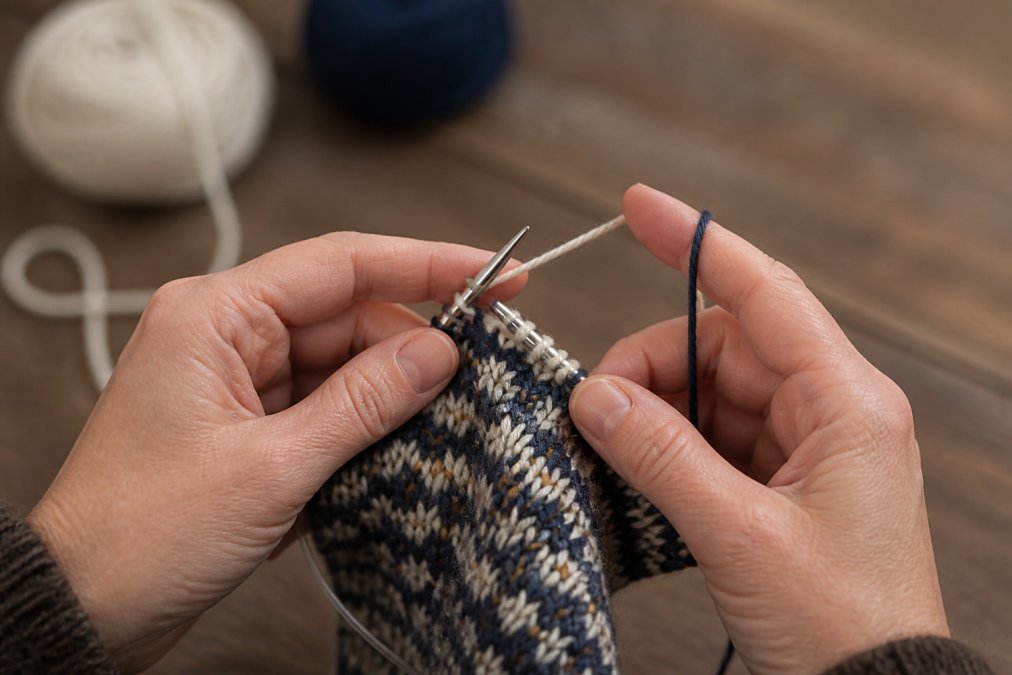
Holding one color in each hand, English style in the right and continental in the left, is the method most experienced colorwork knitters settle on. It keeps the two strands physically separated, which reduces tangling and makes color dominance easier to control. Knitters who prefer one-handed work can carry both strands over the same finger, but the strands must be kept in a consistent order or the dominant color will shift mid-project.
Puckering almost always traces to floats that are too tight. Blocking can relax minor cases, but prevention is faster. Try working the project on one needle size larger than the gauge swatch suggests, then switching to the correct size for plain stockinette sections.
Steeking is the technique of knitting a garment in the round and then cutting it open to create cardigans, armholes, or necklines. The cut is safe because extra stitches, called a steek, are worked at the intended opening and then secured before the scissors come out.
Three reinforcement methods dominate: machine-sewn lines on either side of the cut, crocheted chains worked through the steek columns, or a hand-sewn backstitch. Machine sewing is fastest for wool that felts readily. Crochet reinforcement suits knitters without a sewing machine and adds a firm edge that holds up well. After cutting, the raw edges are folded back and finished with a woven or knitted band.
Yarn choice determines how a colorwork motif reads. Wool with good stitch definition and a slight halo is the traditional choice because it holds the crisp edges that make Fair Isle and stranded patterns legible. But "good wool" is not a single property, it is the sum of crimp, staple length, spin, and halo, and each of those interacts differently with floats.
Crimp is the natural wave in a wool fiber. High-crimp wools, such as Shetland and other heritage breeds, trap air and produce a springy fabric that pushes floats back into the fabric rather than letting them sit proud on the wrong side. Low-crimp wools lie flatter and can let long floats show through to the front on the next row.
Yarn weight should match the motif scale. Fine two-ply suits intricate patterns with small repeats, where each stitch is a single pixel of the design. Sport and DK weights suit bolder geometric designs where each stitch carries more visual weight and a small repeat would look cramped.
| Project Type | Recommended Weight | Typical Needle | Best For |
|---|---|---|---|
| Mittens and gloves | 2-ply / lace | 2.0-2.5 mm DPNs | Intricate repeats, Latvian braids |
| Socks | Fingering | 2.25-2.75 mm | Small motifs, animal designs |
| Hats and cowls | Sport / DK | 3.0-4.0 mm circular | Bold geometric patterns |
| Cardigans | DK / worsted | 4.0-5.0 mm circular | Steeked openings, larger motifs |
The palette is where most colorwork projects succeed or fail, and the failure mode is almost always value, not hue. A palette of six colors that all sit at the same value will produce a muddy fabric no matter how beautiful the skeins look side by side.
A practical method:
Color dominance describes the tendency of one yarn to sit visually in front of the other in stranded fabric. The strand held lower and to the left typically reads as dominant, which means the same chart can produce two different-looking fabrics depending on how the yarns are carried.
A knitting chart is a grid where each square represents one stitch and each row represents one round or row of knitting, read from the bottom up. Flat knitting charts alternate reading direction; circular charts are read right to left on every row. That much is standard. What separates advanced chart work from intermediate chart work is knowing how to read a chart as a design document, and how to use digital tools to modify it without redrawing by hand.
A chart encodes more than stitch placement. It encodes rhythm. When you read a chart, look for the repeat unit first, then the offset between rows, then the symmetry (or deliberate asymmetry) of the motif. Most traditional colorwork motifs are built on a small repeat that tiles across the row and stacks vertically with a half-drop or full-drop offset.
The Big Book of Latvian Mittens: 100 →
Two common traps:
Most guides stop at "use software." The useful question is what the software lets you do that graph paper does not. Chart-editing tools allow you to recolor a motif instantly, test a palette against a photograph of your actual yarn, adjust the repeat count, and grade the motif across sizes, all without redrawing.
The workflow that most designers settle into:
Adapting a chart is a legitimate design skill, not a shortcut. The most common adaptations are changing the repeat count to fit a different gauge, swapping the palette while preserving value structure, and converting a flat chart to a circular chart (or the reverse). Each of these changes the way the motif reads, so each should be tested in a swatch before it is committed to a garment.
Colorwork sessions run long. A single mitten cuff can take several hours, and stranded knitting requires more hand and wrist movement than plain stockinette. Wrist and thumb strain builds quietly and then interrupts a project for weeks.
Practical adjustments that help:
The gap between intermediate and advanced colorwork is rarely about knowing more stitches. It is about tension control, deliberate color choices, and the confidence to cut a steek without hesitation. Each of those skills improves with focused practice on small projects before it is applied to a full garment.
Steeking is often cited as the most challenging advanced colorwork knitting technique because it requires cutting through your knitted fabric. The key is to reinforce the steek area with either a crochet chain or sewing machine stitches before cutting. Practice on a small swatch first, and use a wool yarn that grips well, such as Shetland wool, to prevent unraveling. With proper preparation, steeking opens up efficient ways to knit cardigans and armholes in the round.
Consistent tension in stranded colorwork comes from managing your floats and yarn carry. Keep floats no longer than five stitches, and spread your stitches on the right needle before knitting the next color. Try two-handed knitting: hold one color in each hand to control yarn feed. Swatch in the round to check gauge, and adjust needle size if needed. Regular blocking also helps even out minor tension inconsistencies.
Intarsia uses separate yarn bobbins for each color block, with no floats carried across the back, making it ideal for large single motifs. Stranded colorwork carries two or more yarns across the row, creating floats behind the fabric, which is better for repeating patterns and small motifs. Intarsia prevents bulk in large color areas, while stranded knitting is faster for allover designs. Many advanced projects combine both techniques.
Fiber choice affects stitch definition, warmth, and durability in advanced colorwork. Wool, especially Shetland wool, is ideal because its natural crimp helps floats grip and prevents puckering. All-natural fibers like wool and alpaca block beautifully, blending stitches. For heirloom pieces, choose a smooth, worsted-spun wool that shows colorwork clearly and wears well over time.
For managing multiple colors, use circular needles in the right size for your gauge, and double-pointed needles for small circumferences like mittens. Yarn bobbins or clothespins keep intarsia colors organized. A knitting chart holder or digital tablet stands keep your place. For stranded work, a yarn guide ring can separate colors. Always swatch with your chosen tools to ensure comfort and consistent tension.
The knitter's curse refers to the phenomenon where a knitter's gauge changes over time, often loosening or tightening, which can alter the fit of a project. It's especially problematic in advanced colorwork where consistent tension is crucial. To avoid it, swatch regularly, check gauge throughout your project, and block your swatch as you would the finished piece. Using the same needles and yarn throughout also helps maintain consistency.

0 comentarios