
7 Essential Knitting Tools for Advanced Projects
Publicado el Oct 10, 2026
By Editorial Team
Ahorra un 15% en toda la tienda desde ahora hasta el 31 de diciembre de 2025

Last Updated: October 10, 2026
Advanced knitting projects like cables, colorwork, and lace require precision that basic needles and yarn cannot deliver alone. The 7 essential knitting tools for advanced projects are engineered for control, accuracy, and the specific demands of complex stitch patterns.
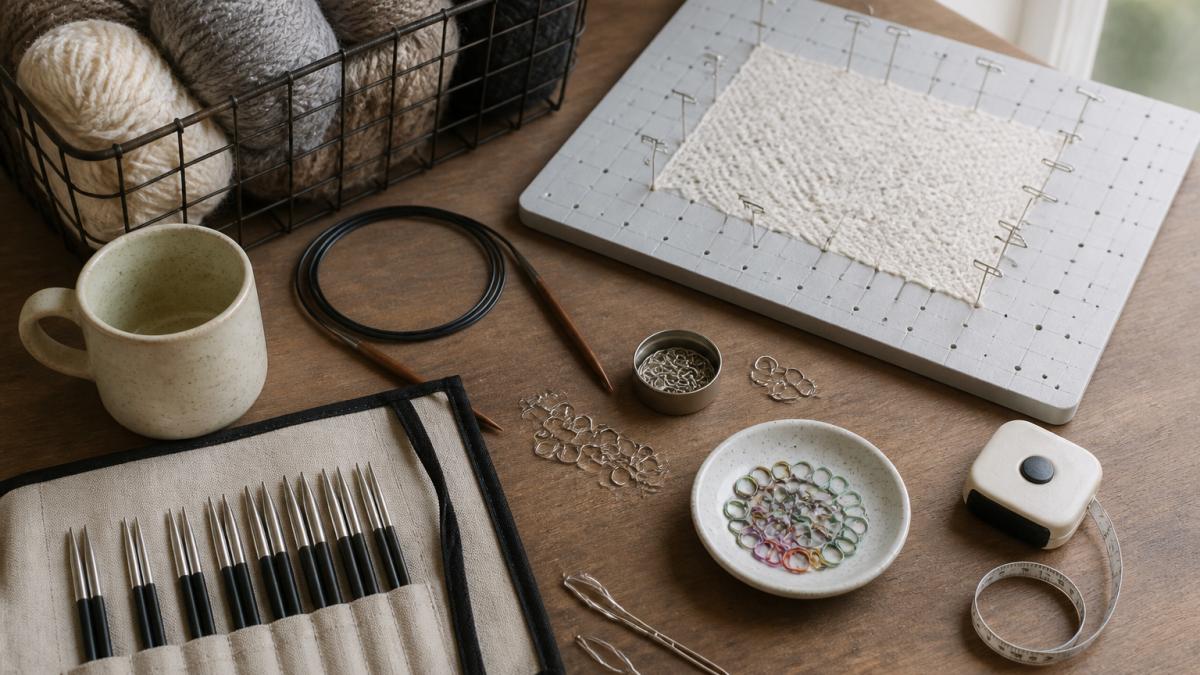
Advanced knitters know that interchangeable circular needles, specialized stitch markers, and precision measurement tools directly impact the quality of the finished piece.
Brae & Heather curates professional-grade knitting tools designed for advanced techniques. Below, we break down each essential tool and why it matters for your most ambitious projects.
Interchangeable circular needles let you swap tips and cords to create the exact needle length and size your project requires, without buying dozens of individual needles.
For seamless sweaters, shawls, and colorwork, you can change tips mid-project rather than switching to entirely different needles.
The addi Turbo system represents the gold standard for interchangeable needles. Made in Germany with nickel-plated brass tips, flexible blue cords, and smooth joins, the Addi Turbo Knitting Needles deliver the smooth, seamless knitting experience that advanced projects demand.

Brae & Heather stocks the complete addiClick system, the modern evolution of interchangeable needles. The addiClick Tips come in multiple styles (Turbo, Bamboo, Olive Wood, and Rocket) and tip lengths, giving advanced knitters complete control over their needle setup. Pair them with addiClick Cords to build needles in any length you need. Standard tips add 10 inches to finished length; short tips add 7 inches, letting you fine-tune for projects that demand precision.
Small-circumference knitting, socks, mittens, sleeves, and hat crowns, requires needles that give you control without constant needle changes.
The Aluminum Double Points from Brae & Heather are lightweight with pointed tips at both ends for continuous, controlled knitting.
The Addi FlexiFlips combine the control of double points with a flexible connection that reduces needle changes each round. Each set includes three 8-inch needles with a sharper Rocket point on one end and a smoother Turbo point on the other, ideal for socks, mittens, sleeves, and hats.

The Addi FlipStix measure approximately 6 inches with the same dual-point design, ideal for tight gauge work or smaller hands.
Stitch markers mark your place so you never lose track of pattern repeats, increases, decreases, or section boundaries. For advanced knitting with colorwork, cables, or lace, a dropped marker means hours of ripping back.
The Douglas Modern Tartan Stitch Marker Set from Brae & Heather includes ring markers and clasp markers in sizes ranging from 10mm to 14mm. Ring markers slide onto your needles to mark pattern repeats; clasp markers hook onto your working yarn to mark row changes or stitch counts.

| Marker Type | Best For | Placement |
|---|---|---|
| Ring markers | Pattern repeats, stitch counts | Slide onto needle |
| Clasp markers | Row tracking, yarn changes | Hook onto working yarn |
Colorwork techniques like Fair Isle, stranded knitting, and intarsia require managing multiple yarn colors simultaneously. The right tools keep your yarns organized, prevent tangling, and let you focus on the pattern.
A yarn swift holds skeins as you wind them into balls. A yarn ball winder creates consistent, center-pull balls that feed smoothly as you knit, preventing tangles.
For colorwork, a center-pull ball winder is essential. When working with multiple colors across a single row, each color must feed smoothly without snagging or creating tension spikes.
Most advanced colorwork knitters wind balls in the 50-100 gram range, a compromise between portability and the number of wind-ups required during a project.
Bobbins are small holders that keep each color separate and prevent tangling when carrying multiple colors across your work. They hold shorter lengths of yarn, reducing bulk and weight.
Flat bobbins are thin and lightweight; disc bobbins are round and hold more yarn. For advanced colorwork with many color changes, disc bobbins are preferred because they hold more yarn and are less likely to slip.
Bobbin tension directly affects your fabric. Wind bobbins to consistent tension, roughly matching the weight of your working yarn, to prevent visible irregularities.
For intarsia work, each color block gets its own bobbin, wound with enough yarn to complete that section.
Tension consistency is essential in colorwork. Each color must maintain even tension throughout the project to prevent visible color blocks.
Many advanced knitters use a swift for skein-to-ball conversion, a ball winder for consistency, and bobbins for knitting. This workflow ensures even tension throughout.
Some knitters separate bobbins by hand or use a yarn organizer to keep bobbins separated and prevent tangling.
A yarn guide or tension ring controls how much yarn flows from each bobbin, useful for knitters who struggle with consistent tension.
A simple two-color Fair Isle pattern might only need two balls of yarn. A complex intarsia sweater demands full bobbin organization. A stranded shawl benefits from bobbins but might not require a full yarn organizer.
Start with the simplest approach that keeps your yarns organized, then add tools as your project demands them.
Cable knitting demands precision. A cable needle temporarily holds stitches while you work other stitches. The right cable needle, used with consistent tension, is the difference between clean, professional-looking cables and loose ones.
Cable needles come in various materials: bamboo offers grip without snagging; metal works well with sturdy wools; plastic is economical but may slip with slippery yarns.
Use a cable needle one to two sizes smaller than your working needles. This prevents held stitches from stretching and keeps the cable needle from dominating the visual weight.
Straight cable needles work well for most cables. Curved or hook-style cable needles prevent stitches from sliding off, useful for slippery yarns.
Most cable needles are 4-6 inches long. Shorter needles work well for small cable crosses; longer needles accommodate larger crosses. Keep multiple lengths on hand.
The key to clean cables is tension consistency. When you slip stitches onto your cable needle, the tension of those held stitches should match your working tension.
When you slip stitches onto a cable needle, they relax slightly. As you work the next stitches, the cable needle stitches are loose. When you knit the held stitches, they tighten up, creating uneven tension and a visible ridge.
To maintain even tension, gently pull the working yarn after slipping stitches onto the cable needle. Maintain the same tension throughout, knitting held stitches at the same tension, not tighter.
For complex cable patterns with multiple crossings, some knitters use stitch holders instead of cable needles.
Another alternative is spare yarn, though this method is slower and more error-prone than a cable needle.
For very large cables (8+ stitches), some advanced knitters use a short circular needle as a cable needle.
A simple two-stitch cable cross works fine with a traditional straight cable needle. A complex pattern with multiple crosses benefits from having multiple cable needles on hand.
Examine the cable pattern and note the size of each cable cross. If cables range from 2 to 8 stitches, keep two cable needles on hand: a shorter one for small crosses and a longer one for large crosses.
For patterns with many cables on a single row, a cable needle holder keeps multiple needles accessible and prevents them from getting lost.
If your cables look uneven, check whether your held stitches are significantly looser or tighter than your working stitches and adjust accordingly.
If stitches are sliding off your cable needle, switch to a slightly larger needle or one with more grip.
If your cables are twisting in the wrong direction, check that you're holding the cable needle on the correct side.
Gauge, the number of stitches and rows per inch, is the foundation of fit. A half-stitch difference in gauge can shift a sweater from perfect fit to unwearable.
Block your gauge swatch to reveal the true gauge after washing and drying, ensuring your finished garment will have the intended dimensions.
Blocking is the final step in any advanced project, shaping and setting your knitting to reach its intended dimensions and drape.
For delicate fibers like Shetland wool, the Mitten Boards handcrafted in the USA by TJS Designs offer a specialized solution. Made from solid maple hardwood, these boards are designed specifically for blocking and drying hand-knit mittens.
Brae & Heather stocks these artisan boards because they represent the care and precision that advanced knitting deserves.
Building your advanced knitting toolkit takes time and thoughtful investment. Brae & Heather's curated selection of interchangeable needles, stitch markers, and blocking tools is designed for knitters who demand precision and durability. Start with interchangeable circular needles and quality stitch markers, then add specialized tools as your projects demand them.
Advanced projects require interchangeable circular needles for adaptability, quality stitch markers to track complex patterns, double-pointed needles for small circumferences, and precision measuring tools for gauge. Addi Turbo needles ($16.00) and Douglas Modern Tartan Stitch Marker Set ($8.09) are reliable choices. The specific tools depend on your project type, colorwork requires yarn management solutions, cables benefit from cable needles, and lace demands accurate stitch tracking.
Stitch markers divide your work into sections, preventing mistakes across color changes and pattern repeats. Ring markers track individual stitches while clasp markers hold larger sections. The Douglas Modern Tartan Stitch Marker Set ($8.09) comes in multiple sizes, letting you choose the right marker for your stitch count and yarn weight.
Cable knitting benefits from needles with smooth, reliable tips that won't split yarn or catch stitches. Addi Turbo circular needles ($16.00) feature nickel-plated brass tips and smooth joins, making them ideal for cables. For small-circumference cable work on sleeves or cuffs, Addi FlexiFlips ($30.00) combine flexible connections with dual-point options. The key is smooth needle surfaces that let stitches glide without resistance during cable crossings.
Accurate gauge prevents size and fit problems in complex projects. Measure over at least 4 inches of knitted fabric in pattern, not stockinette alone, since colorwork and cables change gauge. Count stitches and rows carefully, ideally blocking your swatch first to match finished garment conditions. For precision, mark your measurement area clearly and count multiple times. Mitten Boards ($20.00) help block swatches and finished pieces to true dimensions before measuring.

0 comentarios