Learning to read knitting pattern abbreviations is the bridge between watching knitting videos and actually completing a sweater. Abbreviations compress instructions into shorthand that would otherwise fill pages, turning "knit into the front and back of the stitch" into "kfb" or "inc." Without understanding these symbols, even a beautifully written pattern becomes indecipherable.
The reason abbreviations exist is practical: space. A detailed written pattern for a Fair Isle sweater could run 40 pages. In abbreviated form, it fits into 8. But the real value goes deeper. Abbreviations create a universal language. A knitter in Portland can follow a pattern written in Scotland because "k" means the same thing whether the pattern was published in 1950 or 2026.
Brae & Heather recognizes that pattern abbreviations are often where beginners hit their first real wall. The excitement of buying yarn and needles fades fast when you open a pattern and see "p2tog tbl, yo, ssk" in the first row. This guide breaks down exactly what those symbols mean and how to recognize them as you work.
Common Knitting Abbreviations List for Beginners
The most frequently used knitting abbreviations fall into predictable categories. Mastering these core abbreviations will unlock roughly 80% of the patterns a beginner encounters. Many knitters keep a printed reference card nearby while working, there's no shame in that. Experienced knitters do it too.
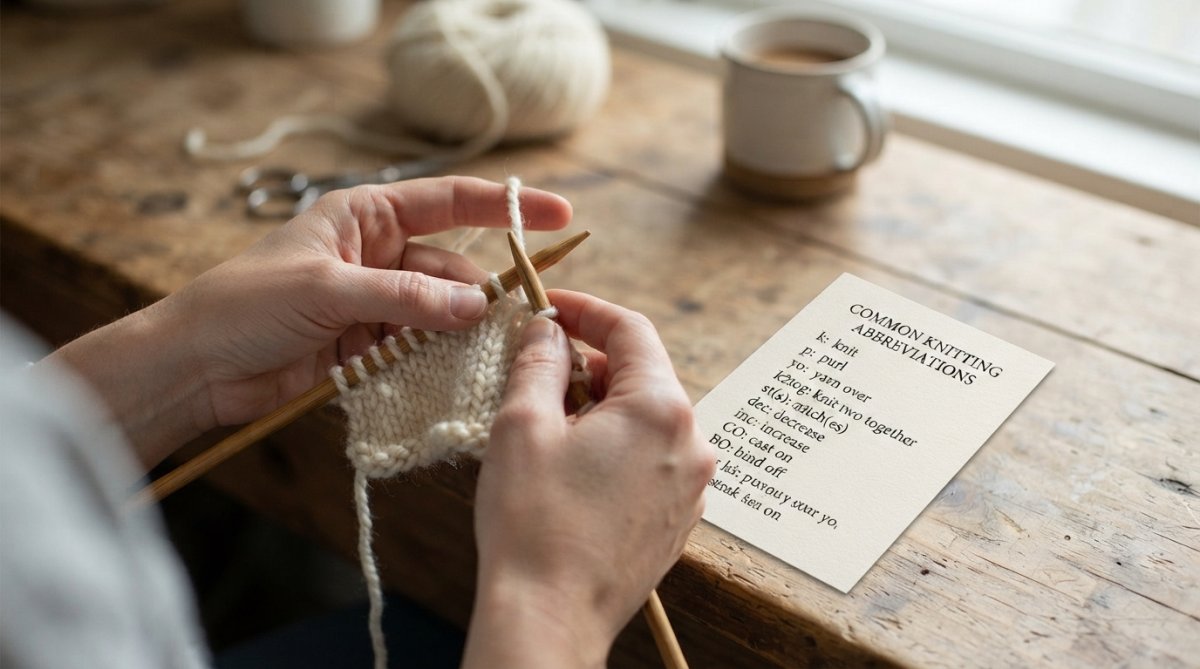
Close-up of hands holding knitting needles with cream-colored yarn mid-stitch, with a printed abbreviation reference card visible on the wooden work surface next to the needles
Basic Stitch Abbreviations
The foundation of knitting rests on two stitches: knit and purl. Everything else builds from these.
k = knit stitch. Insert the needle through the stitch from left to right, wrap yarn around the needle, and pull through.
p = purl stitch. Insert the needle through the stitch from right to left, wrap yarn around the needle, and pull through.
st or sts = stitch or stitches. Used to indicate how many stitches you're working with.
sl1 = slip one stitch. Move a stitch from one needle to the other without knitting it. Often written as "sl1 kwise" (slip one knitwise) or "sl1 pwise" (slip one purlwise).
yo = yarn over. Wrap yarn around the needle to create a new stitch and an eyelet hole. This is fundamental to lace knitting and decorative increases.
The Complete Guide to Lace Knitting: Your lace knitting master class - Paperback
tbl = through the back loop. Knit or purl into the stitch from the back rather than the front, which twists the stitch slightly.
Cast On and Bind Off Abbreviations
Cast on and bind off abbreviations appear at the very beginning and very end of a pattern, but they're often written in full rather than abbreviated, since there are many different methods.
CO = cast on. The abbreviation tells you how many stitches to cast on before beginning the pattern.
BO or bind off = bind off. This secures your stitches so they don't unravel when you remove the needles.
cable cast on = a method that creates a sturdy, elastic edge using two needles.
long-tail cast on = a popular method that requires measuring yarn before you begin.
three-needle bind off = a technique for joining two pieces of knitting together while binding off, commonly used for shoulder seams.
Knitting Abbreviations for Increases and Decreases
Increases and decreases shape your garment. They're how a flat rectangle becomes a fitted sleeve or how a large rectangle tapers into a fitted waistline.
inc or inc1 = increase one stitch. The most common method is kfb (knit into the front and back of the same stitch).
kfb = knit into the front and back. Insert needle through the front of the stitch, knit it, then knit into the back of the same stitch before dropping it off the left needle. This creates one new stitch.
m1 or m1l = make one left. Pick up the horizontal strand between stitches and knit into the back loop to create a new stitch that leans left.
m1r = make one right. Similar to m1l, but you knit into the front loop to create a stitch that leans right.
dec or dec1 = decrease one stitch.
k2tog = knit two stitches together. Insert the needle through two stitches at once and knit them as one, reducing your stitch count by one.
p2tog = purl two stitches together. Same as k2tog but working in purl.
ssk = slip, slip, knit. Slip two stitches knitwise one at a time, then insert the left needle through both and knit them together. This decrease leans left.
psso = pass slipped stitch over. After slipping a stitch and working the next stitch, pass the slipped stitch over the new stitch to decrease.
How to Read Knitting Charts
Charts translate pattern instructions into a visual grid. Each square represents one stitch, and symbols inside the squares tell you what to do with that stitch. This visual system is especially common in colorwork, lace, and cable patterns.
The most important rule for reading charts is direction. Most charts are read from bottom to top and right to left on odd-numbered rows (the right side of the fabric), then left to right on even-numbered rows (the wrong side). This mirrors how you actually knit. Some patterns include arrows showing direction, but many don't, which catches beginners off guard.
A legend at the bottom or side of the chart explains what each symbol means. Common symbols include small squares (knit on right side, purl on wrong side), circles (yarn over), diagonal lines (decreases), and filled squares (purl on right side, knit on wrong side). Different designers sometimes use different symbols for the same stitch, which is why checking the legend is non-negotiable.
Charts work best for patterns with clear stitch patterns or colorwork. They're less common in written-out patterns because they take up space and require more careful reading than a simple "k3, p1" instruction. But learning to read them opens access to patterns from around the world, since charts transcend language barriers.
Regional Variations: US vs. UK Terminology
The same stitch has different names depending on whether you learned to knit in the United States or the United Kingdom. This creates genuine confusion for beginners following patterns from different countries.
US single crochet = UK double crochet. This is the most notorious difference. A US pattern that says "single crochet" means something taller than a UK pattern's "double crochet," even though the names suggest the opposite.
US double crochet = UK treble crochet. Again, the UK version is taller.
The safest approach is to check the pattern's origin. If it's from a UK source, watch for UK terminology. If it's from a US designer, assume US terms. Many modern pattern designers state their terminology upfront to avoid confusion.
Essential Knitting Tools for Beginners
Understanding abbreviations is one piece of the puzzle. You'll also need the right tools to work from a pattern effectively. Brae & Heather offers a curated selection of resources designed specifically to support beginners as they move from basic stitches to more complex patterns.
A printed or digital abbreviation reference card is invaluable. Many knitters laminate a card and keep it in their project bag. A good reference shows common abbreviations with small illustrations of how each stitch looks when completed.
Stitch markers help you track where you are in a pattern. They sit on your needles between pattern repeats and prevent you from losing count. Beginners often underestimate how helpful these are until they've accidentally knit past a marker and realized they've lost track of their pattern.
A pattern notebook or digital file system keeps your patterns organized and lets you track notes, which yarn you used, what size you made, what you'd change next time. This becomes invaluable as you complete more projects.
For learning abbreviations specifically, books that emphasize visual learning are most helpful. Knitting for Beginners: The Unbelievable Guide to Knitting with Pictures, Instructions, and Lessons ($20.23) includes detailed photographs of how abbreviations translate into actual stitches, which helps bridge the gap between the symbol and the physical movement. For more comprehensive reference, Vogue Knitting the Ultimate Knitting Book ($39.95) includes 1,600 color images and expanded sections on techniques, making it an excellent long-term resource as you progress beyond beginner patterns.
Knitting for Beginners: The Unbelievable Guide to Knitting with Pictures, Instructions, and Lessons! (Knitting, How to Knit, Knitting Patterns - Paperback
Troubleshooting Common Pattern Abbreviation Errors
Even experienced knitters occasionally misread an abbreviation and knit several rows before realizing something's wrong. Knowing how to spot these mistakes early saves time and frustration.
The most common error is confusing similar abbreviations. "ssk" and "k2tog" both decrease by one stitch, but they lean in opposite directions.
Getting Started with Your First Pattern
The transition from practicing stitches to following an actual pattern feels like a big leap. It helps to choose a first pattern deliberately. Garter stitch scarves (knit every row in every stitch) are often recommended, but they're also mind-numbing. A better first pattern uses basic abbreviations in a way that's engaging enough to keep you interested.
Frequently Asked Questions
What are the most common knitting pattern abbreviations every beginner should know?
The essential abbreviations you'll encounter most often are: k (knit), p (purl), yo (yarn over), k2tog (knit two together), ssk (slip, slip, knit), and inc (increase). These form the foundation of nearly every beginner pattern. Once you master these core abbreviations, you'll recognize 80% of the instructions in most basic projects. Keep a printed reference card nearby while you work until these become automatic.
How do I interpret complex stitch abbreviations like 'k2tog' or 'ssk'?
These abbreviations describe decrease techniques. K2tog means knit two stitches together as one, which slants the decrease to the right. Ssk (slip, slip, knit) involves slipping two stitches individually, then knitting them together through the back loops, creating a left-leaning decrease. The difference matters for shaping and visual appearance. Your pattern will specify which decrease to use based on the design. Practice these on a swatch before starting your actual project.
Are knitting abbreviations universal across all patterns?
Most abbreviations follow standard conventions, but regional differences exist between US and UK patterns. Additionally, some designers create custom abbreviations for specialty stitches. Always check the abbreviation key at the beginning of your pattern, reputable patterns always include one. This ensures you're interpreting instructions correctly for that specific design.
What does 'md' or 'DS' mean in knitting patterns?
These abbreviations appear less frequently in beginner patterns but are useful to know. 'MD' typically stands for main color or main design, while 'DS' can mean double stitch or a designer-specific notation. Since these aren't standard across all patterns, always refer to the abbreviation key provided with your pattern. If you encounter an unfamiliar abbreviation, the pattern's legend will clarify its meaning rather than guessing.




0 comments