Why Substituting Yarn in Fair Isle Patterns Requires a Different Approach
Swapping yarn in a solid-color sweater is forgiving. Swapping yarn in a fair isle patterns chart is not.
This guide walks through the full substitution workflow: gauge, fiber, color value, swatching, and yardage math.
A thicker substitute pushes floats out of alignment by mid-chart, one lacking bounce leaves fabric flat, and one chosen only for color blurs a crisp motif into mush.
Yarn Weight and Gauge for Fair Isle Knitting
Gauge is the anchor of any substitution. A substitute must match the pattern's stitch and row gauge, not just its labeled weight category.
Read the pattern's stated gauge, then look at the recommended yarn's construction, not only its number.
Check these three things before you buy:
Stitch gauge: the number of stitches per 4 inches on the suggested needle
Row gauge: the number of rows per 4 inches, which controls vertical motif height
Yarn structure: plied versus single, tight versus loose twist
A 3-ply yarn holds its shape under stranded tension; a single ply blooms differently, giving a softer, fuzzier surface and different stitch definition.
Pro TipThe row gauge in colorwork is almost always tighter than in stockinette. If a yarn only lists its stockinette gauge, plan to swatch in pattern and adjust needle size, not just trust the label.
The Best Yarn for Stranded Colorwork: Fiber and Construction
The best yarn for stranded colorwork is a plied, all-natural wool with enough crimp to hold its shape and enough tooth for stitches to grip each other.
Here is how the main fiber options compare for colorwork:
Fiber
Bounce
Warmth
Best For
Wool
High
High
Traditional Fair Isle, mittens, sweaters
Alpaca
Low
High
Soft accessories, drapey garments
Cashmere
Low
Medium
Lightweight luxury pieces
Cotton
Low
Low
Warm-weather colorwork, less structure
Wool remains the standard: it holds twist, resists stretching, and keeps floats tidy. Alpaca adds softness and drape but sags in stranded fabric, so it suits small accessories better than a fitted yoke.
Why construction matters more than the fiber label
Four construction variables govern a substitute's behavior in a Fair Isle chart:
Ply count. A 2-ply or 3-ply yarn gives rounder stitches and cleaner color transitions because the plies trap each other at every color change. A single ply has no opposing twist to lock the stitch, so transitions look flatter and the fabric can bias.
Twist direction and amount. A firmly twisted yarn resists the extra tension stranding puts on the working strand. A softly twisted yarn can pill and shift, especially where long floats cross the back.
Bloom. Woolen-spun yarns bloom after washing, filling the gaps between stitches and giving traditional Fair Isle fabric its dense, wind-resistant hand. A worsted-spun substitute stays crisper and shows more stitch definition, changing the motif's look even at the same gauge.
Matching a Shetland-style specification
When a pattern specifies a Shetland-style yarn, it usually wants a lightweight, woolen-spun, 2-ply yarn with moderate halo and high elasticity, the combination behind the characteristic lightweight-but-warm Fair Isle fabric.
A practical way to check a candidate substitute before you buy:
Pull a strand alongside the original. The substitute should stretch and snap back at roughly the same rate.
Rub the strand between your fingers. Woolen-spun feels fuzzy and airy; worsted-spun feels smooth and dense.
Count the plies under good light. If the original is 2-ply and the substitute is single, expect a different surface.
Squeeze a strand and release it. If it stays compressed, it has low elasticity and will not work well in a chart with frequent color changes.
Brae & Heather's Southern Shetlands Yarn Naturals - Fingering is a 3-ply fingering weight that knits to 28 stitches and 36 rows over 4 inches in stockinette, and 28 stitches and 32 rows in Fair Isle.
Heritage 2-Ply Worsted 100% Wool Yarn
Pro TipIf you cannot find a yarn with a published Fair Isle gauge, knit your swatch in pattern and measure row gauge directly. Row gauge is the number that controls vertical motif height, and it is the one most likely to differ between the original and the substitute.
How to Choose Colors for Fair Isle Knitting
Color choice in Fair Isle is a value problem, not a color problem.
Value is how light or dark a color appears. Contrast is the difference in value between two yarns. A chart needs enough contrast between motif and background, or the pattern disappears.
Use this quick test before you commit:
Photocopy your chart in black and white. If the motif still reads clearly, your values are distinct enough.
Squint at your yarns together. If they blur into one tone, they are too close in value.
Check in low light. Fair Isle is often worn indoors, where value contrast matters more than hue.
Traditional Shetland colorwork leans on heathery colors and subtle shifts, which works because values stay distinct even when hues are close.
Keep a consistent number of colors.
Watch OutThe most common color mistake is choosing yarns by hue alone. Two blues that look different in the skein can be nearly identical in value, which flattens the motif and wastes your colorwork effort.
Knitting a Colorwork Swatch to Test Your Substitution
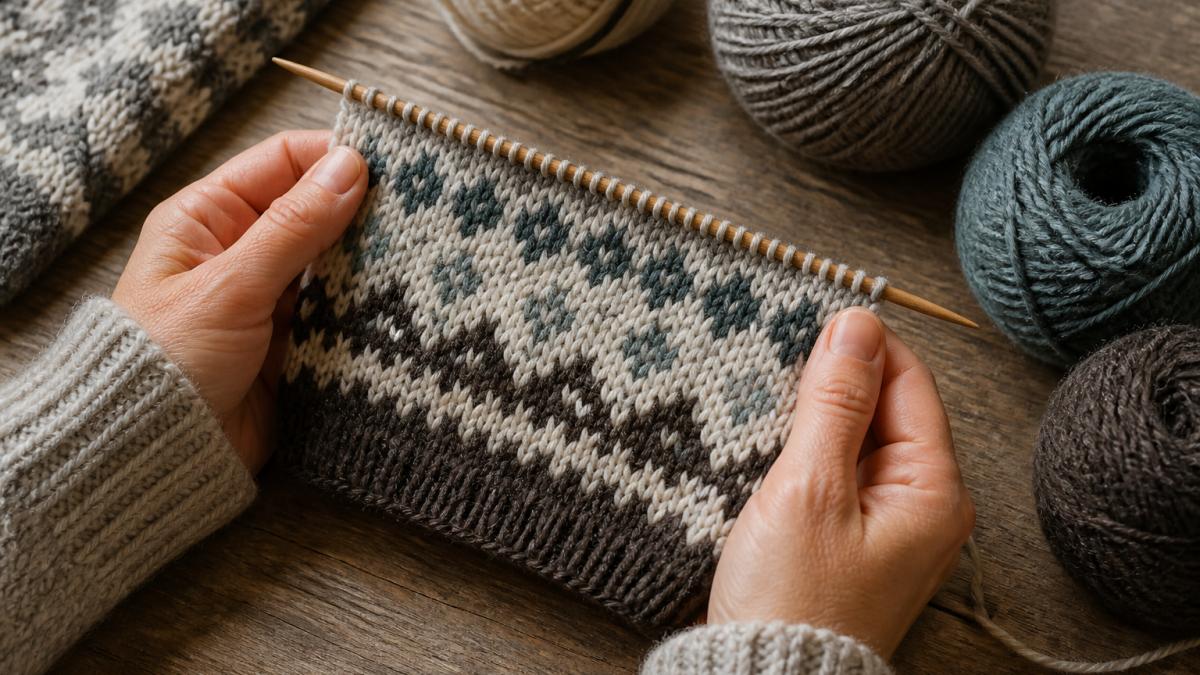
A swatch is the only reliable way to know whether a substitute will work. Knit it in the round, in pattern, at the gauge the chart demands.
Diagram showing the step-by-step process of knitting a colorwork swatch with yarn and needles to test tension.
Follow this swatch routine:
Cast on enough stitches for at least two full pattern repeats, plus edge stitches.
Knit in the round, since flat colorwork gauge differs from circular.
Work at least 4 inches of pattern, then bind off.
Wash and block the swatch as you will the finished piece.
Measure stitch and row gauge in the blocked fabric.
Measure in the middle of the swatch, never at the edges where stitches pull in. If gauge is off, change needle size before changing yarn.
Also check the wrong side. Floats should lie flat and even, not tight or loopy.
Key TakeawaySwatching in pattern, in the round, and after blocking is the single most reliable step in the entire substitution process. It catches gauge, tension, and color problems before you commit to a full garment.
Calculating Yardage for Your Substitute Yarn
Yardage math protects you from running short mid-chart. Substitute yarns rarely come in the same skein length, so compare total yards, not skein counts. In Fair Isle, do this math per color, because a chart that uses 70 percent background and 30 percent motif will not consume yarn evenly.
Step 1: Find the total yardage the pattern requires
Use this formula:
Total yards needed = (yards per skein of original) × (number of skeins called for)
If the pattern lists meterage, convert first. One yard equals roughly 0.91 meters, so 100 meters is about 109 yards. Keep all math in one unit to avoid errors.
Step 2: Split the total by color
Most Fair Isle patterns do not publish a per-color breakdown, so estimate from the chart. Count the stitches of each color in one full pattern repeat, then multiply by the number of repeats across the body or sleeve. A common pattern runs roughly 60 to 75 percent background and 25 to 40 percent motif, but this varies widely.
Worked example for a two-color yoke:
Pattern calls for 6 skeins at 115 yards each = 690 yards total
Background color estimate: 70 percent = 483 yards
Motif color estimate: 30 percent = 207 yards
Add a 15 percent buffer to each: background 555 yards, motif 238 yards
Step 3: Convert to skeins of the substitute
Divide each color's buffered yardage by the substitute skein length, then round up.
Background: 555 ÷ 272 = 2.04, so buy 3 skeins
Motif: 238 ÷ 272 = 0.88, so buy 1 skein
Always round up. Running out of a dye lot mid-project is far worse than one spare skein, and a spare skein of plied wool is easy to use in a hat or mitten later.
Step 4: Account for stranding waste and dye lots
Stranded knitting uses more yarn than plain knitting because every color change carries the unused strand across the back. A 10 to 15 percent buffer covers most charts; add more for long floats or many color changes per row. Buy all skeins of each color, including the buffer, in a single dye lot, a mismatched skein shows as a visible band in a Fair Isle motif even if the color name is identical.
Watch OutDo not rely on ball weight alone to compare yarns. A 50-gram skein of fingering can hold anywhere from 180 to 230 yards depending on fiber and spin. Always compare the labeled yardage per skein, not the grams.
Key TakeawayCalculate yardage per color, add a 10 to 15 percent buffer to each, convert to skeins of the substitute, round up, and buy every skein in one dye lot. That sequence prevents the two most common Fair Isle failures: running short mid-chart and mismatched dye lots.
Step-by-Step: Substituting Yarn for Fair Isle Patterns
The full workflow, from chart to first row. Work through it in order.
Step 3: Match fiber and construction. Choose a plied, all-natural wool for structure and bounce.
Step 4: Check color value. Confirm motif and background have clear value contrast.
Step 5: Knit a colorwork swatch in the round. Wash, block, and measure it.
Step 7: Calculate yardage with a buffer. Buy enough skeins in one dye lot.
Pro TipWhen a pattern specifies a particular Shetland yarn, you are not locked in. You are matching a gauge, a fiber, and a value range. Any plied wool that meets those three tests will knit the chart faithfully.
How do you catch floats without distorting the fabric?
Catch long floats by trapping the working yarn behind the strand every few stitches. Keep the catch loose, a tight catch puckers the front of the fabric, the mistake most knitters make first.
What if the substitute yarn has a different twist?
A tighter twist gives crisper stitch definition and cleaner color separation. A looser twist gives a softer, fuzzier surface.
For a full range of plied wools suited to stranded knitting, browse Brae & Heather's yarn collection and match your chart to a fiber that holds its shape.
Substituting yarn for Fair Isle is a matching exercise, not a guessing game. Gauge, fiber, value, and yardage each have to line up before the first stitch.
Brae & Heather carries the plied wools, heritage patterns, and textile tools that make this process straightforward. The Southern Shetlands Yarn Naturals - Fingering offers a documented Fair Isle gauge, the Heritage 2-Ply Worsted 100% Wool Yarn brings hard-wearing structure to heavier colorwork, and the Regal 2-Ply DK 100% Wool Yarn suits sweaters and accessories alike.
Regal 2-Ply DK 100% Wool Yarn
Frequently Asked Questions
How do I substitute yarn in a Fair Isle pattern?
Start by matching the yarn weight and gauge to the original. Check that your substitute gets the same stitch count over 4 inches. Then knit a colorwork swatch to test how the yarns behave together. Match fiber content where possible, choose colors with clear contrast, and calculate yardage based on the original pattern's requirements. Always swatch in the round if the pattern is knit in the round.
Can I use a different yarn weight for a Fair Isle pattern?
You can, but it changes everything. Going up or down a weight affects gauge, fabric density, and the finished size. If you substitute a heavier weight, your garment will knit up larger unless you adjust stitch counts. For stranded colorwork, a lighter weight than called for can make floats too loose and distort the pattern. Stick to the same weight category when possible.
Should I use the same yarn for both colors in a Fair Isle project?
Ideally, yes. Using the same yarn base for both colors ensures consistent gauge, tension, and how the fabric wears. Mixing yarns with different fiber contents or twist can cause one color to bloom differently after blocking. If you must mix, test them together in a swatch first. Wool yarns with similar twist and ply work best for stranded colorwork.
How do I choose contrasting colors for Fair Isle knitting?
Squint at your color pair or photograph them in black and white. If they blend into the same gray tone, the pattern will disappear. Choose colors with different values, not just different hues. Traditional Fair Isle uses heathered shades that create depth without harsh contrast. Test your palette by knitting a small swatch of the actual pattern repeat before committing to full skeins.




0 comments