Authentic Shetland wool is fiber spun from the fleece of Shetland sheep, a small breed native to the Shetland Isles, and it carries a documented chain of origin from island flock to finished yarn. That chain is what separates the real thing from a soft wool blend wearing a Scottish-sounding label.
Fleece, Fiber, and the Shetland Sheep Breed
The Shetland sheep is small, hardy, and raised on open hill grazing where weather shifts fast. Its fleece grows in two distinct layers:
Coarse outer wool that sheds rain and wind
Fine undercoat that traps warmth close to the skin
Shetland Wool Characteristics: What Your Hands Will Tell You
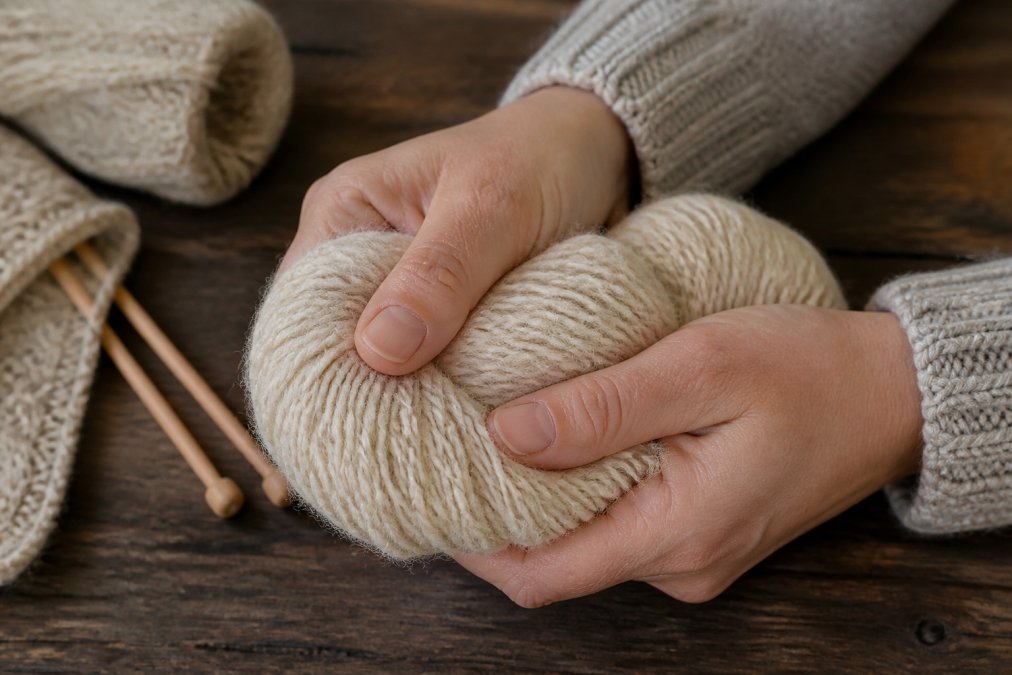
Shetland wool feels light, springy, and slightly dry to the touch, with a soft halo that builds as the yarn works up. Squeeze a skein and it should bounce back rather than flatten.
Close-up of hands testing the crimp and soft texture of authentic shetland wool skeins during the selection process.
Crimp: Fine, tight waves that give the yarn memory
Halo: A gentle fuzz, not a thick cloud
Weight: Featherlight for its volume
Smell: Clean wool, never chemical or heavily scented
Drape: Fluid, never stiff or wiry
Pro TipRub the yarn gently between your palms for ten seconds. Genuine Shetland wool warms and softens; synthetic blends stay cool and slick.
How to Verify Provenance and Ethical Sourcing
Provenance verification means tracing the yarn back through every hand it passed: the crofter who kept the sheep, the wool broker who graded the clip, the mill that spun it, and the retailer that sold it. Provenance verification means tracing the yarn back through every hand it passed: the crofter who kept the sheep, the wool broker who graded the clip, the mill that spun it, and the retailer that sold it.
The Four Links in a Verifiable Chain
The flock. Authentic Shetland wool comes from Shetland sheep, a small, hardy breed raised on open hill grazing. Ask whether the seller can name the breed and, ideally, the island or croft. A named breed with a named place is a strong signal; "Scottish wool" alone is not.
The broker or sorting partner. Fleeces are graded and hand-sorted before spinning, and reputable producers work with named wool brokers or sorting operations. If a seller cannot say who graded the fleece, the fiber may be anonymous commodity wool.
The spinner or mill. This is the single most useful question you can ask. Genuine Shetland yarn is spun by identifiable mills, and those mills are proud to be named. "Who spun this yarn?" should produce an answer within one reply.
The retailer. A trustworthy retailer states the spinner, the breed, and the fiber content on the product page, not just in an email after you ask.
Reading a Label Like an Auditor
Labels are where vague language does its work. Compare what you see against these patterns:
"100% Shetland wool", a specific breed claim. Good.
"Shetland-style wool" or "Scottish-style wool", a marketing phrase, not a breed. Treat as unverified.
"Wool blend" with no percentages, you cannot confirm the Shetland content at all.
A named spinner plus a breed plus a weight, the strongest combination, because all three can be checked independently.
Verifying Ethical Treatment, Not Just Geography
Geographic origin does not prove animal welfare, and modern buyers increasingly want both. Because there is no single universal certification that covers every Shetland flock, verification works best as a set of questions rather than a single logo:
Mulesing-free. Mulesing is a painful procedure practiced in some wool-producing regions; ask directly whether the fleece is mulesing-free.
Shearing practice. Ask when and how sheep are shorn. Ethical operations shear seasonally and avoid stress injuries.
Traceability to the croft. The more specific the origin, a named island, a named croft, a named sorting partner, the easier it is to verify treatment claims.
Consistency between claim and detail. A seller who names their mill and their broker is far more credible than one who prints a sustainability slogan with no names attached.
Pro TipSend one email before you buy: "Who spun this yarn, where did the fleece originate, and is it mulesing-free?"
Why This Matters for the Finished Garment
A documented chain is not just an ethics exercise, it predicts how the yarn will behave. Fleece that was properly hand-sorted produces even, consistent yarn with predictable gauge. Anonymous commodity wool often spins unevenly, which shows up later as puckered colorwork and uneven blocking. Provenance and performance are the same question asked two ways.
The Best Yarn for Fair Isle Knitting: Weights, Types, and What to Buy
The best yarn for Fair Isle knitting is a fine, smooth, worsted-spun Shetland in jumper weight or 4ply, because it holds crisp colorwork definition without bulk. Gauge matters more than brand here.
Key TakeawayMatch yarn weight to pattern gauge, not to personal preference. A jumper weight substitution changes the entire fabric.
Knitting with Shetland Wool Tips: Gauge, Colorwork, and Care
Knitting with Shetland wool rewards a light hand. The fiber blooms after blocking, so a slightly loose gauge often settles into the right fabric.
Jamieson & Smith Shetland Heritage Naturals
Swatch in the round, since colorwork tension differs from flat knitting
Use 3mm needles for jumper weight over Fair Isle patterns
Keep floats loose, no more than five stitches wide
Block gently in cool water, then lay flat to dry
Watch OutNever machine wash untreated Shetland wool. One warm cycle can shrink a finished sweater by several sizes and fuse the fibers permanently.
Counterfeit Detection: How to Spot Fake Shetland Wool
Most guides tell you to check the label. This section gives you a tactile test, a visual test, and a red-flag protocol you can run in a store or on a listing page before you spend anything.
The Burn and Feel Test (Tactile Authentication)
You cannot always burn a sample, but when you can, a loose end, a snagged fiber, a swatch, the behavior of the fiber tells you what the label will not.
Smell: Genuine wool smells like burnt hair or feathers. Acrylic and other synthetics smell like melted plastic.
Ash: Wool leaves a soft, crushable black ash. Synthetic fiber leaves a hard, plastic bead that will not crumble.
Flame behavior: Wool self-extinguishes and does not melt or drip. Synthetics melt, drip, and keep burning.
The Visual Authentication Checklist
Authentic Shetland wool has a specific look that mass-produced imitations struggle to fake:
Crimp. Fine, tight, regular waves. Straight, glassy, or uniformly smooth fiber is a warning sign.
Halo. A gentle, even fuzz that builds as the yarn works up, not a thick, uniform cloud and not a slick, hairless surface.
Spin consistency. Genuine yarn is even in thickness. Lumpy, slubby, or wildly variable thickness suggests low-grade or blended fiber.
Color depth. Natural undyed shades shift subtly across the skein and between skeins. Flat, uniform, plasticky color often signals synthetic dye on synthetic fiber.
Drape. Fluid and light, never stiff or wiry. Stiffness is a common tell for acrylic-heavy blends.
Red Flags in "Shetland-Style" Sweaters
A Scottish-sounding brand name with no spinner, mill, or breed named anywhere. The name is the entire claim.
"Shetland-style" or "inspired by" language. Style is not origin. Authentic wool is described by breed and source, not by vibe.
A price far below what heritage yarn costs. Real Shetland wool is a specialty agricultural product with a documented supply chain; a sweater priced like fast fashion cannot contain it.
No fiber percentage on the label. If the label will not commit to a number, assume the Shetland content is minimal or zero.
A care label that permits machine washing. Untreated Shetland wool felts in warm water and cannot be machine washed. A machine-washable "Shetland" sweater is almost certainly treated, blended, or synthetic.
A listing that shows the same photo across dozens of unrelated products. That is a reseller of commodity goods, not a wool producer.
A Quick Decision Protocol
Run these three checks in order before buying:
Fiber content. Does the label say 100% Shetland wool, or does it hedge with "blend" or "style"?
Spin and hand. Does the yarn pass the squeeze-and-release test and show fine, regular crimp?
Documentation. Can the seller name the spinner, the mill, or the wool broker?
If a seller fails any one of these, treat the yarn as unverified.
Frequently Asked Questions
Is Shetland wool soft or itchy?
Authentic Shetland wool sits in the middle: not as silky as Merino, but far softer than most coarse wools. The fine undercoat gives it a gentle hand, while the coarser outer fibers add resilience. Worsted-spun options like Shetland Heritage feel smoother against the skin than woolen-spun jumper weight. For garments worn next to skin, look for Heritage or fine 2ply, and save the toothier yarns for outerwear, colorwork yokes, and stranded patterns where durability matters more than next-to-skin comfort.
How can you tell if a yarn is 100% Shetland wool?
Check the label for '100% Real Shetland Wool' or a named Shetland spinner, then examine the fiber itself. Genuine Shetland wool shows a soft halo, visible crimp, and slight variability in shade when undyed. Hold a strand to the light: authentic fleece has a gentle sheen, not a synthetic gloss. If the price is unusually low or the label only says 'Shetland-style' or 'Shetland-type,' treat it as a blend or imitation, not authentic Shetland wool.
Why is Shetland wool considered ideal for colorwork and Fair Isle knitting?
Shetland wool's crimp and slight halo help adjacent colors blend visually, which is exactly what Fair Isle and stranded colorwork need. The yarn is sticky enough to grip without splitting, yet fine enough for 2ply jumper weight and 4ply fingering to create crisp pattern definition on 3mm needles. Undyed natural shades also give a broad neutral palette that plays well with dyed colors, so traditional knitting patterns retain the depth and complexity seen in historic garments.
What should you look for when buying Shetland wool for heritage projects?
Prioritize provenance first: a named Shetland spinner, a stated sheep breed, and a clear description of hand-sorted fleece. Next, match yarn weight to the pattern. Jumper weight 2ply suits Fair Isle yoked sweaters, while Shetland Heritage works for finer colorwork and lace. Finally, buy from a seller who lists meterage, gauge, and shade numbers, and who can answer questions about staple length and spinning method. Those details separate heritage-grade yarn from generic wool.
Choosing authentic Shetland wool takes patience, but the reward is a garment that outlives trends. Brae & Heather stocks the Jamieson & Smith range, including Shetland Heritage Naturals, 2ply Jumper Weight, and Shetland Aran Worsted, alongside patterns built for real bodies and clear instructions. Get started with Brae & Heather and knit with fiber you can trace from flock to finished piece.




0 comments