
Fair Isle vs Stranded Knitting: Key Differences
Publié le Oct 15, 2026
By Editorial Team
Économisez 25 % sur les patrons et accessoires de tricot, aucun code requis

Last Updated: October 14, 2026
Fair Isle stranded knitting and its broader technique family are closely related, often confusing knitters new to colorwork. The distinction matters because it shapes how you approach patterns, manage tension, and choose your next project. At Brae & Heather, we design patterns that honor traditional methods while remaining accessible to intermediate knitters.
Fair Isle is a specific style of stranded colorwork originating from the Shetland Islands, characterized by traditional geometric motifs and a particular construction method. Stranded knitting, by contrast, is the broader technique of working with two or more colors in a single row or round, carrying unused yarn across the back of the work as floats.

The relationship is simple: all Fair Isle is stranded knitting, but not all stranded knitting is Fair Isle. Fair Isle represents heritage and particular design conventions; stranded knitting is the technical foundation that makes it possible.
The table below resolves the terminology quickly; the notes underneath explain the nuance most quick answers skip.
| Aspect | Fair Isle | Stranded Knitting |
|---|---|---|
| Scope | A specific tradition within stranded colorwork | The broader technique family |
| Historical association | Shetland Islands, particularly Fair Isle | Global; used across many knitting cultures |
| Typical color count per row | Usually two | Two or more |
| Motif character | Small, repeating geometric bands and allover patterns | Any motif, including modern and pictorial designs |
| Construction | Traditionally worked in the round | Worked in the round or flat |
| Float behavior | Floats are short by design because motifs repeat frequently | Float length depends entirely on the motif |
| Yarn dominance | Often deliberately managed so one color reads forward | Optional; many patterns ignore dominance |
| Best for | Heritage-inspired projects and traditional aesthetics | Experimentation, custom motifs, and modern colorwork |
In everyday knitting conversation, "Fair Isle" is often used as shorthand for any stranded colorwork, and you will see pattern listings, yarn labels, and even some reference books apply the term broadly. A more precise usage reserves Fair Isle for the Shetland tradition and its descendant styles, and uses stranded knitting (or stranded colorwork) for the general technique. Fair Isle is a style with conventions, motif vocabulary, and a regional history; stranded knitting is a method, the mechanical act of carrying two or more yarns across the back of the work.

Fair Isle knitting is associated with the Shetland Islands, and the name comes from one of the islands in that group. The tradition developed around small, repeating geometric motifs worked in the round, often with two colors per row. Stranded knitting appears in many knitting traditions worldwide, which is why the broader term is more accurate for colorwork that does not follow Shetland conventions.
Some knitters reserve "Fair Isle" strictly for the traditional style and prefer "stranded colorwork" for everything else; others use "Fair Isle" loosely. Neither is wrong in casual conversation, but if you are writing a pattern or teaching a class, being precise helps readers find what they want. If your design uses traditional Shetland-style motifs and construction, "Fair Isle" is fair; if it uses modern or pictorial motifs, "stranded colorwork" is more accurate.
Mastering Fair Isle stranded knitting comes down to three things: how you hold the yarns, how you carry the unused color across the back, and how you keep floats from distorting the fabric.
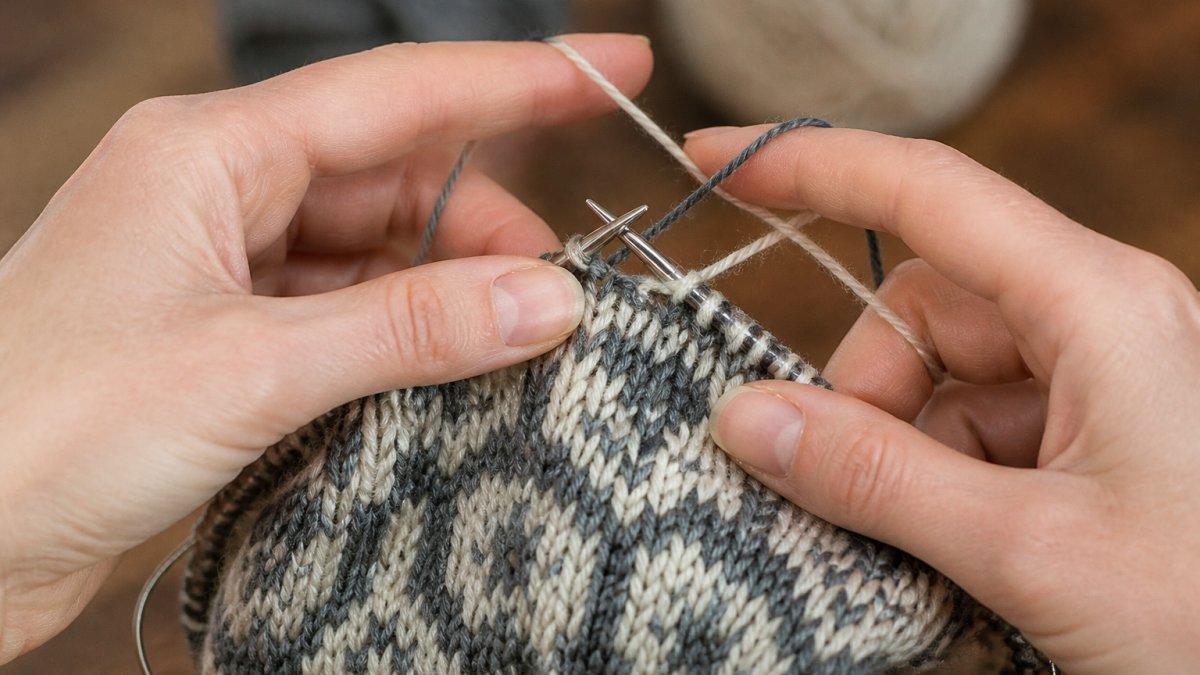
There are two common approaches: one yarn in each hand (Continental and English), or both yarns in the same hand separated by different fingers. Either works. What matters is that you hold the same color in the same position every time, because switching positions mid-project changes your gauge for that color and shows up as uneven stitches. Decide up front which color is your "background" and which is your "pattern" color, and keep them in the same hands throughout. If one color is consistently tighter, it is usually the one in your dominant hand, relax that hand slightly rather than tightening the other.
When you knit with one color, the other travels horizontally behind your active stitches. That strand is a float. Floats are not a mistake; they are the structural back of stranded fabric, adding warmth and density, which is why stranded colorwork is common in cold-weather garments.
Most knitters keep floats to about five stitches or fewer. Beyond that, the float can snag on rings, buttons, or fingers and pull the fabric when the piece stretches.
Puckering almost always comes from floats that are too tight, not too loose. The fix is not to knit more loosely overall but to give the float extra slack at the moment you switch colors. Many knitters spread the stitches on the right needle before working the next color, forcing the float to be slightly longer; when the fabric relaxes, it sits flat.
A quick check: after a few rows, stretch the fabric gently sideways. Floats that feel taut like guitar strings are too tight; floats that sag noticeably are too loose. You want them to lie flat against the back with a slight curve.
Rionag Beanie Knitting Pattern by Brae & Heather →
Stranded colorwork is most commonly worked in the round, because the right side always faces you and the floats stay on the inside. Working flat is possible but requires purling wrong-side rows and managing floats on the purl side. If you are new to stranded work, start in the round.
Colorwork gauge is almost always tighter than plain stockinette in the same yarn and needle, because floats pull the fabric in slightly, so a stockinette swatch will mislead you. Swatch in the actual colorwork pattern, work at least 30 stitches and 30 rows, and measure both stitch and row gauge. If your gauge is off, change needle size before starting.
Floats are the foundation of stranded knitting's structure, but managing their length prevents puckering, excessive stretch, and snagging. The rule many knitters follow: floats should span no more than five stitches before being caught or anchored. When a float would exceed five stitches, catch it by twisting the unused yarn around your working yarn on the wrong side. This technique, called catching floats, secures the yarn without visible bumps on the right side when done carefully. Some knitters catch every three or four stitches for added security in garments that receive heavy wear.
Even tension across both yarn colors is the difference between a polished finished piece and one that looks distorted. Uneven tension creates visible differences in stitch size where colors change, disrupting the visual pattern and compromising garment fit. Switching between two yarns naturally creates slight tension variations, so your hands must adjust each color independently while maintaining overall consistency. Start by ensuring both yarns come from the same source, either a single ball or wound from the same skein; yarn from different dye lots may have slightly different weights or textures.
Fair Isle and intarsia represent two distinct approaches to colorwork, each suited to different design goals. Intarsia involves working with separate bobbins of yarn for each color section, never carrying yarn across the back. It works best for large blocks of solid color that don't repeat across the row, creating a flat, lightweight fabric with no floats, ideal for garments requiring drape or flexibility. Fair Isle and stranded knitting, by contrast, carry yarn continuously across the back, creating a denser, warmer fabric with built-in structure. Fair Isle's traditional geometric motifs repeat frequently across the row, making carried floats manageable and integral to the design.
Selecting a Fair Isle project requires considering your skill level, yarn preferences, and the time you're willing to invest. The Rionag Beanie works in the round with traditional geometric motifs, making it an ideal stepping stone for knitters ready to explore Fair Isle. For knitters seeking something slightly more ambitious, the Rionag Cowl carries Fair Isle character into a warm, seamless accessory worked in the round with three size options. It coordinates with the Rionag Beanie, letting knitters build a coordinated collection as their confidence grows. [The Hearts Aflame Pattern suits knitters comfortable with color and story in their work](/products/hearts-aflame-pattern), capturing the moment when autumn gives way to winter.

Choose yarn that matches the pattern's fiber recommendations. Traditional Fair Isle uses all-natural fibers like wool for warmth and elasticity. Yarn weight and yardage requirements are specified in each pattern; following them ensures your finished piece fits and performs as designed.
Fair Isle and stranded knitting represent a gateway into sophisticated colorwork. The distinction between them clarifies not just terminology but also design philosophy and construction choices. Whether you're drawn to traditional Shetland patterns or contemporary designs, understanding how these techniques differ helps you select patterns that match your vision and skill. Brae & Heather's curated collection of Fair Isle patterns and premium fibers provides the foundation to explore colorwork with confidence.
Yes, Fair Isle is a specific style of stranded knitting with distinct regional origins. All Fair Isle uses the stranded colorwork technique, but not all stranded knitting is Fair Isle. Fair Isle traditionally features small, repeating geometric motifs in two colors per row, while stranded knitting as a broader technique can include more colors and larger pattern areas. The key difference lies in the pattern tradition and design conventions rather than the construction method itself.
Floats form when you carry yarn across the back of the work between color changes. To prevent overly long floats that catch on fingers, catch the carried yarn around the working yarn every 3-4 stitches, or weave it through stitches. Keep tension consistent so floats don't pucker the fabric or create tight spots. Distribute floats evenly across the back, and avoid pulling the carried yarn too tight, which distorts the front of your work. Practice on gauge swatches first to find your ideal float length.
Smooth, consistent yarn works best for Fair Isle because it shows colorwork motifs clearly and makes tension easier to manage. Natural fibers like wool hold their shape well and provide the warmth traditional Fair Isle projects require. Avoid yarn with excessive texture or slubs, as these obscure your pattern details. Shetland wool is a classic choice for Fair Isle, offering durability and the authentic heritage feel. Choose yarn weight appropriate to your pattern, and always knit a gauge swatch with both colors to ensure accurate fit.
Yes, stranded colorwork works equally well flat or in the round. When working flat, you knit one direction on the right side and purl back on the wrong side, carrying both colors as you go. Purling can feel awkward at first when managing two colors, so many knitters prefer working in the round for colorwork projects. Either method produces the same stranded construction with floats on the back. Choose based on your project type and personal comfort, sweaters and blankets work flat, while hats and cowls are often worked in the round.

0 commentaire