Why Knitters Search for Woolly Thistle Alternatives
Finding the right yarn is challenging when a favorite becomes difficult to source or too expensive. The woolly thistle alternative for knitters addresses this frustration by offering substitutes for niche European yarns, particularly heritage Shetland varieties, with comparable fiber properties and fewer sourcing headaches.
Discovering quality alternatives means understanding what makes a yarn work for your project, then finding another option that delivers the same tactile experience and stitch definition. The right substitute can be just as satisfying as the original.
The real challenge is finding an alternative that matches fiber content, weight, and character. This guide shows how to evaluate yarn properties and identify the best woolly thistle alternative for knitters based on your project needs.
Pro TipBefore committing to a substitute, always knit a gauge swatch with the new yarn. Fiber properties vary significantly between mills, and a swatch will reveal how the yarn behaves, its elasticity, how it blooms when wet, and whether the stitch definition matches your expectations.
Understanding Yarn Weight: What Is the Difference Between Worsted and DK Yarn
Yarn weight is the thickness of the strand and directly affects how your finished garment looks and feels. Worsted yarn is a medium-weight option spun to create a smooth, lustrous finish. DK yarn, or "double knit," sits between fingering and sport weights, offering lighter drape while maintaining good stitch definition.
Worsted knits at 16-20 stitches per 4 inches and produces denser, warmer fabric. DK knits at 20-24 stitches per 4 inches and creates finer, more delicate fabric.
For Fair Isle colorwork, worsted-spun yarns create more texture and visual depth, while DK yarns produce crisper stitch definition and accommodate smaller motifs without bulk.
Understanding this difference helps you identify a woolly thistle alternative for knitters that will work for your project. Substituting DK for worsted changes fit and drape; spinning method also matters.
Key TakeawayYarn weight determines gauge, which determines fit. Worsted creates warmer, denser fabric; DK creates lighter, more refined drape. Always match weight unless you're intentionally changing the garment's character.
Heritage Shetland Wools as Direct Woolly Thistle Alternatives
Heritage Shetland wools are direct alternatives to niche European yarns for knitters seeking authentic colorwork and traditional fiber properties. Shetland wool is prized for its character, slight crimp, natural loft, and ability to bloom beautifully when blocked.
The Shetland Museum and Archives has documented how traditional Fair Isle garments used specific yarn characteristics that modern mills have largely abandoned. This inspired a collaborative project to recreate those original spinning methods. The result is yarns that deliver the visual complexity and drape that made heritage Fair Isle so distinctive.
Shetland wool resists pilling and offers excellent elasticity, so garments hold their shape through wear and washing. Its 24-26 micron count makes it comfortable against skin while maintaining structure. For knitters accustomed to premium European alternatives, Shetland delivers comparable quality without sourcing difficulties.
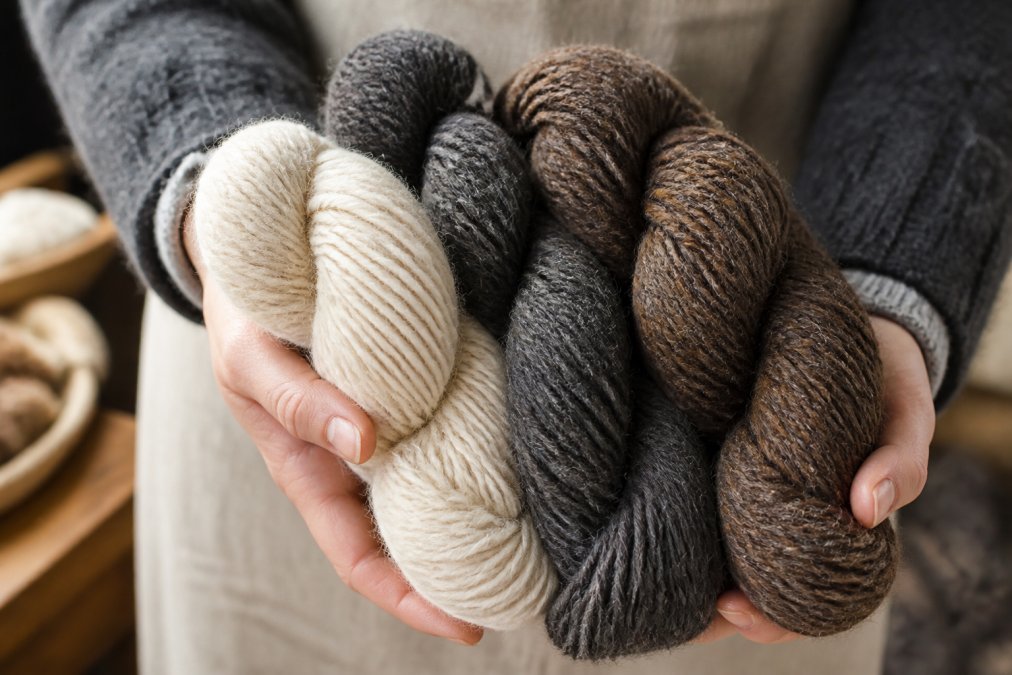
Close-up of hands holding multiple skeins of natural Shetland wool in undyed cream, charcoal, and traditional brown shades, showing the crimp and texture of the fiber in natural window lighting
Jamieson & Smith Shetland Heritage and Jumper Weight
Jamieson & Smith's Shetland Heritage line recreates 19th-century Fair Isle garments based on fiber analysis and historical documentation. The Jamieson & Smith Shetland Heritage Naturals is worsted spun at 2.8nm, creating smooth finish with remarkable color definition.
Jamieson & Smith Shetland Heritage Naturals
At 110 meters per 25-gram ball, this yarn requires 3mm needles and produces 30 stitches and 32 rows over a 10-centimeter square in Fair Isle pattern. Its slight fineness gives it properties that made historical Fair Isle visually complex, mirroring museum pieces.
The Jamieson & Smith 2ply Jumper Weight is a four-ply woollen-spun yarn with more texture and loft than worsted versions. It knits at 28 stitches over 4 inches in stocking stitch, or 28 stitches and 32 rows in Fair Isle pattern.
Jamieson & Smith 2ply Jumper Weight
Best ForKnitters recreating historical Fair Isle patterns or seeking the exact tactile experience of heritage Shetland work. The fiber properties and spinning method directly match what museum garments were made from.
At 50 grams and 61 meters per ball, this yarn excels for cables where stitch definition matters. The worsted spinning creates clean stitch lines, and the smooth finish allows precise color placement.
Many knitters overlook Shetland Aran as a woolly thistle alternative for knitters, assuming heavier yarns lose Shetland's character. The same crimp, elasticity, and fiber properties carry through to Aran weight.
How to Substitute Yarn for Knitting Patterns: Matching Gauge and Fiber Content
Substituting yarn requires matching three critical properties: gauge, yardage, and fiber characteristics.
Gauge is the number of stitches and rows per unit of measurement. If your pattern requires 20 stitches per 4 inches and you use yarn that knits at 18 stitches per 4 inches, your garment will be 10 percent larger. Always knit a gauge swatch wet and blocked to reveal the yarn's true behavior.
Yardage determines whether you have enough fiber to complete the project. Account for color changes, pattern complexity, and personal knitting tension, which can vary by 5-10 percent.
Fiber content shapes how the finished garment looks and wears. Woollen-spun yarn has more loft and texture than worsted-spun yarn of the same weight. Non-superwash wool blooms and softens with wear, while superwash-treated wool resists this transformation.
Create a substitution checklist noting fiber content, yardage per unit weight, gauge, and spinning method. A perfect match is rare, but matching three of four usually produces acceptable results.
Criterion
What to Match
Why It Matters
Gauge
Stitches and rows per 4 inches
Determines finished garment size
Yardage
Total meters or yards available
Ensures you have enough to complete project
Fiber type
Wool, blend, natural fiber
Affects durability, drape, and aging
Spinning method
Worsted vs. woollen
Changes texture, loft, and stitch definition
Watch OutNever substitute based on weight name alone. A "DK" from one mill may knit at 22 stitches per 4 inches while another mill's "DK" knits at 24 stitches. Always swatch and measure, or you risk a garment that doesn't fit.
For knitters seeking a woolly thistle alternative for knitters without international sourcing complexity, American-made options deliver quality comparable to European producers.
Southern Shetlands Yarn Naturals for Fine Colorwork
Southern Shetlands Yarn Naturals - Fingerling is a 3-ply fingerling yarn produced domestically in small batches, offering consistent quality without shipping delays and customs complications of European imports.
At approximately 114 yards per skein, this yarn knits at 28 stitches and 32 rows per 4 inches in Fair Isle pattern using 3mm needles. The three-ply construction creates smooth stitch definition ideal for intricate colorwork, with direct access to the producer for questions.
Maritime Family Fiber Yarns for Versatile Projects
Maritime Family Fiber produces several options that work as woolly thistle alternatives for knitters across different project types. The Regal 2-Ply DK 100% Wool Yarn offers a looser-spun heavy DK at 20 stitches per 4 inches on 4.5mm needles. At 272 yards per 4-ounce skein, this yarn provides generous yardage for projects requiring fine detail.
For heavier projects, the Atlantic 3-ply Aran 100% Wool Yarn delivers 135 yards per 4-ounce skein at 14 stitches per 4 inches. This yarn works well for cables, where the three-ply construction creates clean stitch lines. The Sport Single Ply 100% Wool Yarn provides 430 yards per 4-ounce skein at 24 stitches per 4 inches, making it ideal for lace and lightweight colorwork.
All Maritime Family Fiber yarns use wool sourced from small flocks and farms, emphasizing sustainability and traceability.
Pro TipWhen evaluating American-made alternatives, contact the producer directly. Most small mills are happy to discuss fiber sourcing, answer questions about yarn behavior, and help you troubleshoot substitutions. This direct relationship is a genuine advantage over distant European mills.
Benefits of Non-Superwash Wool for Heritage Knitting
Non-superwash wool, untreated wool that hasn't undergone chemical processing to resist felting, offers distinct advantages for heritage knitting projects. Most traditional Fair Isle garments were made from untreated wool, and the fiber's natural properties shaped how those garments were designed and how they age.
Evaluating Fiber Properties: Micron Count, Crimp, and Drape
Understanding fiber properties transforms how you evaluate a woolly thistle alternative for knitters. Three properties deserve particular attention: micron count, crimp, and drape.
Frequently Asked Questions
What makes a yarn suitable as a woolly thistle alternative for Fair Isle and colorwork?
A true woolly thistle alternative needs consistent ply structure, defined stitch definition for colorwork clarity, and authentic fiber content. Look for worsted-spun wool with good crimp and elasticity, these properties create the stitch definition and pattern complexity that Fair Isle demands. Shetland Heritage yarns, for example, are designed specifically to replicate the characteristics of historical Fair Isle garments, offering the color depth and pattern precision that modern four-ply yarns cannot match.
How do I know if a yarn substitution will work for my pattern?
Check three factors: gauge (stitches and rows per inch), yardage (total yardage available), and fiber content (whether the pattern specifies natural fiber requirements). If your substitute yarn matches the pattern's gauge on the recommended needle size and has sufficient yardage, it will work. Test by knitting a swatch and blocking it according to the pattern's instructions. Non-superwash wool may behave differently than commercial yarn, so blocking is essential to see the true drape and behavior.
Are there US-based suppliers for high-quality, non-superwash wool similar to European yarns?
Yes. Southern Shetlands Yarn Naturals offers 3-ply fingerling weight wool produced domestically at $16.99 per skein, while Maritime Family Fiber provides multiple weights including DK, Aran, and sport weights ranging from $7.55 to $10.00. Both suppliers focus on small-batch production from local flocks, offering the sustainability and fiber quality that many knitters seek when moving away from mass-produced alternatives.
What are the benefits of choosing non-superwash wool for heritage knitting projects?
Non-superwash wool retains natural lanolin, which provides superior elasticity, loft, and durability. It blocks more dramatically than treated yarn, allowing Fair Isle patterns to bloom and colorwork to achieve true definition. Non-superwash fiber also develops a subtle patina over time, creating the character and longevity that heritage garments are known for. However, it requires hand washing and careful drying, which many knitters view as part of the craft tradition.




0 commentaire