
Why Choose Locally Sourced Wool: A Knitter's 2026 Guide
Publié le Sep 16, 2026
By Editorial Team
Économisez 25 % sur les patrons et accessoires de tricot, aucun code requis

Last Updated: September 16, 2026
Choosing locally sourced wool means buying fiber from regional farms and mills rather than imported yarns shipped from overseas. For knitters, that choice affects everything from the carbon footprint of a skein to the way it feels between your fingers.
Below, we break down the practical case for local fiber, from supply chain transparency to the tactile qualities that separate a farm-direct skein from a mass-produced one. The case starts with distance.

Every mile a skein travels adds emissions that have nothing to do with knitting. Imported yarns often cross oceans, pass through multiple warehouses, and change hands several times before reaching a shelf. Local wool skips most of that.
A fleece shorn, washed, spun, and dyed within a few hundred miles carries a fraction of the transport burden. The Environmental Protection Agency's guidance on sustainable materials management outlines how shorter material loops reduce waste and energy use across a product's life. Fewer handoffs also mean fewer chances for mislabeled or blended fiber to slip into the supply chain.
Money spent on local wool stays in the region. It pays the shepherd who raises the flock, the mill that spins the fleece, and the dyer who finishes it. That circulation supports rural economies and keeps fiber infrastructure alive.
Small-scale farming also tends to favor slower, more careful methods.
American wool offers distinct advantages for knitters who care about quality and origin. Domestic flocks produce fiber suited to a range of projects, from fine lace to sturdy outerwear, and the yarn often reaches the needles with far less processing than imports. The differences show up in ways you can feel before you ever cast on.
The tactile difference between domestic and imported wool comes down to three measurable traits. Micron count is the average fiber diameter in micrometers, finer fibers (lower numbers) feel softer against skin, while coarser fibers feel stronger and more durable. Crimp is the natural wave in a fleece, and it governs loft, elasticity, and how much air the yarn traps for warmth. Hand-feel is the combined sensation of both against your fingers and neck.
The benefits of American wool extend beyond the fiber itself:
Three measurements separate a pleasant yarn from a scratchy one: micron count, crimp, and hand-feel. Understanding them helps you predict how a skein will behave before you cast on.
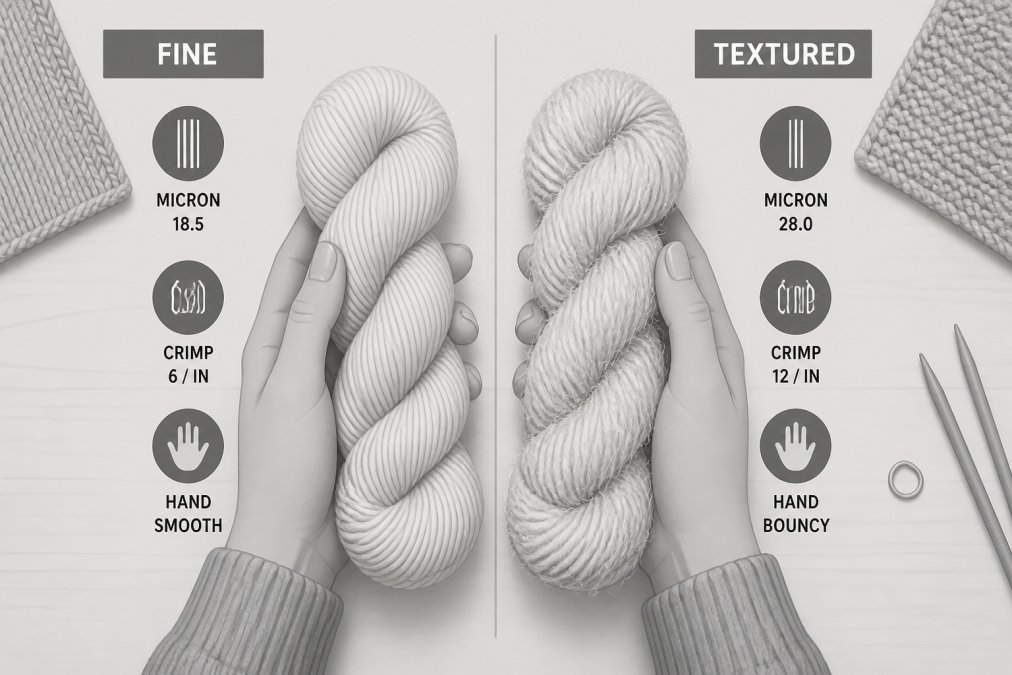
Mass-produced yarns are often blended and chemically treated to produce uniform softness. Local wool frequently skips those steps, so the natural character of the breed comes through. A fine Shetland skein feels airy and slightly crisp; a coarser breed feels denser and more resilient. Neither is better in the abstract. The right choice depends on the project.
Ethical yarn brands publish where their fiber comes from and how the animals are treated. If a label says only "wool" with no origin, that is a signal to dig deeper.
Use this checklist before buying:
Traceability means a brand can trace a skein back to a specific flock or at least a defined region. Farm-to-closet claims go further, describing every step from shearing to finished yarn. The Federal Trade Commission's guidance on truthful advertising requires that such claims be substantiated, so brands that make them should be able to back them up.
Local wool usually costs more than imported yarn, and the gap is real. Understanding where that money goes helps you decide whether the premium is worth it for a given project, and it is the question most buying guides skip entirely.
Imported yarns benefit from economies of scale that domestic producers simply cannot match. A large overseas mill might process tons of fiber per run, buy raw fleece at commodity prices, and spread fixed costs across enormous volume. A regional mill running a few hundred pounds at a time carries the same equipment, labor, and compliance costs across a fraction of the output.
Here is where the money goes:
| Cost Factor | What It Covers | Why It Raises Price |
|---|---|---|
| Small-batch spinning | Limited mill runs | Less efficiency per yard |
| Domestic labor | Fair wages for farm and mill workers | Higher than overseas rates |
| Traceability | Record-keeping and certification | Administrative overhead |
| Heritage breeds | Slower-growing, lower-yield flocks | Fewer pounds per animal |
| Local dyeing | Small dye lots | Per-unit cost climbs |
For knitters, the trade is straightforward: fewer skeins, better fiber, and a supply chain you can actually verify. A single skein of well-made local wool often goes further than a cheaper import because the crimp and elasticity hold up through repeated wear and washing. Over the life of a garment, the cost per wearing can end up lower even when the sticker price is higher.
Local wool rewards careful handling. Because it often skips chemical softeners and synthetic blends, it responds best to gentle washing and air drying.
Local wool follows the seasons. Most shearing happens in spring, and fresh fleece reaches mills shortly after. Yarn from that clip tends to appear in late summer and fall, which is why autumn is the best time to buy current-year fiber.
Sourcing wool locally is a decision that touches farming, milling, and the finished garment on your needles. The fiber is traceable, the supply chain is short, and the money stays in the region that produced it.
Locally sourced wool travels a shorter distance from farm to mill to your door, which reduces the carbon footprint tied to shipping and cold storage. Wool is also a renewable fiber: sheep regrow their fleece every year, and the fiber is biodegradable at the end of a garment's life. Small-scale farms often practice regenerative agriculture, rotating grazing to support biodiversity and soil health. Because local wool stays out of long global supply chains, it also produces fewer of the synthetic fiber byproducts linked to micro-plastic pollution in waterways.
It often does, though the deciding factors are wool fiber quality factors like micron count, crimp, and hand-feel. Local producers tend to work in small batches, which means more consistent spinning and fewer blended lots. Yarns like Southern Shetlands Yarn Naturals Fingerling, a 3-ply produced in small batches, give smooth, even stitch definition for colorwork and lace. Commercial yarns can be excellent too, but they are usually pooled from many sources, so the tactile experience of local wool is often more distinctive.
Look for supply chain transparency: named farms, named mills, and clear animal welfare standards. Brands that publish their sourcing, batch sizes, and fiber origin are easier to trust than vague 'eco-friendly' labels. Traceability matters, so check whether the label lists the breed, the farm region, or the spinning mill. If a brand cannot say where the fleece came from, that is a signal to keep looking. Small producers often answer questions directly by email, which is a simple way to verify claims before you buy.
Hand wash in cool water with a gentle wool wash, then press the water out rather than wringing. Lay the piece flat to air dry on a towel, reshaping it to its blocked dimensions. Store folded, not hung, and keep it away from moths with cedar or lavender. Because natural fibers like wool have crimp and natural insulation, they bounce back well with minimal handling. Avoid hot water and agitation, which cause felting, and skip the dryer entirely to protect the fiber's structure.
Brae & Heather curates premium fiber and expertly designed patterns for knitters who want that level of care in every project. The shop carries Shetland wool, heritage yarns, and a full library of patterns to match. Explore the collection at Brae & Heather and start your next project with fiber you can trace back to the farm.

0 commentaire