Finding knitting patterns for intermediate knitters can feel like standing at a crossroads. You have mastered the basics, but the leap from simple scarves to intricate garments often seems intimidating. This guide from Brae & Heather bridges that gap, curating projects that build your skills methodically while producing pieces you will be proud to wear.
What Makes a Knitting Pattern Intermediate?
An intermediate knitting pattern sits between beginner and advanced by introducing techniques that require attention but not decades of experience. These patterns typically combine multiple skills such as shaping, working in the round, or following a chart, rather than relying on one simple repeat.
A pattern earns its intermediate rating when it asks you to manage more than one new element at a time. A hat with a simple ribbed brim is beginner; a hat with a stranded colorwork chart and a shaped crown moves into intermediate territory. This progression builds the confidence and muscle memory needed for advanced garment construction later.
12 Knitting Patterns for Intermediate Knitters to Master
The projects below move you from your first tentative colorwork through to more ambitious accessories. Each pattern teaches a specific skill that will serve you in countless future projects.
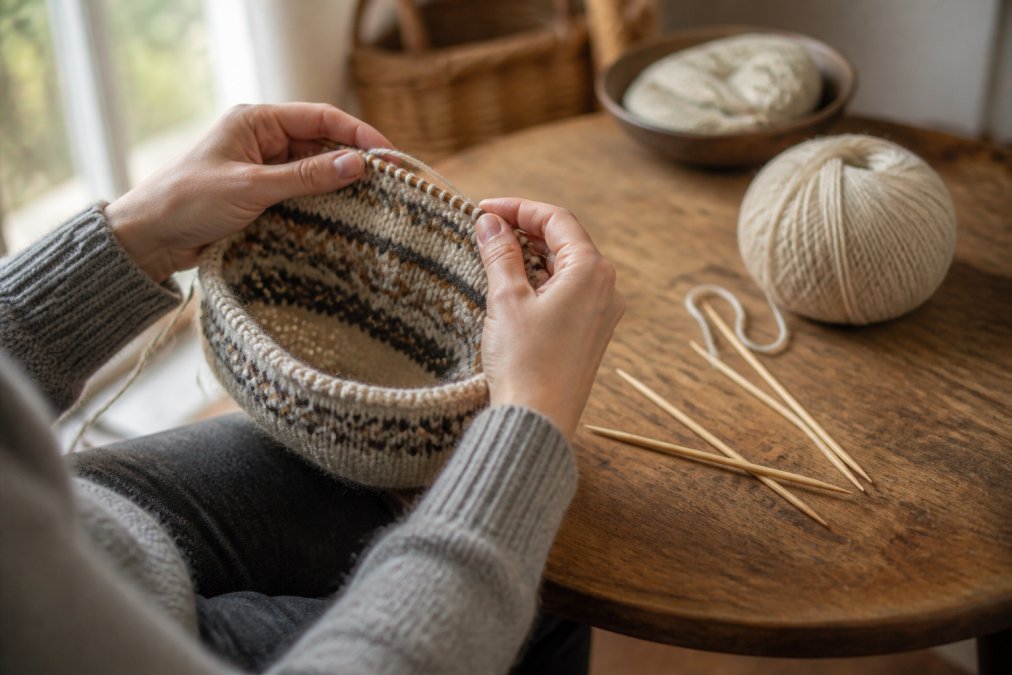
A knitter's hands holding a partially finished colorwork cowl in natural light, with a ball of natural wool yarn and wooden needles on a table nearby
1. Rionag Cowl: Your Gateway to Fair Isle
The Rionag Cowl is an ideal starting point for knitters ready to try Fair Isle, also known as stranded colorwork. Worked in the round, this pattern keeps the wrong side hidden inside the tube, which simplifies managing your yarn floats.
This knitting pattern from Brae & Heather costs $6.99 as a digital download. It is designed for knitters beginning their fair isle journey, making it a perfect confidence builder before you tackle larger garments.
2. Cozy Cables Collection: Texture Without Fear
Cables look complex, but they are simply knit stitches worked out of order using a cable needle. The Cozy Cables book demystifies this process with 16 patterns that range from quick accessories to a weekend cardigan. For $23.99, this collection from Kalurah Hudson makes cabled texture feel approachable rather than intimidating.
3. Charming Colorwork Socks: Small Canvases, Big Lessons
Socks are the perfect canvas for practicing colorwork because they are small, portable, and require a relatively small yarn investment. Charming Colorwork Socks by Charlotte Stone offers 25 patterns at $24.99, ranging from whimsical animal designs to scenic motifs.
The book includes Charlotte's best tips and tricks for stranded colorwork, making it suitable even if you are new to knitting socks. Working through several of these designs will dramatically improve your color dominance control and tension consistency.
4. The Big Book of Latvian Mittens: Heritage in Every Stitch
For those ready to immerse themselves in rich knitting tradition, The Big Book of Latvian Mittens by Ieva Ozolina features 100 knitting patterns and charts, priced at $26.99. It includes step-by-step instructions for the distinctive Latvian braid and other finishing techniques.
The designs use stranded colorwork techniques with 2-ply wool and double pointed needles, making it a perfect way to use up colorful yarn scraps from your stash. Each mitten is a small, self-contained project that allows you to experiment with intricate patterns without a massive time commitment.
5. Hearts Aflame: A Story in Stranded Color
Hearts Aflame is a Brae & Heather pattern that tells a story through its stranded colorwork design. Inspired by a late autumn scene beneath the northern lights, this piece captures the drama of two hearts entwined by fate. At $6.99, this digital pattern offers a more narrative approach to colorwork.
This pattern is an excellent next step after completing simpler stranded projects. The design incorporates multiple colors and more complex chart reading, pushing your skills further while producing a deeply personal piece.
6. Rionag Beanie and Mitts: A Matching Set
Completing a matching set provides a sense of accomplishment that single projects rarely match. The Rionag Beanie and Rionag Mitts, each $6.99, are designed to pair beautifully with the cowl.
The mitts are worked on double point needles or using the magic loop method, reinforcing your comfort with smaller circumference knitting. Both patterns are ideal for knitters building their fair isle skills.
Essential Intermediate Knitting Techniques to Practice
Intermediate knitting techniques form the foundation of more complex projects. The most valuable skills to practice are stranded colorwork, cabling, lace knitting, and shaping. Each technique requires different tools and approaches, but all benefit from consistent practice on small projects.
The Complete Guide to Lace Knitting: Your lace knitting master class - Paperback
A common approach is to focus on one technique at a time, using small accessories as your practice canvas. For example, knit a hat to practice decreases and shaping, then move to mittens for colorwork, and finally a cowl for cables. This methodical progression helps you isolate challenges and build competence without becoming overwhelmed.
How to Read Complex Knitting Charts with Confidence
Reading knitting charts is a skill that transforms how you approach patterns, allowing you to see the structure of your knitting at a glance. A chart is a visual representation of your fabric as viewed from the right side, with each square representing one stitch. Mastering charts is essential for complex colorwork and lace patterns.
Start by familiarizing yourself with the chart key, which explains the meaning of each symbol. Read the chart from bottom to top, and for flat knitting, read right to left on right-side rows and left to right on wrong-side rows. For circular knitting, every row is read right to left. Practice with simple charts first, tracking your place with a ruler or magnetic board.
Choosing the Best Natural Fibers for Sweaters and More
Intermediate knitters are ready to move beyond the yarn that came with their first kit. The answer depends on the project you're knitting, the drape you want, and how much care you're willing to put into the finished piece. Here's a practical guide to the most common all-natural fibers and how to substitute one for another.
Before you buy yarn for a project, ask yourself three questions:
What is the garment? A sweater needs elasticity and memory; a shawl needs drape and stitch definition; socks need durability and abrasion resistance.
How will it be worn? Next-to-skin garments need softness; outer layers can handle more texture.
How will it be washed? Some fibers are machine-washable; others require hand washing and flat drying.
The All-Natural Fiber Lineup
Wool (Shetland, Merino, Corriedale)
Wool is the workhorse of natural fibers. It has natural crimp, which gives it elasticity and helps garments hold their shape. Shetland wool, in particular, is prized for colorwork because its slightly scratchy texture helps the yarn grip itself, preventing the floats from sagging. Merino is softer and drapier, making it ideal for next-to-skin garments like cowls and hats.
Best for: Sweaters, hats, mittens, colorwork.
Substitution tip:
Alpaca
Alpaca is warmer than wool and has a beautiful drape, but it has no crimp, which means it stretches over time (peer-reviewed research). A sweater knit in 100% alpaca will grow with wear, especially at the elbows and hem. It's a luxurious choice for shawls and scarves where drape is the goal, but risky for a fitted sweater.
Best for: Shawls, scarves, cowls, lightweight garments.
Substitution tip:
Cotton
Cotton is cool, breathable, and machine-washable, but it has no elasticity (peer-reviewed research). A cotton sweater will stretch out with wear and won't bounce back. It's a great choice for summer tops and baby garments, but poor for anything that needs to hug the body.
Best for: Summer tops, dishcloths, baby items.
Substitution tip:
Silk
Silk is strong, lustrous, and has a beautiful drape, but it's also slippery and has no elasticity (peer-reviewed research). On its own, it's best for lace shawls and special-occasion pieces.
Best for: Lace shawls, special-occasion garments.
Substitution tip:
How to Substitute Yarn for Any Pattern
Yarn substitution is a skill that separates intermediate knitters from beginners. Here's a step-by-step process that works for any pattern:
Check the pattern's gauge. This is the most important number. If the pattern says 20 stitches per 4 inches on size 7 needles, you need a yarn that achieves that gauge. Don't assume a worsted weight yarn will work just because the pattern says "worsted."
Compare the fiber content. If the pattern calls for wool, a wool substitute is the safest choice. If you want to try a different fiber, be prepared to adjust your needle size and possibly your garment size.
Knit a swatch. This is non-negotiable. Knit a 6-inch by 6-inch swatch in the pattern stitch, wash it the way you'll wash the finished garment, and measure your gauge.
Consider the yardage. If you're substituting a yarn with different yardage per skein, you'll need to buy more or fewer skeins. Divide the pattern's total yardage by the yardage of your substitute yarn to get the number of skeins.
Think about the drape. A yarn that's the same weight but a different fiber will produce a different fabric. Make sure the drape matches your vision for the finished piece.
A Note on Fiber Blends
Watch OutAlways wash and block your swatch before starting a project. Natural fibers can change dramatically after washing, some bloom and soften, others stretch, and a few (like superwash wool) can grow significantly. Knowing how your yarn behaves before you knit 40,000 stitches will save you from a disappointing finished garment.
Common Intermediate Pitfalls and How to Fix Them
Every knitter encounters pitfalls, and knowing how to fix them is the mark of experience. One of the most common issues is inconsistent tension in colorwork, where the floats on the back of the work are either too tight or too loose. The key is to stretch the stitches on your right needle before stranding the yarn across.
Another frequent challenge is twisted stitches, which often happen when you wrap the yarn the wrong way on a knit or purl stitch. The fix is to pay attention to your yarn wrap direction and to practice until the motion becomes automatic. Dropped stitches and missed yarn overs are also common, but they are easily fixed with a crochet hook and a bit of patience. The most important skill is learning to read your knitting so you can spot errors early.
Your Next Steps as an Intermediate Knitter
Progressing as an intermediate knitter is about choosing projects that stretch your abilities while remaining achievable. Consider investing in a comprehensive reference like the Vogue Knitting the Ultimate Knitting Book at $39.95, which covers everything from cast-ons to complex construction. With 1,600 color images and sections on brioche, entrelac, and double knitting, it is an invaluable resource.
For those drawn to lace, The Complete Guide to Lace Knitting at $36.32 offers a master class in everything from basic stitches to designing your own shawls. Both books provide the depth of knowledge that helps you troubleshoot problems and expand your repertoire.
Choosing the right knitting patterns for intermediate knitters is the key to unlocking your full creative potential. Brae & Heather offers expertly designed patterns and premium materials, including authentic Shetland wool, to support your journey. Explore the curated collection of patterns and books to find inspiration for your next project and elevate your crafting experience.
Frequently Asked Questions
What defines an intermediate knitting pattern?
An intermediate knitting pattern typically combines two or more techniques beyond basic knit and purl. You might encounter shaping, working in the round, simple cables, or basic colorwork. These patterns expect you to understand gauge, read your knitting, and fix minor mistakes. The instructions assume you know how to cast on, bind off, and follow a pattern without hand-holding. If you can knit a scarf with ribbing and you are ready to try shaping or a new stitch pattern, you are ready for intermediate projects.
How do I know if I am ready for intermediate knitting projects?
You are ready for intermediate knitting projects when you can knit and purl comfortably, maintain an even gauge, and finish a simple project like a garter stitch scarf or basic beanie. You should also feel comfortable reading your knitting to identify a knit versus a purl stitch. If you have completed a few beginner patterns without frustration and want to learn cables, lace knitting, or colorwork, you are ready. Start with a small project like a cowl or mitts to practice new techniques without a large time commitment.
What are the best techniques for intermediate knitters to learn next?
The best intermediate knitting techniques to learn next are cables, lace knitting, and stranded colorwork. Cables teach you to use a cable needle and read texture. Lace knitting introduces yarn overs and decreases, improving your ability to read charts. Stranded colorwork, like Fair Isle, builds confidence with multiple yarns in one row. Mastering these three techniques opens the door to sweaters, shawls, and mittens. Books like Cozy Cables or The Complete Guide to Lace Knitting offer step-by-step instruction and pattern collections to practice each skill.
How do I choose the right natural fiber for intermediate patterns?
Choose a natural fiber based on your project and how much blocking it needs. Wool is the most forgiving for cables and colorwork because it is elastic and holds stitch definition well. For lace, a wool or wool blend with good drape shows off openwork patterns. Cotton works for home decor but lacks the bounce of wool for garments. When a pattern calls for a specific yarn weight, match it with a natural fiber in the same category to hit gauge. Shetland wool is an excellent choice for colorwork projects like mittens.
What are some classic intermediate knitting projects for home decor?
Classic intermediate knitting projects for home decor include cabled throw pillows, textured blankets, and colorwork cushion covers. These projects let you practice cables or stranded colorwork on a larger canvas without worrying about fit. A blanket made of simple cable panels is a satisfying way to build endurance for bigger projects. Latvian mitten patterns can also be adapted into decorative wall hangings or ornaments. Because these items do not need to fit a body, they are low-pressure ways to try new techniques at your own pace.




0 commentaire