Knitting pattern difficulty levels exist on a spectrum, and understanding where you fall on that spectrum is the first step toward selecting patterns that challenge without frustrating. The categories, beginner, advanced beginner, intermediate, and advanced, aren't arbitrary labels.
Triple B Beanie Chunky Knitting Pattern by Brae & Heather
What makes this important is that many knitters misjudge their own level. Someone who can knit a basic stockinette stitch might assume they're ready for Fair Isle colorwork. They're not.
Beginner Knitters
Beginner knitters are building foundational skills. They understand how to cast on, hold needles and yarn, and execute basic stitches. At this stage, the focus is on developing muscle memory and consistency.
The defining characteristic of beginner work is simplicity: straight rows, minimal shaping, and straightforward construction.
Brae & Heather's Triple B Beanie Chunky Knitting Pattern exemplifies beginner-appropriate design, a straightforward chunky beanie that keeps the focus on basic technique rather than complexity.
Advanced Beginner
Advanced beginners have moved past the initial learning curve. They cast on smoothly, manage tension reasonably well, and can execute knit and purl stitches without thinking. They've completed several projects and understand the basic rhythm of following a pattern.
At this level, knitters are ready for simple shaping: basic increases and decreases, working in the round with circular needles, and following straightforward pattern instructions. They can handle simple stitch patterns like ribbing or basic cables.
Intermediate Knitters
Intermediate knitters have solid technical skills and can execute most standard knitting techniques. They read patterns fluently, understand gauge, and can troubleshoot common problems. They've worked with various yarn weights and needle types. They understand construction concepts like working seamless garments, grafting seams, and blocking.
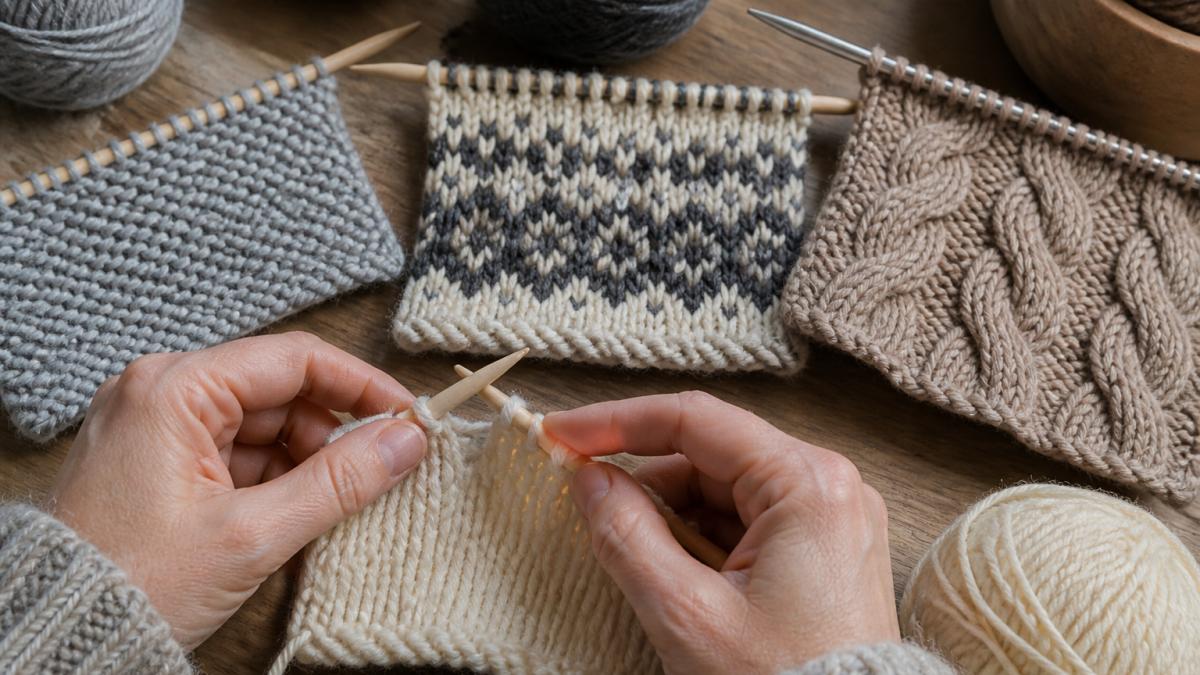
Intermediate work includes Fair Isle colorwork, cable patterns, lace with chart reading, and garment shaping. These projects demand attention to detail and the ability to track stitch counts across multiple rows.
Advanced and Experienced Knitters
Advanced knitters have developed what might be called pattern literacy. They don't just follow instructions, they understand the underlying logic. They can modify patterns, design their own, and tackle complex construction techniques like brioche knitting, entrelac, or intricate lace with multiple color changes.
These knitters work with demanding yarns, execute precise finishing, and manage projects with hundreds of stitches and dozens of pattern rows. They understand gauge deeply and can adjust patterns for different yarn weights.
How to Read a Knitting Pattern and Assess Difficulty
Reading a knitting pattern is a skill in itself. Before committing to a project, knitters need to decode what the pattern is actually asking them to do. The written instructions, abbreviations, stitch counts, and construction method all signal difficulty level.
Pattern Abbreviations and Symbols
Knitting patterns use shorthand to compress instructions. Common abbreviations like K (knit), P (purl), YO (yarn over), and K2tog (knit two together) appear in every pattern. The density and variety of abbreviations signal complexity.
A beginner pattern might use only K, P, and basic increases and decreases. An intermediate pattern introduces cable stitches (C4F, C4B), decreases worked at different angles (ssk, k2tog, p2tog), and yarn overs for lace.
If you're reading a pattern and encounter abbreviations you don't recognize, that's a signal the pattern sits above your current skill level. Brae & Heather's Vogue Knitting: The Ultimate Knitting Book includes comprehensive abbreviation guides and technique explanations that clarify what each notation requires.
Gauge, the number of stitches and rows per inch, is often overlooked, but it's a genuine difficulty indicator (YDKWYDK: Gauge and why it's important). Patterns with tight gauge (more stitches per inch) demand greater precision.
Stitch count matters too. A simple scarf might use 30 stitches. A lace shawl might use 200+ stitches. Managing larger stitch counts requires better organizational skills and greater risk of dropping stitches unnoticed.
Knitting Pattern Abbreviations and What They Tell You
Beyond recognizing abbreviations, understanding what they represent helps you assess whether you're ready for a pattern. Some abbreviations signal straightforward techniques; others indicate specialized skills.
When you encounter an abbreviation you don't recognize, that's information. It tells you the pattern requires learning a new technique before you begin. That's not necessarily a reason to avoid the pattern, it's a reason to plan time for learning.
Beginner Knitting Patterns: Where to Start
Selecting the right first projects builds confidence and prevents the frustration that leads to abandoned work.
Essential Stitches for Beginners
Beginners need to master the knit stitch and purl stitch first. These two stitches form the foundation of almost all knitting. Stockinette stitch (knitting one row, purling the next) creates the smooth V-pattern most people recognize as knitting (How to Read a Knitting Pattern).
From there, beginners benefit from learning simple increases (yarn overs, knit front and back) and decreases (knit two together, slip-slip-knit). These four techniques, knit, purl, increase, decrease, enable a surprising range of projects.
Project Types That Build Confidence
Scarves, dishcloths, and simple blankets are ideal beginner projects. They work flat, progress predictably, and forgive minor mistakes. A dropped stitch in a scarf is usually recoverable; a dropped stitch in a fitted garment can derail the entire project.
Brae & Heather's Knitting for Beginners: The Unbelievable Guide walks through essential stitches with photographs and step-by-step instruction, then guides readers toward appropriate first projects.
Knitting for Beginners: The Unbelievable Guide to Knitting with Pictures, Instructions, and Lessons! (Knitting, How to Knit, Knitting Patterns - Paperback
Project Type
Best For
Time Investment
Difficulty
Scarves
Building consistency
10-20 hours
Beginner
Dishcloths
Learning tension control
3-5 hours
Beginner
Simple hats (in the round)
Circular needle skills
8-12 hours
Advanced Beginner
Basic sweaters
Garment shaping
30-50 hours
Intermediate
Intermediate Knitting Techniques and When You're Ready
The jump from advanced beginner to intermediate represents a shift in what's possible. Intermediate knitters can handle multiple techniques within a single project and manage complexity without feeling overwhelmed.
Shaping, Cables, and Colorwork
Shaping, the increases and decreases that create fitted garments, requires understanding how to space shaping evenly and how different decrease methods affect the final look.
Cables involve working stitches out of order, using a cable needle to create twisted textures.
Colorwork, whether stranded Fair Isle or intarsia, introduces yarn management and the need to maintain consistent tension across color changes. Fair Isle patterns require reading charts and managing two colors simultaneously.
Choosing a Stretch Project Safely
A stretch project is one that introduces a new technique within a familiar framework. An intermediate knitter ready to learn cables might choose a pattern they've worked before but with added cable panels.
The mistake knitters make is attempting too much at once. Learning cables, shaping, and colorwork in a single project is asking for frustration. Choose one new skill per project.
Rating Systems and Pattern Difficulty Crosswalk
The knitting world uses inconsistent difficulty ratings. One publisher's "intermediate" might be another's "advanced beginner." Creating a mental crosswalk helps you navigate this inconsistency.
Many patterns use a 1-5 scale, while others use descriptive labels. Some rate based purely on stitch techniques; others factor in construction complexity. The most reliable approach is to read the pattern itself rather than trusting the label.
Look for these indicators:
Stitch abbreviations you don't recognize signal higher difficulty
Patterns with frequent shaping changes (increases/decreases on most rows) are intermediate or above
Lace patterns with chart reading are typically intermediate minimum
Patterns requiring gauge precision and seaming are intermediate or above
Patterns with multiple colors or complex construction are advanced
Beyond Stitches: What Really Makes a Pattern Difficult
This is where most guides fall short. A pattern's difficulty isn't determined by stitches alone. Construction, finishing, and individual learning differences all factor in.
Construction Complexity and Finishing
A simple pattern worked top-down in one piece is easier than one requiring seaming multiple pieces. Finishing, grafting seams, blocking, weaving in ends, adds difficulty. A pattern that requires precise blocking to achieve the correct finished dimensions is harder than one that works regardless of blocking.
Garment fit also matters. A sweater with minimal shaping is forgiving. One with detailed shaping at the waist, armholes, and neckline requires precision.
Accessibility and Individual Learning Differences
Not everyone learns visually. Some knitters struggle with chart reading but excel at written instructions. Others find charts intuitive but get lost in dense written directions.
Yarn choice affects difficulty too. A pattern that works beautifully in a smooth, forgiving yarn becomes punishing in a slippery or splitty yarn. Beginners benefit from medium-weight, smooth yarn. Advanced knitters can handle laceweight and textured yarns that demand greater precision.
Assessing Your Current Knitting Skill Level
Honest self-assessment prevents the frustration of choosing patterns beyond your reach.
Infographic showing knitting techniques from beginner garter stitch to advanced cable and colorwork patterns.
Start by asking what you've completed successfully. Can you finish a simple scarf without major problems?
Next, consider what techniques make you uncomfortable.
Finally, try a small swatch of an unfamiliar stitch before committing to a full project.
Selecting patterns that match your skill level transforms knitting from frustrating to rewarding.
Frequently Asked Questions
What are the different knitting skill levels?
Knitting skill levels typically span beginner, advanced beginner, intermediate, advanced, and experienced. Beginners master cast-on and basic stitches like knit and purl. Advanced beginners add techniques like increasing and decreasing. Intermediate knitters tackle shaping, cables, and colorwork. Advanced and experienced knitters handle complex construction, intricate stitch patterns, and finishing techniques. The progression reflects both stitch knowledge and project complexity.
How do I know if a knitting pattern is suitable for a beginner?
Look for patterns labeled beginner or easy that use only knit and purl stitches, simple cast-on methods, and straightforward bind-off. Beginner knitting patterns typically have lower stitch counts, minimal shaping, and clear, detailed instructions. Projects like scarves, dishcloths, and simple beanies are ideal starting points. Check the pattern's gauge requirement and yarn weight, simpler patterns often use bulkier yarn and larger needles, making them easier to work with.
What makes a knitting pattern intermediate or advanced?
Intermediate patterns introduce shaping techniques, basic colorwork or cables, and more complex stitch patterns beyond garter and stockinette. Advanced patterns demand multiple techniques in one project, intricate stitch charts, advanced finishing like seaming or grafting, and precise gauge work. Difficulty also depends on construction, garments require more skill than accessories, and patterns with multiple pieces or color changes demand stronger technical knowledge and problem-solving ability.
Can a beginner knit an intermediate pattern?
Sometimes, if you choose carefully and accept it as a learning project. Select intermediate patterns with only one new technique and detailed instructions. Practice that technique on a swatch first. Choose a pattern with positive reviews from knitters at your level. Be prepared for slower progress and potential mistakes, this is a stretch project, not a relaxation knit. Having a reference book like Vogue Knitting: The Ultimate Knitting Book can help you troubleshoot unfamiliar techniques.
How do I read knitting pattern abbreviations and what do they mean?
Pattern abbreviations are shorthand for stitches and techniques. Common ones include K (knit), P (purl), YO (yarn over), K2tog (knit two together), and inc (increase). Most patterns include an abbreviation key at the start. Familiarize yourself with standard abbreviations before starting, they save space and make patterns easier to follow. Charts often replace written abbreviations for complex colorwork or lace, with symbols representing each stitch type.
What knitting techniques should beginners learn first?
Start with cast-on (long-tail or simple cast-on), knit stitch, purl stitch, and bind-off. These four fundamentals let you complete simple projects. Next, learn to read basic pattern instructions and recognize increases and decreases. Practice on garter stitch (knit every row) and stockinette stitch (knit one row, purl one row) projects. Knitting for Beginners: The Unbelievable Guide offers photographs and step-by-step guidance for mastering these essentials.
Are knitting pattern difficulty ratings standardized?
No single standard exists across all pattern publishers. Some use beginner/intermediate/advanced; others use numbered scales or descriptive labels like easy or complex. Craft organizations provide guidelines, but individual designers interpret difficulty differently. The best approach is to read the pattern details, stitch types, construction method, and required techniques, rather than relying solely on a label. Cross-referencing multiple sources helps you understand where a pattern truly sits.
What should I do if a pattern feels too difficult?
Stop and assess what's unclear: Is it a specific stitch? The construction? Chart reading? Find a tutorial or reference book covering that skill, practice on a swatch, then return to the pattern. Alternatively, set the pattern aside and build skills with easier projects first. Don't force a pattern that frustrates you, abandoned projects happen when difficulty jumps too high. Use resources like The Complete Guide to Lace Knitting or technique books to fill knowledge gaps before attempting advanced work.



0 commentaire