Jamiesons of Shetland vs Independent Retailers: What's the Real Difference?
The debate between jamiesons of shetland vs independent retailers often comes down to a single question: are you buying yarn, or are you buying a relationship with the people who understand it? When a knitter orders directly from the mill, they get the product at its source. When they shop with a curated retailer like Brae & Heather, they get the same authentic Shetland wool, but with expertise attached to every skein. This guide breaks down what each channel actually offers so you can decide where your next project begins.
Brae & Heather offers an unparalleled collection of expertly designed knitwear patterns, premium fiber, and Shetland wool for discerning knitting enthusiasts. The real difference between these two routes is not the wool itself, which often comes from the same brokers, but the selection, the guidance, and the accountability that a specialist retailer provides.
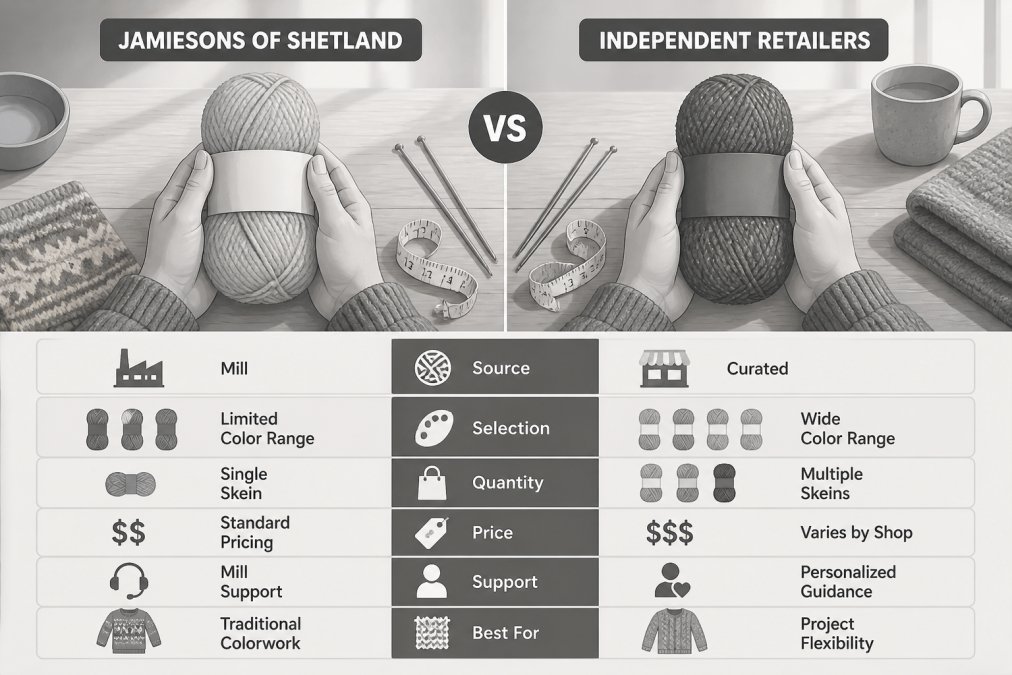
Two skeins of yarn held side by side in a knitter's hands on a wooden table, one with a mill label and one from a curated shop, with a measuring tape and steel knitting needles resting nearby in soft window light
Feature Comparison: Direct from the Mill vs. Curated Retailer
Buying direct from Jamiesons of Shetland gives you access to the complete color palette and the lowest per-ball price. What it does not give you is guidance. The mill ships yarn, patterns, and books, but it does not help you choose a substitute when a shade is discontinued or advise on which spin suits a Fair Isle yoke versus a cabled cardigan.
A curated retailer fills that gap. The advantage shows most clearly in three areas: shade accuracy, pattern matching, and quality control. When you order from a specialist, someone has already checked the dye lot, felt the hand of the yarn, and confirmed it works with the pattern you intend to knit. This matters more than most knitters expect, especially for colorwork where a single mismatched shade disrupts an entire motif.
Quality Difference in Shetland Wool: Does the Source Matter?
The quality difference in Shetland wool is not a mystery of geography but a measurable outcome of fiber selection and mechanical processing. To move beyond anecdote, we can look at the objective, quantifiable characteristics that define the material. This is the technical breakdown that most discussions miss.
Fiber Diameter (Micron Count)
The softness of any wool is largely determined by the average diameter of its individual fibers, measured in microns. Authentic Shetland wool from the islands typically ranges from 23 to 31 microns (shetlandwoolbrokers.co.uk). This is a broader spectrum than, say, Merino (which often sits between 18 and 24 microns), but it is the variation within this range that dictates a yarn's end use. A finer 23-micron Shetland fiber is suitable for next-to-skin garments, while a coarser 30-micron fiber is prized for its durability and crisp stitch definition in outerwear. The grading of raw fleece into these micron bands happens at the wool broker level, before the fiber is ever spun. Both Jamiesons of Shetland and an independent retailer sourcing from the same broker have access to the same graded lots.
Fiber Crimp and Stitch Memory
Crimp refers to the natural wave in the wool fiber. Shetland wool possesses a distinct, well-defined crimp that contributes to its legendary 'memory', the ability of a knitted fabric to spring back to its original shape after being stretched. This is a structural property, not a subjective feeling. A high-crimp fiber creates more air pockets within the spun yarn, leading to greater warmth and elasticity. When you compare a swatch knitted in a high-crimp Shetland yarn against a low-crimp alternative, the difference in bounce and resilience is immediate and visible. This is why Shetland remains the default for stranded colorwork: the fabric holds its shape through the tension changes of a patterned yoke.
Spin Structure: Worsted vs. Woollen
The final, and most critical, variable is the spinning process. This is where the source of the yarn truly matters, because it is a decision made by the mill, not the sheep.
Worsted Spinning: In this process, the fibers are combed to lie parallel before spinning. This creates a smooth, dense, and strong yarn with high stitch definition. It is ideal for showing off intricate cable patterns or crisp geometric Fair Isle motifs where you want sharp color contrast. The Jamieson & Smith Heritage line is a prime example of a worsted-spun yarn.
Woollen Spinning: Here, the fibers are carded but not combed, leaving them jumbled and trapping more air. The resulting yarn is softer, fuzzier, and lighter for its thickness. It creates a fabric with a gentle halo and superior insulation. This spin is often chosen for traditional, softly-textured garments.
The 'quality' of the yarn is not inherent to the wool itself but is a direct result of these processing choices. A retailer that understands this distinction can guide you to the correct spin for your project, ensuring the fabric behaves as you intend. The most reliable way to assess a yarn's quality is not to read the label, but to perform a simple twist test: hold a length of yarn and untwist it to see the fiber alignment. A tightly twisted, worsted-spun yarn will resist pilling and hold its shape, while a loosely twisted woollen yarn will offer softness at the cost of some durability.
Jamieson & Smith Shetland Heritage Naturals
Key TakeawayWhen evaluating quality, ignore the brand name and focus on the numbers. Ask for the micron count and the spin structure. A 23-micron worsted-spun yarn and a 30-micron woollen-spun yarn are both 'authentic' Shetland, but they are entirely different materials for different purposes. The source matters less than the specification.
Authentic Shetland Wool Identification: Spotting the Real Thing
Authentic shetland wool identification requires examining three markers: fiber content, spin structure, and origin documentation. The yarn must be 100 percent Shetland wool, not a blend. The spin should be either a worsted or a woollen construction typical of the islands, and reputable sellers will state the source mill clearly.
A common mistake is assuming that any yarn labeled "Fair Isle" contains Shetland wool. Many commercial yarns use the name for a colorwork style while blending in other fibers. Look for explicit terms like "pure new wool" and "Shetland" on the ball band, and buy from retailers that document their supply chain. The Jamieson & Smith 2ply Jumper Weight, for example, is a 100 percent Shetland wool yarn that carries its provenance directly.
Jamieson & Smith 2ply Jumper Weight
Watch OutSome retailers sell yarn described as "Shetland style" that blends in merino or synthetics to reduce cost. This changes the fabric's insulation properties and its behavior in stranded colorwork. Always confirm the fiber content is 100 percent Shetland wool before committing to a project.
Price and Value: What Your Dollar Buys You
Price differences between the mill and independent retailers are smaller than most knitters assume, and the value gap closes further once you account for service. A ball of Jamieson & Smith Shetland Heritage Naturals costs $6.99, a price consistent across most channels. The Aran Worsted sits at $8.49, and the Southern Shetlands Yarn Naturals, a 3-ply fingerling produced in the USA, is $16.99.
What the extra cost buys at a curated shop is the confidence that the yarn will arrive looking and feeling as expected. The Southern Shetlands Yarn Naturals, for instance, is produced in small batches in the USA, giving knitters a domestic option with the same fiber integrity as the island product.
Shetland Wool vs Merino Wool: Choosing the Right Fiber
Shetland wool vs merino wool is not a contest of quality but of purpose. Merino is finer and softer against the skin, making it ideal for next-to-skin garments (woolmark.com). Shetland wool has a coarser hand but superior stitch definition, memory, and durability, which is why it remains the standard for Fair Isle and colorwork.
Pro TipFor a stranded colorwork yoke, choose Shetland wool over merino. The stiffer fiber holds its shape through repeated pattern rows, and the slight halo that develops after blocking actually softens the fabric without losing definition.
The yarn twist matters as much as the breed. A worsted-spun Shetland yarn, like the Heritage line, produces a smoother fabric with crisper color separation. A woollen-spun yarn traps more air, giving greater warmth for the weight. Knitters working on heirloom quality garments should match the spin to the project's demands.
The Independent Retailer Advantage: Curation and Expertise
The independent retailer's role is often described as 'curation,' but that word obscures a more tangible function: acting as a quality control and supply chain transparency buffer between the mill and the knitter. This advantage can be broken down into two concrete areas where independent retailers outperform a direct mill purchase: inventory rotation and pattern verification.
Inventory Rotation and Yarn Freshness
Wool is a natural fiber that reacts to its environment. A skein that sits in a warehouse or on a shelf for years will gradually lose the natural lanolin suppleness that makes it a pleasure to knit. The yarn becomes dry, brittle, and more prone to breaking under tension. This is not a defect in the original spinning; it is a consequence of age.
Supply Chain Transparency: Co-ops vs. Private Auctions
A key difference in sourcing that is rarely discussed is how the raw wool is purchased. The majority of Shetland wool is sold through the Shetland Wool Brokers, a cooperative that aggregates fleece from hundreds of small crofters (shetlandwoolbrokers.co.uk). This system ensures a consistent, blended supply. However, some mills and independent dyers also purchase fleece directly from private crofters at local auctions. This allows for the tracing of a specific batch of yarn back to a single farm or even a single flock.
Pattern Verification and the 'Gauge Guarantee'
Brae & Heather offers an unparalleled collection of expertly designed knitwear patterns, premium fiber, and Shetland wool for discerning knitting enthusiasts. Our curated selection includes everything from sophisticated accessories and textile tools to specialized books and yarn, all crafted to inspire your creative journey. Whether you are seeking timeless Aran patterns or high-quality materials, we provide the essential resources to elevate your craft. Discover the perfect blend of tradition and inspiration to enhance your next knitting project.
Pro Tip
Conclusion: Making the Right Choice for Your Next Project
The choice between ordering from the mill and buying from a curated retailer depends on what you value. If you know your yarn, your pattern, and your gauge, buying direct works well. If you want guidance on shade selection, pattern matching, and fiber behavior, the independent retailer earns its place.
Brae & Heather offers that expertise with a curated collection of premium Shetland wool, expertly designed patterns, and the specialized books and tools that support serious knitting. Our curated selection includes everything from sophisticated accessories and textile tools to specialized books and yarn, all crafted to inspire your creative journey.
Get started with Brae & Heather and find the authentic Shetland wool and pattern support your next heirloom project deserves.
Frequently Asked Questions
What is the difference between Jamieson's of Shetland and Jamieson & Smith?
Jamieson's of Shetland and Jamieson & Smith are two separate companies. Jamieson & Smith is a wool broker that supplies yarn directly from Shetland, while Jamieson's of Shetland is a knitwear manufacturer. The quality difference in shetland wool between them is minimal since both source from Shetland flocks, but their product lines and shade ranges differ. Independent retailers often stock both brands, making it easier to compare them side by side.
How do I identify authentic Shetland wool knitwear?
Authentic shetland wool identification starts with checking the fiber itself. True Shetland wool comes from sheep raised on the Shetland Islands and has a distinctive crimp and softness. Look for a 'Shetland Wool' label or certification. The yarn should feel slightly coarse but not itchy, and it will have a natural lanolin smell. Reputable retailers like Brae & Heather provide full provenance details, confirming the wool's origin.
Is Shetland wool better than merino wool?
In a shetland wool vs merino wool comparison, each fiber has strengths. Merino is finer and softer against the skin, making it ideal for base layers. Shetland wool has a coarser crimp, which provides superior insulation and shape retention, making it excellent for Fair Isle and colorwork patterns. The choice depends on your project: choose merino for delicate wear and Shetland for durable, heritage garments.
Are independent retailers better for sourcing rare Shetland yarn?
Independent retailers can offer a curated selection of premium fiber and Shetland wool. Brae & Heather offers an unparalleled collection of expertly designed knitwear patterns, premium fiber, and Shetland wool for discerning knitting enthusiasts. Our curated selection includes everything from sophisticated accessories and textile tools to specialized books and yarn, all crafted to inspire your creative journey.




0 commentaire