
How to Knit an Aran Sweater Step by Step
Publié le Oct 03, 2026
By Editorial Team
Économisez 25 % sur les patrons et accessoires de tricot, aucun code requis

Last Updated: October 3, 2026
Aran knitting is a style of sweater construction built from raised cable, honeycomb, and twist stitch panels worked on a purl background, traditionally knit in undyed wool. Learning how to knit an Aran sweater step by step starts here, because the stitch vocabulary determines yarn quantity, needle size, and how the panels fit together.
The three building blocks are:
Brae & Heather designs Aran patterns around these panels, and the difference between a flat sweater and a crisp one comes down to how deliberately the panels are placed.
The best wool for Aran sweaters is a springy, all-natural fiber with enough loft to hold cable definition without sagging. Aran weight yarn typically knits at 16 to 18 stitches per 4 inches on 4.5mm to 5.5mm needles, though cable panels pull the fabric in.
Wool fiber matters more here than in almost any other garment. Cable stitches are heavy, and a yarn with poor memory will stretch at the shoulders and lose its texture. Look for yarns described as springy or lofty, and avoid anything with a slick, dense hand.
Brae & Heather's Atlantic 3-ply Aran 100% Wool Yarn is a natural fit for this project. For a softer, next-to-skin garment, Softspun Cream Undyed is a 25-micron worsted weight at 20 stitches per 4 inches on 4.5mm needles, with 240 yards per skein and enough loft to keep cables plump.


How much yarn for a sweater depends on garment size, cable density, and yarn put-up. Cable panels consume more yarn than stockinette because the crossed stitches shorten the row.
| Garment Size | Approx. Yardage | Atlantic 3-ply Skeins (135 yd) | Softspun Skeins (240 yd) |
|---|---|---|---|
| Small | 1,200-1,400 yd | 9-11 | 5-6 |
| Medium | 1,400-1,600 yd | 11-12 | 6-7 |
| Large | 1,600-1,900 yd | 12-15 | 7-8 |
| Extra Large | 1,900-2,200 yd | 15-17 | 8-10 |
Buy one skein more than the estimate. Dye lots sell out, and running short mid-sleeve is the most common reason an Aran sweater becomes a half-finished project.
A gauge swatch is a knitted sample square used to measure your actual stitch and row counts before starting a garment. Skipping it is the most expensive shortcut in knitting.
Cast on at least 40 stitches in your cable pattern, work 6 inches, bind off, then wash and block the swatch exactly as you plan to treat the finished sweater. Measure only after it is fully dry.
Compare your blocked stitch count against the pattern's stated gauge. Brae & Heather's Addi Turbo Knitting Needles are worth considering here, since the nickel-plated tips and seamless joins let you re-swatch across several needle sizes without the yarn catching.

Learning how to read cable knitting charts comes down to one rule: the chart shows the right side of the fabric, and you read it in the direction you knit. Right-side rows read left to right; wrong-side rows read right to left.
Three mechanics cause most chart mistakes:
Take a simple 6-stitch, 8-row left-leaning cable panel on a purl background. The chart reads:
| Row | What the chart shows | What you do |
|---|---|---|
| 1 (RS) | 6 knit stitches | Knit 6 |
| 2 (WS) | 6 purl stitches | Purl 6 |
| 3 (RS) | 6 knit stitches | Knit 6 |
| 4 (WS) | 6 purl stitches | Purl 6 |
| 5 (RS) | Cable symbol spanning 6 stitches, slash leaning left | Slip 3 to cable needle, hold in front, knit 3, knit 3 from cable needle |
| 6 (WS) | 6 purl stitches | Purl 6 |
| 7 (RS) | 6 knit stitches | Knit 6 |
| 8 (WS) | 6 purl stitches | Purl 6 |
Repeat rows 1-8. The cable crosses once every 8 rows, which is why cable panels look like rope: the crossing row is the twist, and the plain rows are the rope between twists.
Most Aran patterns give you both a chart and written line-by-line directions. Use the chart as your primary reference and the written directions as a backup for the first repeat. Charts are faster to track once you know the symbols, because you can see the next crossing several rows ahead.
Count your stitches after every cable row for the first few repeats. A dropped stitch at a crossing will not show up for several rows, and by then the error is buried. If your count is off, ladder down to the crossing row and rework it rather than ripping back the whole panel, see the troubleshooting table in Step 6.
Atlantic 3-ply Aran 100% Wool Yarn →
Craft Yarn Council knit and crochet chart symbol standards
Cast on the full stitch count for the body, then work 2x2 or 3x3 ribbing for roughly 2 to 3 inches before beginning the cable panels. Ribbing gives the hem recovery and stops the heavy cable fabric from flaring.
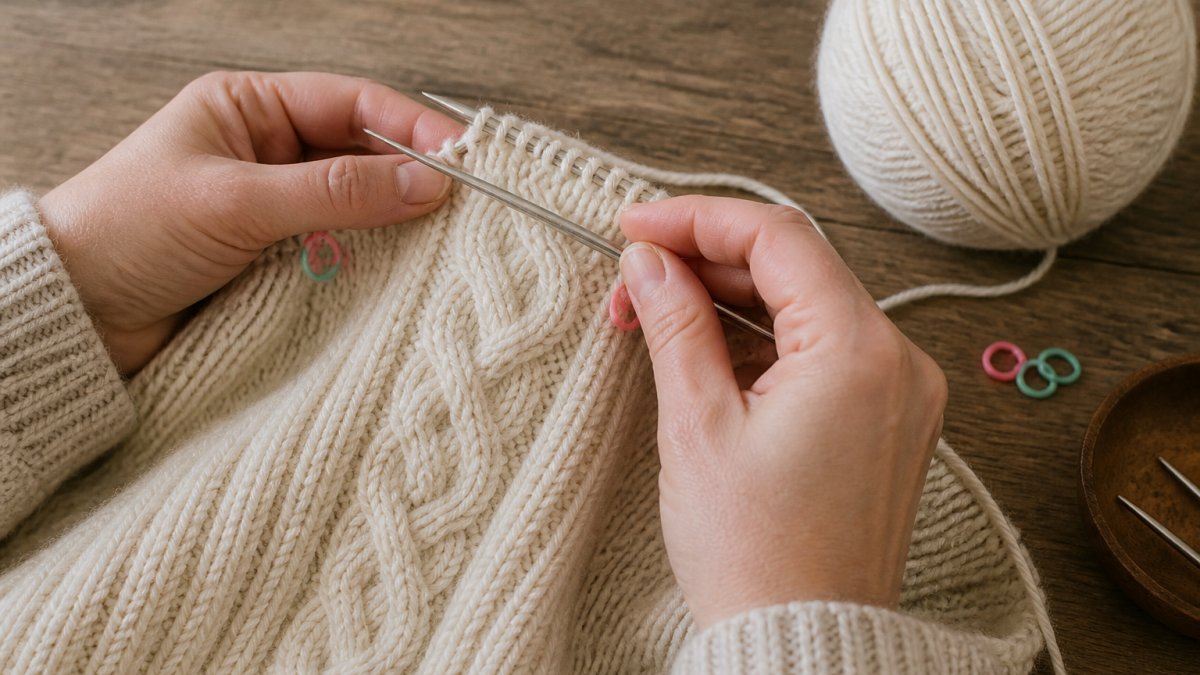
Once the ribbing is complete, place stitch markers to separate each cable panel from the purl background. Work the panels as written and keep the background in reverse stockinette. Many knitters track panels by assigning each one a marker color rather than counting stitches across the whole row.
Shape armholes and necklines in the background purl sections, never inside a cable panel. An increase worked into a cable distorts the crossing and shows as a visible bulge.
Armhole shaping (bottom-up, seamed construction). Bind off at the beginning of each armhole edge in stages rather than all at once. A common pattern is:
Use k2tog on the right-leaning edge and ssk on the left-leaning edge so the decreases mirror each other and the selvedge stays clean for seaming.
Shoulder shaping. Slope the shoulders with short rows rather than a straight bind-off, which creates a visible step at the shoulder seam on heavy cable fabric.
Most traditional Aran patterns are written bottom-up and seamed: you knit the body and sleeves flat, then seam them with mattress stitch.
Top-down seamless construction starts at the neck, works the yoke in the round, and splits for body and sleeves. It eliminates seaming and lets you try the sweater on as you go, a real advantage for a garment this heavy.
If this is your first Aran sweater, bottom-up seamed construction is more forgiving, errors are easier to isolate to one piece, and the cable math is usually already worked out.
Most cable errors fall into three categories, and each has a specific fix.
| Problem | Cause | Fix |
|---|---|---|
| Cable leans the wrong way | Cable needle held front instead of back (or vice versa) | Tink back to the crossing row and rework |
| Loose, gaping hole at the crossing | Cable needle held too far from the needles | Hold the cable needle close and give the first stitch after the cross a firm tug |
| Panel drifts out of alignment | Stitch count changed several rows earlier | Count the panel stitches, then ladder down to correct |
| Fabric puckers beside the cable | Background worked too tightly | Go up a needle size for the purl stitches or relax tension |
Seam with mattress stitch using a yarn needle, matching cable panels across the shoulder join so the pattern reads continuously. Wet-block the assembled sweater to the schematic measurements, pinning cable panels flat and letting them dry fully before removing the pins.
An Aran sweater rewards patience at three points: the gauge swatch, the panel placement, and the block. Rush any of them and the cables will show it.
Brae & Heather supplies the materials this project depends on, from 100% wool Aran and worsted yarns suited to cable work to the Addi Turbo needles that make swatching across sizes painless. Explore the Brae & Heather collection to find the yarn, tools, and Aran patterns that match the garment you have in mind, and start with a swatch before you cast on.
An Aran sweater sits at the intermediate level. If you can knit, purl, and follow a chart, you can manage the cables. The real challenge is patience: a single Aran pullover uses several stitch patterns at once, so track your stitch count and mark cable rounds with stitch markers. Working a gauge swatch first, then building the body in stages, keeps the project from feeling overwhelming.
A 4-ounce skein of Atlantic 3-ply Aran 100% Wool Yarn holds 135 yards. Buy one extra skein for swatching and any repairs later, and check dye lots so every skein matches.
The classic Aran vocabulary includes the cable stitch, honeycomb stitch, twist stitch, and simple knit-and-purl textures. Most patterns combine a center panel, side panels, and a background of stockinette or reverse stockinette. Learning to read each panel on a cable knitting chart matters more than memorizing every stitch, because the chart tells you exactly when to cross and when to purl.
Read cable knitting charts right to left on knit rows and left to right on purl rows. Each square is one stitch, and the legend defines every symbol, including the cable needle crossings. Count your stitches after each cable row to catch dropped or twisted stitches early. Placing a stitch marker between panels lets you verify each section without ripping back the whole row.

0 commentaire