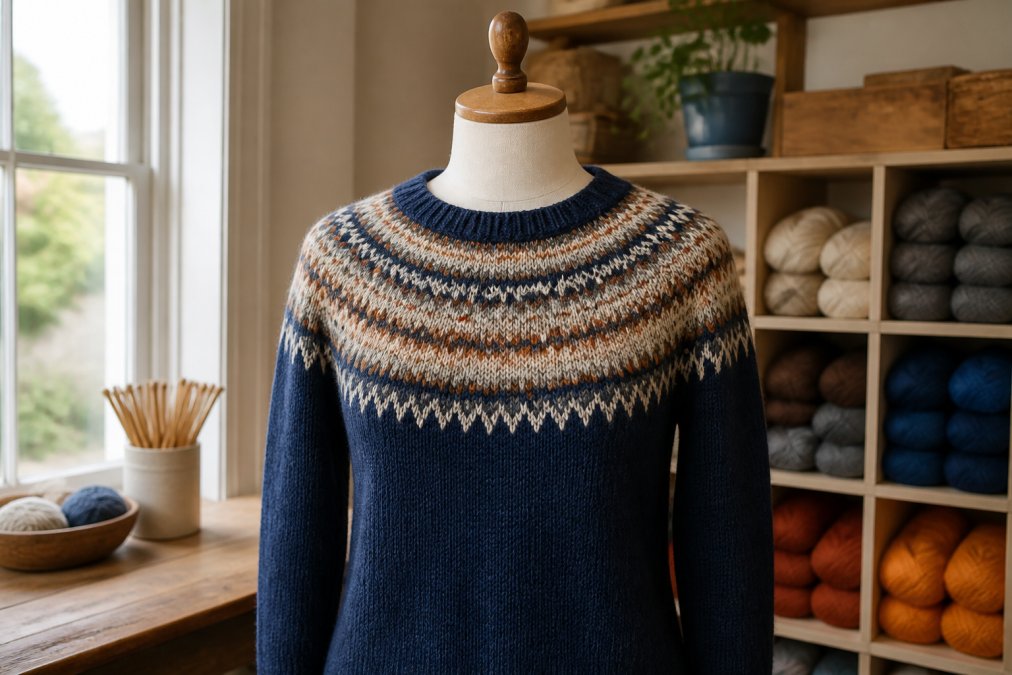
Finished Fair Isle sweater displayed on dress form showing completed Nordic yoke pattern with crisp color definition and geometric motifs, natural daylight
What Makes a Fair Isle Pattern Intermediate
An intermediate fair isle knitting pattern sits between basic stockinette colorwork and advanced techniques. Intermediate designs introduce stranded colorwork over larger yoke areas, more complex color sequences, and pattern repeats requiring genuine chart-reading skills. Unlike beginner patterns with simple two-color alternation, intermediate work demands attention to float management, tension consistency, and tracking multiple pattern repeats simultaneously.
The Big Book of Latvian Mittens: 100 Knitting Patterns for Colourful Latvian Mittens - Paperback
What separates intermediate from advanced is scope and complexity. An intermediate fair isle pattern might feature a yoke sweater with 8-12 color changes per round, while advanced pieces involve 15+ colors or combined techniques like cables with colorwork. According to the Craft and Hobby Association's fiber arts participation data, colorwork techniques rank among the top skill-progression goals for knitters moving beyond basics.
How to Read Fair Isle Knitting Charts
Reading fair isle knitting charts is the gateway skill for colorwork success. Charts use symbols or colors to represent each stitch, with rows numbered from bottom to top. Each square represents one stitch, and the chart width shows how many stitches form the pattern repeat. Charts let knitters see the entire pattern at once, making it easier to spot mistakes and anticipate color changes.
Understanding Color Dominance in Charts
Color dominance affects how a pattern reads visually and how to manage your working yarns. In stranded colorwork, one color typically dominates, meaning it appears more frequently in the pattern repeat. Count the stitches of each color in one repeat to identify which color appears more often. The dominant color should be held in your dominant hand if using two-handed colorwork, as it requires fewer yarn manipulations.
Brae & Heather's curated pattern collections account for color balance, designs are engineered so neither color overwhelms the finished piece, creating sophisticated visual harmony.
2025 Christmas Stocking Pattern by Brae & Heather
Tracking Pattern Repeats
Pattern repeats are the foundation of readable charts. A typical fair isle yoke might use a 12-stitch repeat that cycles horizontally across the round. Mark your current row with a sticky note or chart ruler as you knit to prevent losing count mid-pattern. Most intermediate patterns include 8-16 row repeats. Use stitch markers between repeats if your pattern allows, or place markers at the start and midpoint of the yoke to anchor your progress.
Best Wool for Fair Isle Knitting
Wool fiber choice shapes everything about a fair isle project: how colors blend, how stitches define the pattern, and whether the finished garment feels authentic to tradition. Fair isle originated in Shetland, where local wool became inseparable from the technique. That heritage matters technically: traditional Shetland wool has specific properties that make colorwork behave beautifully.
Shetland Wool Heritage and Quality
Shetland wool comes from sheep native to the Shetland Islands and has been used for fair isle knitting for centuries. The fiber is finer than many other wools, typically ranging from 18-24 microns, allowing for tight, detailed stitching without excessive bulk (peer-reviewed research). Shetland wool also has natural elasticity and memory, stitches hold their shape through blocking and wear, essential for colorwork where pattern definition matters.
Shetland's natural crimp creates stitch definition that makes color transitions pop. Brae & Heather offers Jamieson & Smith Shetland Heritage yarn, which recreates the exact characteristics of handspun yarn found in Fair Isle garments housed in the Shetland Museum and Archives. The yarn is worsted spun from combed tops, giving it the soft feel and smooth finish that allows fair isle patterns to display properly.
Pro TipShetland Heritage yarn is slightly finer than modern 4-ply jumper weight, which means it knits at a tighter gauge. This produces sharper color definition and prevents the fuzzy look that can happen with thicker wools.
Yarn Weight and Fiber Compatibility Guide
Yarn weight directly affects how a fair isle pattern reads. Fingering weight (2-3 ply) creates fine, detailed colorwork but demands patience. Jumper weight (4-ply) is the traditional choice for fair isle, offering balance between detail and speed. Worsted weight is thicker and faster but can obscure fine pattern details.
Pure wool is essential for fair isle. For intermediate patterns, jumper weight Shetland wool offers the best entry point, it knits fast enough that a yoke sweater feels achievable, yet produces the stitch definition that makes fair isle patterns genuinely beautiful. Brae & Heather's Jamieson & Smith 2ply Jumper Weight provides this exact profile: 100% Shetland wool in the traditional palette of shades originally designed for fair isle.
Yarn Weight
Best For
Gauge
Pattern Detail
Knitting Speed
Fingering (2-3 ply)
Fine lace, delicate motifs
28-32 sts/4"
Exceptional
Slow
Jumper Weight (4-ply)
Traditional fair isle
28-32 sts/4"
Excellent
Moderate
Worsted (5-6 ply)
Larger motifs, quick projects
18-22 sts/4"
Good
Fast
Stranded Colorwork Knitting Tips
Stranded colorwork is the technique underlying fair isle knitting. Instead of switching yarns between color blocks, stranded colorwork carries both colors across the entire row, dropping one and picking up the other as the pattern dictates. This creates floats, horizontal yarn strands running behind the stitches, which must be managed carefully to prevent loose stitches or puckering.
Managing Floats and Tension
Floats are the defining challenge of stranded colorwork. When a color sits unused for more than 5-7 stitches, the yarn creates a float behind the work. If floats are too tight, they pull the fabric and create puckering. If too loose, they create loops that catch on fingers or snag during wear.
The most common mistake is holding floats too tightly. Many knitters unconsciously tense their working yarn when managing two colors, creating floats that are 20-30% tighter than their main stitches. The fix is counterintuitive: relax your tension slightly when managing floats, allowing them to sit gently behind the stitches without pulling. For floats longer than 7 stitches, catch the float mid-way by twisting it around your working yarn.
Watch OutPuckering from tight floats is nearly impossible to fix after blocking. If you notice puckering appearing as you work, stop and reknit that section with looser float tension.
Two-Handed Colorwork Technique
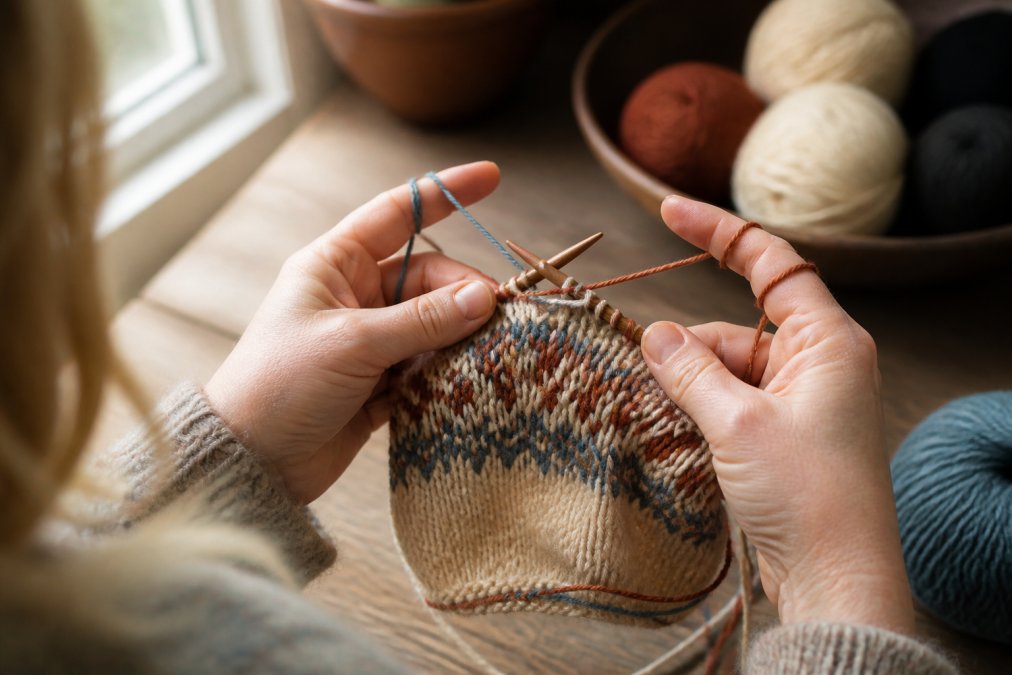
Two-handed colorwork, holding one color in each hand, is faster and more efficient than dropping and picking up yarns. Hold the dominant color in your dominant hand and the secondary color in your non-dominant hand. This distributes the workload and maintains more consistent tension.
Practice the color changes on a simple swatch before starting a full project. Spend 20-30 minutes getting comfortable with hand positions and rhythm.
5 Essential Intermediate Fair Isle Patterns
These patterns represent the sweet spot for intermediate knitters: complex enough to build real skills, achievable enough to finish, and beautiful enough to wear proudly.
1. Classic Nordic Yoke Sweater
A yoke sweater is the quintessential fair isle project. The colorwork concentrates in the yoke area, with stockinette body and sleeves, making it manageable in scope while delivering maximum visual impact. Nordic yoke patterns typically feature geometric motifs, snowflakes, diamonds, or geometric borders, that repeat across the round.
Nordic yoke sweaters are ideal for intermediate knitters because the structure is self-correcting. If tension wavers, it's visible in the yoke and can be adjusted before spreading to the body. A classic Nordic yoke typically takes 40-60 hours and uses approximately 1,200-1,600 yards of jumper weight yarn, becoming a genuine heirloom piece.
2. Festive Fair Isle Stocking
A stocking is the perfect intermediate project for building fair isle confidence without committing to a full sweater. Stockings typically feature 6-8 inch colorwork cuffs with traditional motifs, followed by stockinette legs and feet. The cuff provides genuine colorwork practice while remaining small enough to finish in 15-25 hours.
Brae & Heather's 2025 Christmas Stocking Pattern combines traditional Fair Isle motifs with festive charm, featuring Christmas trees and sheep worked in natural, earthy shades. Stockings are forgiving projects, if tension wavers or a color sequence gets muddled, the impact is contained to that section.
3. Colorwork Socks with Pattern Repeats
Colorwork socks introduce fair isle technique at a smaller scale, making them ideal for testing new color combinations or practicing tension control before committing to a sweater. A sock uses roughly 200-300 yards of yarn, so experimentation is low-risk. The circular knitting required for socks also builds muscle memory for managing two-color stranded knitting in the round.
Charming Colorwork Socks by Charlotte Stone offers 25 distinct patterns ranging from whimsical animals to nature-inspired designs. Knitting multiple pairs builds consistency, your tension on the fifth pair will be noticeably better than the first.
Latvian mittens represent a distinct fair isle tradition, featuring geometric patterns that are sharper and more angular than Nordic designs. The mitten construction offers a different technical challenge than yoke sweaters while remaining achievable for intermediate knitters.
The Big Book of Latvian Mittens by Ieva Ozolina provides 100 patterns with detailed charts and step-by-step instructions for techniques like forming the thumb and creating Latvian braids. A pair of Latvian mittens uses 100-150 yards of yarn and typically takes 12-20 hours to complete.
5. Shetland Wool Week Designs
The Shetland Wool Week Annual features 8-12 patterns from established knitwear designers, all specifically created to showcase Shetland wool. Shetland Wool Week Annual 2025 includes designs like the Freefield Jacket, which combines colorwork with shaping, and the Nesbister Gansey, a traditional fisherman's sweater with geometric motifs.
Hands holding knitting needles with two distinct colors of Shetland wool, demonstrating two-handed colorwork position with visible floats and proper tension management, natural window lighting
Step-by-Step Troubleshooting for Puckering
Puckering, visible bunching along float lines, is the most common complaint from intermediate fair isle knitters. The good news is that puckering is almost always a tension issue, which means it's preventable and fixable.
Identify where puckering occurs. Puckering typically appears along horizontal lines where floats run behind the work. If concentrated in certain sections, examine those sections for tension inconsistency.
Check float length. Examine floats longer than 7 stitches. If a float runs uninterrupted for 10+ stitches without being caught, it may be too loose. Catch long floats by twisting them around your working yarn mid-way through.
Test tension on a swatch. Knit a test swatch using the exact same yarn, needles, and stitch pattern as your main project. Deliberately knit one section with tight floats and another with relaxed floats. This visual reference helps you calibrate your tension.
Reknit problem sections. If puckering appears during knitting, stop and reknit that section with looser float tension. Mark the problem row with a safety pin, unravel back to that point, and reknit with adjusted tension.
Block aggressively. Wet-block your finished piece, pinning it to specific dimensions and allowing it to dry completely. This relaxes fibers and can reduce puckering caused by slightly-too-tight floats.
Sustainable and Ethical Yarn Sourcing for Fair Isle
Fair isle tradition is rooted in place, specific sheep breeds, specific landscapes, specific cultural practices. Choosing yarn that honors this heritage means prioritizing sustainable and ethical sourcing.
Shetland wool from established producers like Jamieson & Smith represents generations of expertise and commitment to animal welfare. These producers work with local farmers who maintain heritage sheep breeds specifically for wool quality. When selecting yarn for fair isle projects, prioritize producers with transparent supply chains. Know where the sheep are raised, how they're sheared, and how the fiber is processed. Brae & Heather curates products from producers meeting these standards, including Jamieson & Smith Shetland Heritage and Shetland Aran Worsted.
A single fair isle sweater made from genuine Shetland wool will outlast multiple synthetic pieces, making it the more sustainable choice despite higher upfront cost. Jamieson & Smith, family-owned since 1884 and based in Shetland, sustains not just a business but an entire cultural and agricultural tradition.
Essential Tools and Accessories for Fair Isle Success
The right tools transform fair isle knitting from frustrating to fluid. Beyond needles and yarn, several accessories make a genuine difference.
Circular needles in appropriate sizes are essential. For yoke sweaters, you'll need a 24-32 inch circular needle to accommodate the stitches comfortably. Addi Turbo needles are industry standard, the nickel-plated brass tips glide through wool effortlessly, and the seamless joins prevent snagging.
A chart ruler or sticky note keeps your place on the pattern chart, preventing the frustration of misreading rows or losing track of progress.
Blocking supplies, a blocking board or towels, T-pins, and a spray bottle, are essential for finishing fair isle projects properly. Blocking relaxes the fabric and allows you to even out tension inconsistencies.
Invest in quality tools. The difference between cheap needles and excellent ones becomes obvious within the first hour of knitting.
Choosing intermediate fair isle knitting patterns requires understanding your current skill level and selecting projects that challenge without overwhelming. The patterns outlined here represent proven paths forward, each building specific skills that transfer to more advanced work. Brae & Heather's curated collection of patterns, specialty yarns, and tools provides everything needed to approach these projects with confidence. Start with a stocking or pair of socks to build fundamental colorwork skills, then move to a yoke sweater or Nordic-inspired piece. Each project deepens your understanding of how tension, float management, and color choice work together to create beautiful, lasting knitwear.
Frequently Asked Questions
What are the most common mistakes when knitting intermediate Fair Isle patterns?
The most frequent errors include inconsistent tension between the two colors, catching floats too tightly (which causes puckering), and losing track of pattern repeats on the knitting chart. Many intermediate knitters also struggle with managing floats that are too long, which weakens the fabric. Reading your chart carefully and using stitch markers to track repeats prevents these issues. Practice with smaller projects like socks or mittens before tackling a full sweater.
How do I choose the best wool for fair isle knitting?
Shetland wool is the traditional choice for Fair Isle knitting because of its exceptional color depth and spinning quality. Look for 100% natural fiber options like Jamieson & Smith yarns, which offer authentic Shetland heritage wool ($6.99 per ball). The yarn weight matters too: 2ply jumper weight works beautifully for stranded colorwork, while Aran weights suit larger projects. Avoid acrylic blends, which don't hold tension well in colorwork and lack the characteristic loft of wool fiber.
What makes a knitting pattern considered 'intermediate' rather than advanced?
Intermediate Fair Isle patterns assume you can already knit stockinette stitch smoothly and understand basic colorwork. They typically feature repeatable motifs, manageable float lengths (under 7 stitches), and straightforward shaping like simple yokes or set-in shoulders. Advanced patterns introduce complex techniques like steeking, intricate yoke construction, or multiple color changes per row. Intermediate patterns focus on building confidence with stranded colorwork technique rather than pushing structural complexity.
How do I manage tension in two-color knitting?
Holding one color in each hand (two-handed colorwork) helps maintain even tension by distributing the work between your hands. Keep both yarns slightly loose and consistent, too tight creates puckering, too loose creates holes. Practice with a gauge swatch first, aiming for 28-32 stitches per 4 inches depending on your yarn. Block your finished piece to even out minor tension variations. If you struggle with two-handed technique, try holding both colors in one hand but maintaining separate tension for each.





0 commentaire