
Baawool Alternative for Premium Fiber: 2026 Guide
Publié le Sep 13, 2026
By Editorial Team
Économisez 25 % sur les patrons et accessoires de tricot, aucun code requis

Last Updated: September 14, 2026
Discontinued yarns leave a real gap in a stash. When a favorite line disappears, knitters hunting a baawool alternative for premium fiber are usually chasing one thing: a wool with the same hand-feel, stitch definition, and heritage character. Brae & Heather carries Shetland wool that fills that space. The options below compare fiber content, spin, and price so you can match a replacement to the project, not just the label.
Most commercial "wool" yarns are blends, and blends behave differently under the needles. A true alternative starts with fiber content you can read on the band, then moves to spin, ply, and weight.
The table below summarizes the natural fibers covered in this guide by weight, spin, and best use.
| Yarn | Weight | Spin | Best For |
|---|---|---|---|
| Shetland Heritage Naturals | Fingering | Worsted | Fair Isle colorwork |
| 2ply Jumper Weight | Fingering | Woollen | Traditional garments |
| Shetland Aran Worsted | Aran | Worsted | Cables, colorwork |
| Southern Shetlands Naturals | Fingering | 3-ply | Shawls, socks |
| Heritage 2-Ply Worsted | Worsted | 2-ply | Sweaters, hats |
Natural fibers come from animals or plants; synthetic alternatives are manufactured, and the two feel different the moment you cast on. The reason is structural, not marketing. Wool fiber grows with crimp, the natural wave along each staple, and its surface is covered in overlapping scales (Wool: From Properties and Structure to Genetic Insights and Sheep Improvement Strategies). Crimp gives wool its loft and spring; the scales let fibers interlock during fulling and felting. Synthetic filament is extruded smooth and straight, so it has no crimp to compress and no scales to grab.

That structure produces the properties knitters actually feel:
Technical specs tell you what a fiber is; your hands tell you what it will do. Squeeze a skein and release it. Wool springs back immediately. Cotton and linen stay compressed. Acrylic feels slick and slightly squeaky against dry skin. Run the skein across the inside of your wrist, the thinnest, most nerve-dense skin you have, to check for prickle. Prickle is a mechanical response to fiber diameter, not an allergy, and it is the single best predictor of whether you will actually wear the finished garment (pubmed.ncbi.nlm.nih.gov).
Blocking is where the structural gap becomes obvious. Wool's crimp and scales let it be shaped with moisture and heat, then hold that shape permanently. A lace shawl in wool opens up and stays open. The same shawl in a smooth synthetic will relax back toward its knitted dimensions. This is why heritage patterns, Fair Isle, Aran, Shetland lace, were developed on wool and behave best on wool. If you substitute a synthetic "wool-like" yarn, expect to reblock after every wash and expect the stitch definition to soften.
The best natural yarn for heritage patterns is a worsted-spun Shetland wool, because its smooth finish and fine weight give the stitch definition that old Fair Isle and Aran designs depend on. The Textile Institute's fiber reference notes that spin method shapes how a yarn reflects light and holds pattern.
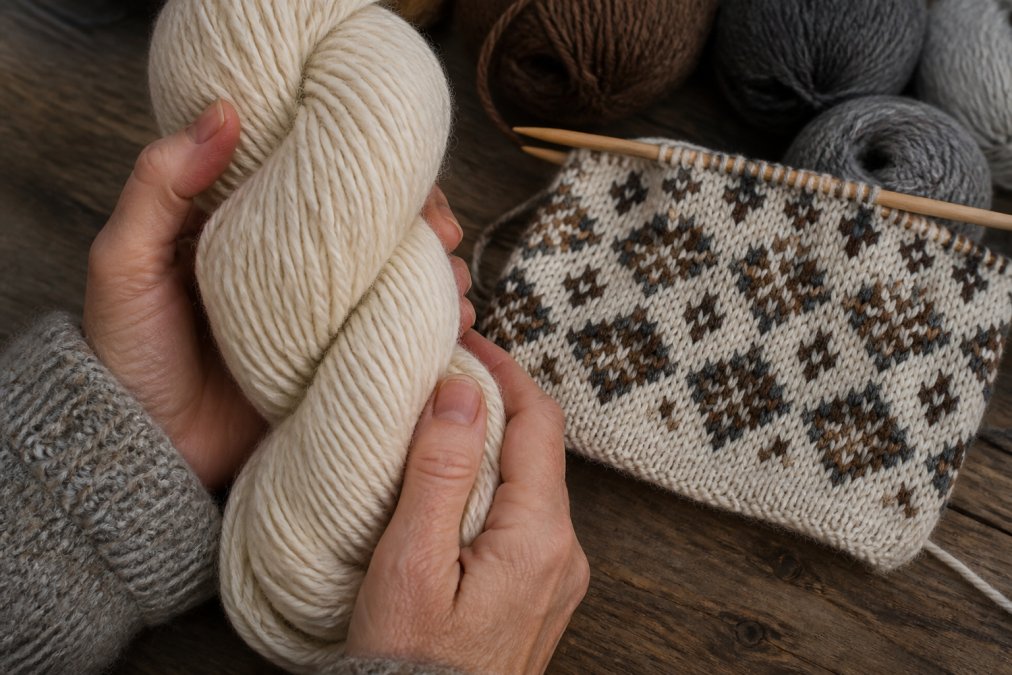
Shetland wool is a fine, soft fiber from sheep bred for generations on the islands, and it is prized for heirloom quality. Jamieson & Smith's Shetland Heritage line was recreated from garments held in the Shetland Museum and Archives collection, giving it the character of nineteenth-century handspun.
Vegan yarn skips animal fiber entirely, drawing on cellulose fibers like cotton, linen, and bamboo. These drape well but behave differently: less elasticity, more weight. For knitters avoiding lanolin, a lanolin-free plant fiber is a genuine alternative, though it won't match wool's memory.

Judging yarn quality for an heirloom starts with two things: the fiber content printed on the band and the ply structure you can see when you untwist a strand. Both predict how the finished piece will wear.
A plied yarn twists multiple strands together, adding durability and balance. Single-ply yarns are softer but pill more. Check the label for the ply count and the breed, not just the color.
WPI (wraps per inch) tells you the yarn weight class; knitting gauge and crochet tension confirm it. Drape follows from all three: a firm gauge holds shape, a loose one flows. Swatch before committing to a heritage project.
Sticker price misleads because skeins vary wildly in yardage. Divide price by yards to get cost-per-yard, then multiply by the yardage your pattern requires. A 4-ounce skein at 430 yards (like the Sport Single Ply at $7.55) works out to roughly 1.8 cents per yard. A smaller, cheaper-looking ball at half the yardage can cost more per yard and leave you short mid-project. Run the math before you commit to a sweater quantity:
Premium natural fiber costs more per yard than synthetic, but it also lasts longer, blocks better, and can be repaired. For an heirloom garment meant to be worn for decades, cost-per-wear is the number that justifies the investment.
Care is the trade-off that separates premium natural fiber from synthetic convenience.
A common pattern is to knit a wool garment, wear it for years with hand-washing, and find it looks better than the day it came off the needles. That durability is the point of premium fiber.
Charts cannot tell you how a yarn will feel against skin. Squeeze the skein: springy and smooth predicts a pleasant knit and a comfortable wear. Slick and flat predicts a yarn that will slide on the needles but feel cool and lifeless. If you can, knit a small swatch and wear it against your neck for an hour before committing. Hand-feel varies between dye lots and even between skeins, so buy from the same lot when possible.
Shetland wool is a strong natural option because it is worsted-spun, plied, and built for stranded colorwork. Its fiber memory helps garments hold shape over years of wear. For heirloom knitting, look for 100% wool with clear fiber content on the label.
Start with the project type. Fair Isle and stranded colorwork reward a finer, plied yarn with good stitch definition. Cables and textured stitch patterns need loft and body. Check wraps per inch, recommended gauge, and ply count before buying. Match the yarn weight to the pattern, then confirm the fiber content is 100% wool or another natural fiber suited to the drape you want.
Longer staple fibers create smoother, stronger yarn with less pilling over time. Short-staple wool can feel soft but sheds and wears faster under friction. For heirloom projects, longer-staple wools like Shetland hold stitch definition and resist abrasion across decades. Staple length also affects hand-feel: longer fibers feel smoother against skin, while shorter fibers add loft and warmth.
Small-flock and single-origin wools offer a shorter supply chain than mass-produced fiber. Shetland wool from named producers supports heritage breeds and traditional spinning methods. Look for clear origin information, undyed natural shade ranges, and producers who document their fiber sourcing.
Match the yarn weight and gauge first. A fingering-weight pattern knit at 28 stitches per 4 inches needs a yarn that hits that tension. Check ply structure: plied yarns behave differently from single-ply in colorwork and cables. Compare fiber content for drape and stretch. Swatch before committing, and adjust needle size if the fabric feels too dense or too loose.
Choosing a baawool alternative comes down to matching fiber, spin, and weight to the project in front of you. Brae & Heather curates Shetland wool, heritage patterns, and textile tools for exactly this kind of decision, with worsted-spun yarns, undyed naturals, and Aran weights suited to colorwork and cables. Browse the collection and start your next heirloom with fiber you can trust.

0 commentaire